Werner Rügemer, Septembre 23, 2026
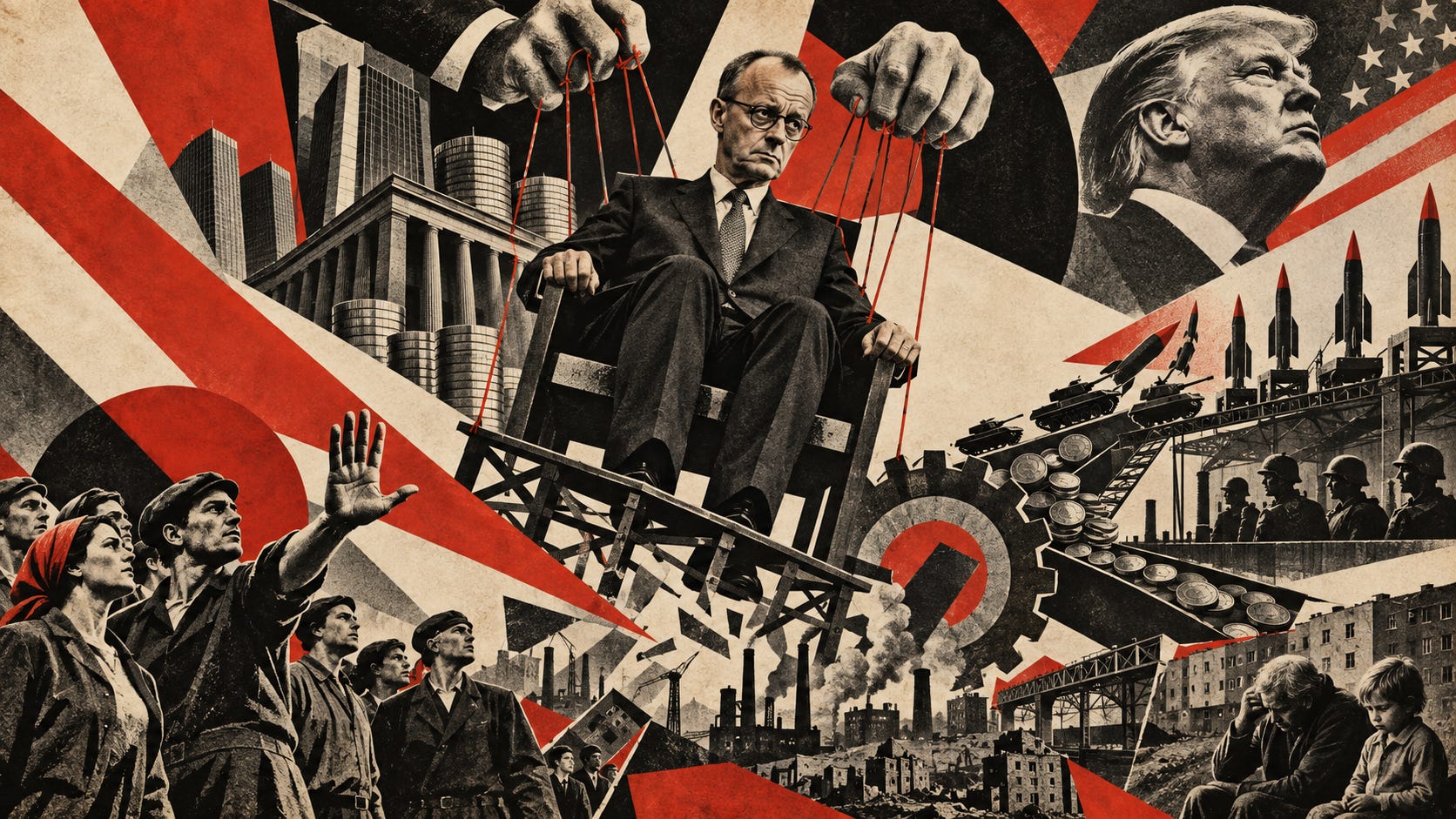
Federal Chancellor Friedrich Merz is by far the most unpopular head of government in the history of the Federal Republic of Germany: even before the current 2026 regional elections, Merz himself polled even lower than his own party, at 84 percent disapproval. Now, in the state of Saxony-Anhalt, the CDU has been halved; the same happened in the capital, Berlin; in the state of Mecklenburg-Western Pomerania, the CDU even disappeared entirely from the state parliament, with less than 5 percent.
Merz, Selling Off Germany, Phase 1: The Mittelstand (Middle class)
Merz organized this political collapse himself. Since 2005, he has been the leading architect of Germany’s impoverishment, tied to the dismantling of democracy and the welfare state:
In 2005, the US corporate law firm Mayer Brown recruited him for its new branch in Germany, in Düsseldorf. The private-equity-type US investors then flooding into Germany needed knowledgeable advice: how to buy and exploit the most valuable Mittelstand companies? The leading CDU politician Merz — chairman of his party’s parliamentary group in the Bundestag until 2004 — was especially well suited: no one knew the CDU’s traditional economic backbone, the Mittelstand, better than he did. And he was a lawyer. And, quite unusually for the industry, he immediately became a co-owner of the firm as well.
As a result, Merz also became a member of a dozen supervisory boards of the companies the firm advised. He thus became a multimillionaire from three sources: as a lawyer, as co-owner of his firm, and as an officer in the advised companies. This came with his own private jet and a second residence on Bavaria’s Tegernsee, where German billionaires and Russian oligarchs keep their villas.
Merz’s most important predecessor, CDU chancellor Helmut Kohl, had organized the sell-off of East Germany starting in 1990. And starting in 2005, though without holding public office, Merz now organized the sell-off of West Germany. Thousands of Mittelstand firms were “restructured,” divisions and properties were sold off, wage freezes were imposed, temporary agency work was expanded, works councils were pushed out: tens of thousands of jobs were destroyed. His fellow party member and Chancellor Angela Merkel covered for the sell-off through silence and toleration.
Merz, Selling Off Germany, Phase 2: The DAX Corporations
This success with the second-tier US “locust” investors did not go unnoticed by the leading first-tier capital organizer then also rising globally: BlackRock, headquartered in New York, with its legal seat in the largest US tax haven, the mini-state of Delaware. BlackRock had risen with the help of US President Barack Obama. And Obama’s successor as US president, Joe Biden, also owed his rise to the fact that he had risen politically himself as a member of Congress from the rising tax haven of Delaware.
In 2016, BlackRock hired Merz, the sell-off man: he became chairman of the supervisory board of BlackRock’s German subsidiary, BlackRock Asset Management Deutschland AG. Merz received barely 200,000 euros a year for this — but of course that was too little for both sides: Merz also got a consulting contract whose fee has never been disclosed to this day. Secret profits — that’s what matters!
From 2016 to 2020, this highly paid BlackRock officer now organized the sell-off of Germany at the highest level: now it was the turn of Germany’s most important listed companies, the DAX corporations, from Adidas to Wirecard, including Allianz, Deutsche Bank, BASF, Bayer, DHL Deutsche Post, Deutsche Telekom, Lufthansa, RWE, BMW, Munich Re, Rheinmetall, SAP, Siemens, and Vonovia. Merz organized secret meetings with the finance ministers of the Merkel government — first with Wolfgang Schäuble (CDU), then with Olaf Scholz (SPD) — and with the Chancellery: all of them agreed to the sell-off, and none of them spoke about it publicly — not Merkel, not parliament, not the mass media.
That is how BlackRock became the largest shareholder in the few hundred most important large German companies, present in all 40 DAX corporations, as well as in the MDAX, TecDAX, SDAX, and so on. And BlackRock is never there alone, but always together — in varying combinations — with the next-largest of the new first-tier US capital organizers: Vanguard, State Street, Capital Group, Fidelity, Wellington, T Rowe Price. They are extensively interlocked with each other through cross-holdings and coordinate among themselves.
Merz: “Dare More Capitalism!”
While he held no political office and was instead an officer of Mayer Brown and BlackRock, Merz could openly voice his capitalist creed.
In the business establishment’s flagship paper, the Handelsblatt, numerous columns let him earn extra money on the side. And in a fit of enthusiasm, he wrote his 2008 book Dare More Capitalism (Mehr Kapitalismus wagen). There the rising multimillionaire freely proclaimed his unchristian articles of faith:
“The minimum wage harms Germany as a business location!”
And: “Tax havens increase returns!”
And: “Abolish protection against dismissal!”
And: “132 euros for Hartz IV recipients is enough!”
And: “Raise VAT!”
And: “Lower taxes for high earners!”
And: “Abolish codetermination!”
And: “Privatize all social insurance!”
This pleased the locust investors Merz advised. And it pleased — and still pleases — the top locusts, BlackRock & Co.
By the way: multimillionaire Merz remained, at the same time, a co-owner of the US firm Mayer Brown until 2021: unearned profits matter especially — including for shareholders.
BlackRock: Profits — the Mittelstand and Workers Impoverished
This is how BlackRock & Co. — with the help of Merz, Merkel, Schäuble, and Scholz — became the leading shareholder group in Germany. They are present, at the same time, in the carmakers VW, BMW, and Daimler; in the housing corporations Vonovia, Deutsche Wohnen, and LEG; and in the chemical and pharmaceutical corporations Bayer, BASF, and so on: they form new-style monopolies, and the DAX is the largest monopoly of all.
In Germany, they thus cut jobs freely and without state regulation while investing abroad, above all in the United States, where extremely high state subsidies await them. And they invest in China, because everything Merz has helped dismantle in Germany over the past 20 years exists there: skilled workers, integrated production and supply chains, innovation, and, not least, the growing purchasing power of employees, whose wages have been rising steadily for 30 years — thereby giving an extra boost to the Chinese economy.
In Germany, by contrast, with Merz at the helm: since 2005, the destruction of the Mittelstand and, with it, of many traditional supply chains. Job losses, an accelerated reduction in labor income through the tightened implementation of the four Hartz laws, and cuts to pensions — and thus a fall in purchasing power, which then drags the whole economy down as well.
It is true that, under Merkel, the statutory minimum wage was finally introduced — but, in keeping with Merz’s own creed, it is still being undermined by companies on a millions-fold scale today, under his own chancellorship as well. Take one example: a billion unpaid working hours a year already before this, and even more with home office — lost income and pension rights. That delights Merz and his friends, quietly, in their secure luxury residences on the Tegernsee, in Miami, in the Caribbean, near the former Epstein estate.
Chancellor Merz styles himself as an “economic” expert and promises: “With me, the economy will turn upward again!” But Merz’s dishonest use of the word “economy” really means: BlackRock & Co., profits for the small, radical minority of the super-rich. The impoverishment of the majority continues. The main way out of this dishonest policy: rearmament, agitation against Russia, war preparation!
Merz: No “Firewall” Against Trump
That is why Merz follows every command of the most powerful and brutal capital lobbyist, the most powerful far-right figure, racist, and nationalist of “Western civilization” — namely, US President Donald Trump. Merz may go on invoking the “firewall” against the small AfD for as long as he likes: against Trump, Merz has no firewall at all!
Merz, in line with similar leading European figures such as his fellow party member Ursula von der Leyen, President of the European Commission, and France’s Emmanuel Macron, meets Trump’s central demands without any resistance whatsoever: raising military budgets to 5 percent, taking over the US proxy war against Russia already lost by Ukraine, buying ever more expensive US fracking gas, tariffs on European products, paying for the weapons the US has supplied to Ukraine, and supporting the genocide in the Middle East.
This further deepens the impoverishment of the majority population that has already been under way. Even if most people do not understand the geopolitical connections, they do notice the deterioration in their working and living conditions, and those of their children and grandchildren. That is why the governing parties of recent years are in decline — even more so in East Germany, where the impoverishment began.
Why Doesn’t Merz Resign?
From 2005 onward, Merz let his activities within the CDU lie dormant. The perpetual chancellor Merkel quietly promoted the impoverishment that the publicly invisible Merz helped organize, all papered over with her standing catchphrase, “We are all doing fine.” No leading figure could emerge within this CDU under those conditions.
And the CDU did not decline only among voters: since 1990, its membership has been cut in half. What remains are a few older habitual voters, civil servants, rural residents, as well as several tens of thousands of high earners from the ranks of lawyers, managers, and clergy — including military chaplains and Bundeswehr officers.
The CDU’s biggest donor in recent years — more than two million euros — is Christoph Kahl: he made his billions through the real-estate group Jamestown, dealing in luxury property — in the United States. And the current biggest donor — 500,000 euros in 2025 — is Stephan Schambach, a German-American online retailer whose company Demandware is listed on the New York Stock Exchange. Next come, as CDU donors, the business dynasties who, with the help of CDU chairman and West Germany’s founding chancellor Konrad Adenauer, were allowed to keep their profits from the Nazi era without punishment — that is, to this day still the Quandts, the Oetkers, and the Piëchs.
Oh, and among Merz’s important supporters is also a genuine owner of a baroque castle, the lord of the manor Christian Alexander Freiherr von Stetten, of the old noble House of Stetten, a construction entrepreneur and owner of vast landholdings, and chairman of the CDU’s Mittelstand caucus in the Bundestag.
So the political newcomer and multimillionaire Merz has almost nothing left behind him within his own party — apart from a handful of old and newly rich multibillionaires, and BlackRock & Co., whom Merz is not allowed to mention publicly. And the CDU’s traditional junior coalition partner, the FDP, which time and again in the Federal Republic’s history had to (or was allowed to) rescue a CDU government, has vanished entirely on account of its crude servility to capital. And the more recent junior partner, the SPD, has shrunk even further because of its role in this impoverishment of its own electorate. Which is why new elections would only make the collapse even clearer.
So Merz does not resign. He goes on dishonestly promising his “reforms” — meaning, more of the same: freedoms and war profits for BlackRock & Co. in Ukraine, the Middle East, and worldwide; rearmament against Russia, so that his new and old multibillionaire capitalists — and the new drone manufacturers as well — can also get their slice of the pie there; and, at the same time, further cuts to wages, pensions, and the welfare state, all under a vassal status for Germany (and the EU) that Trump has made even more dangerous and damaging; and the dismantling of democracy.
Merz has lately taken to repeatedly praising his predecessor Adenauer as a model. But Adenauer, with his CDU, at least had — and could point to — an “economic miracle.” Merz, by contrast, has the permanent crisis he himself organized, and, apart from the secretive super-rich, he has almost no one left behind him.
That is why the tasks facing the democracy and peace movement today are incomparably more important and more far-reaching than after the founding of the Federal Republic. And the international networking this requires is today far more important — and also far more achievable — across Europe, and reaching all the way into the growing counter-movement within the United States itself.
NAMES MENTIONED
Konrad Adenauer, Joe Biden, Adolf Hitler, Christoph Kahl, Helmut Kohl, Ursula von der Leyen, Emmanuel Macron, Angela Merkel, Friedrich Merz, Barack Obama, Oetker family, Piëch family, Quandt family, Werner Rügemer, Stephan Schambach, Wolfgang Schäuble, Olaf Scholz, Christian Alexander Freiherr von Stetten, Donald Trump
TAGS
Germany, Friedrich Merz, Werner Rügemer, BlackRock, CDU, private equity, financialization, small and medium-sized businesses, DAX, inequality, welfare state, Donald Trump, rearmament, Russia, democracy, peace movement, Mittelstand

Werner Rügemer, born in Bavaria in 1941, has lived in Cologne since 1975; an interventionist philosopher, he works as a writer, consultant and guide to Cologne’s political and historical landmarks.
Author of BlackRock Germany. Die heimliche Weltmacht, ihre Praktiken in Deutschland und Friedrich Merz (“BlackRock Germany: The Secret Global Power, Its Practices in Germany and Friedrich Merz”). Berlin, 2025, 104 pages, €14.80
Read Werner Rügemer, a voice from the other Germany: interview