
The Costa Rican economist, the daughter of Holocaust survivors with close family in Israel, has emerged as the frontrunner to succeed António Guterres while broadly sharing the UN leadership’s positions on Israel and Gaza
Ben Kroll, With reporting from Reuters, Haaretz, August 10, 2026
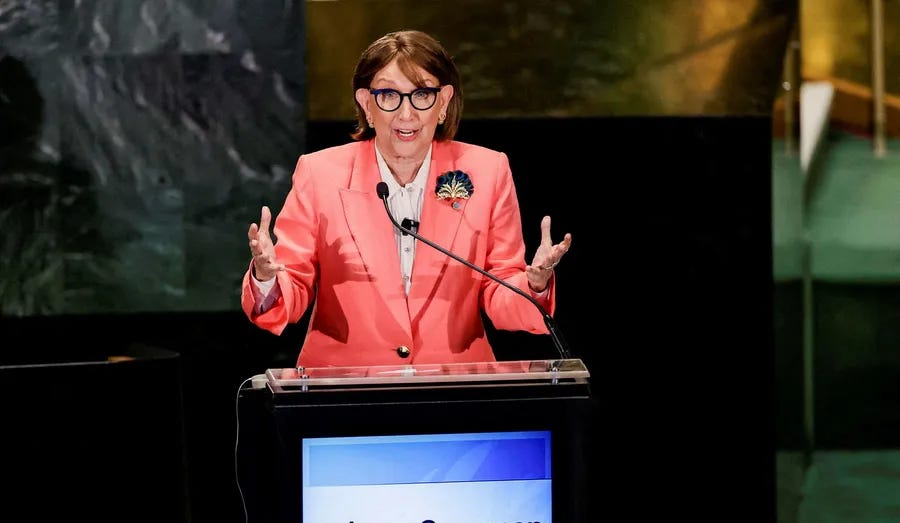
Rebeca Grynspan, a former vice president of Costa Rica, has emerged as the early frontrunner to become the next United Nations secretary-general. If chosen, she would become the first woman and first Jewish person to hold the UN’s top post.
Grynspan, an economist, currently serves as secretary-general of the UN Conference on Trade and Development, the UN body focused on global trade, investment, finance and economic development, particularly in developing countries.
In a non-binding straw poll among the Security Council’s 15 members, Grynspan received 10 ‘encourage’ votes, ahead of former Guyanese Foreign Minister Carolyn Rodrigues-Birkett with nine and Rafael Grossi, the Argentine head of the UN’s nuclear watchdog, with seven.
Security Council members are asked to vote for or against a candidate, or to express “no opinion” over his or her candidacy during the initial anonymous poll. The next round of voting will reveal whether one of the council’s five permanent members – China, France, Russia, the United Kingdom or the United States – has effectively vetoed a nomination.
Once a consensus is reached among the Security Council members, the nomination moves to the UN General Assembly, where the candidate is formally appointed. A specific timeframe has yet to be published, but Antonio Guterres’ second term will end on December 31, and the next Secretary-General will then replace him.
Grynspan has said in a 2022 podcast interview that her Jewish parents fled Poland for the Soviet Union before World War II as antisemitism intensified and the Nazi threat grew. Her father escaped with most of his family, while her mother fled with her two sisters, leaving behind her parents, who were later killed in the Holocaust. After the war, both sought to reach Mandatory Palestine but were detained by the British in Cyprus, where they met, before moving to Costa Rica.
According to a UN press release from 2006, she attended the Hebrew University of Jerusalem, where she studied economics and sociology. In 2020, she spoke at an Israeli tech event co-sponsored by Israeli government ministries.
Grynspan’s sister, Frida, moved to Israel at the age of 17, where she, too, attended Hebrew University, according to a 2014 profile of the family published by the English-language Costa Rican outlet The Tico Times. Grynspan’s niece and nephew both served in the Israeli army, the outlet reported.
Before leading the UNCTAD, Grynspan served as secretary general of the Ibero-American General Secretariat, which leads annual meetings of leaders from Spanish and Portuguese-speaking nations. Before that, she was Associate Administrator of the UN Development Programme, as well as Costa Rica’s second Vice President, between 1994 and 1998.
In 2017, Grynspan was the keynote speaker at an event organized by B’nai B’rith Uruguay marking the 79th anniversary of Kristallnacht – the November 1938 pogroms against Jews and Jewish-owned property across Nazi Germany.
Her positions on Israel, the Palestinians and the wider Middle East conflict do not appear to diverge significantly from those of the UN leadership. In a November 2023 speech following Hamas’ October 7 attack on southern Israel, Grynspan condemned “the horrific loss of civilian lives’ both in the Hamas attack and in Israel’s subsequent bombardment of Gaza, including strikes affecting civilians, hospitals, shelters, schools and UN facilities.”
Echoing Guterres, Grynspan called for an immediate cease-fire in Gaza. “This means the unconditional release of the hostages in Gaza, now. The protection of civilians, hospitals, UN facilities, shelters and schools, now. Unfettered access to deliver supplies to all people in need in Gaza, now. And the end of the use of civilians as human shields, now. None of these appeals should be conditional on the others,” she said.
Under her leadership, the UN body she heads released reports on the economic impact of the Israel-Gaza war. In 2024, it found that the Palestinian economy had suffered its steepest-ever decline amid the war, with the entire population of Gaza falling below the poverty line. It added that even under an optimistic reconstruction scenario backed by substantial foreign aid, Gaza would need several decades to return to prewar living standards.
A 2025 report found that Israeli restrictions imposed on Gaza following Hamas’ 2007 takeover, combined with repeated wars, had hollowed out its economy even before October 7. It estimated that Gaza lost $35.8 billion in potential GDP between 2007 and 2023. The latest war then caused another devastating collapse, with infrastructure damage estimated at $18.5 billion by January 2024.
While Israeli officials have yet to publicly comment on the possibility that Grynspan could succeed Guterres, the right-wing pro-Israel NGO UN Watch described her candidacy as “raising concerns that the same patterns of bias and politicization [currently in the UN] would persist.”
The NGO, known for its fierce opposition to the UN’s positions, labeled the economic reports “a series of harsh and one-sided reports on Israel, raising concerns about fairness and reinforcing fears that she may be too willing to align with the system’s entrenched bias.”