Nano Shabtai, Haaretz, July 28, 2026
Photos Yair Meyuhas
Name: Podium
Director: Yael Polka
Playwright: Yael Polka
Theatre: HABAIT Theater, Jaffa
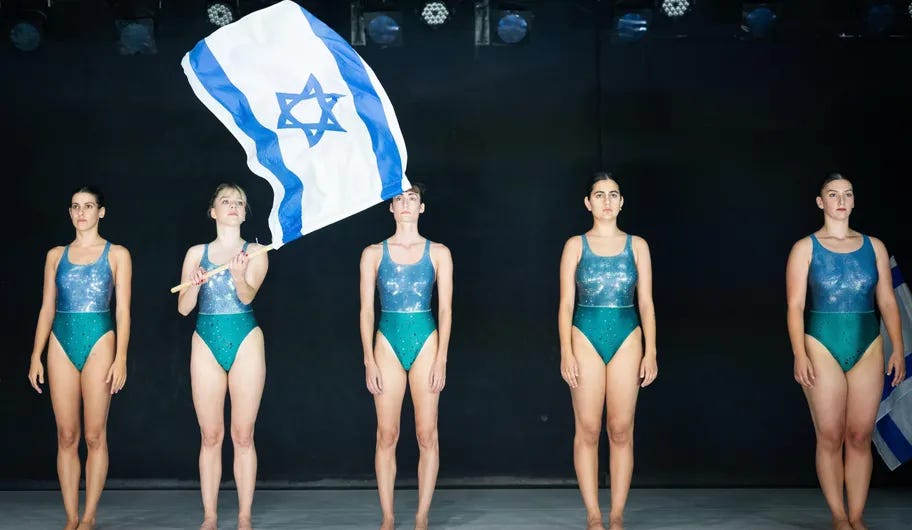
“Podium” focuses on a group of young women specializing in synchronized swimming. It’s largely based on the personal experience of Yael Polka, who began training at the age of five. By 10, she had already won the title of Israeli champion and she continued to swim and excel, eventually coaching the national team.
To accomplish these feats, as described and presented in her debut play (which was first developed and staged as part of a 2025 program at the Acre Festival of Alternative Israeli Theatre), talent and willpower are not enough. One chilling sentence from a coach sums up the essence of the ambition required to excel in the field: “You have to fall in love with your pain.”
These professional dancer-athletes cope with a total loss of private life. The grueling training sessions take place six days a week, for at least eight hours a day. They have no time for a family meal or any other activity. Polka leads the show as the narrator, wearing a coach’s uniform, occasionally asking the trainees to recreate a duet she created or performed in a specific Olympics event, including technical explanations.
The soundtrack – comprised of patriotic, cheerful Israeli folk songs – is played to simulate the way it sounds to the swimmers. The minimalist, documentary-like details are precisely what create a strong effect, its power lying primarily in a sweeping defamiliarization – the fact that there is no swimming pool on the stage. This clean effect and meticulous minimalism led my 14-year-old daughter to declare, as we left the theater, that the play was “perfect.”
Indeed, “Podium” is a perfect production in terms of both form and content, even though it is evident at every moment that it is also a first effort. That, too, is part of its charm.
Perhaps unintentionally, the play doesn’t deal only with the world of competitive women’s sports; it makes an incisive critical statement about the manipulative way in which our aggressive world operates.
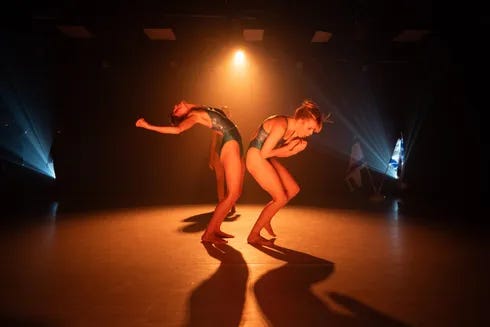
It’s a breathtakingly accurate demonstration of the conditioning that these girls undergo on the way to becoming the perfect victim. The kind of victim who doesn’t even realize she’s a victim, at least not for a long time. The statement builds thematically, without ever slipping into emotional manipulation. Thanks to this almost dry thematic approach (pun intended) rooted in a Spartan modesty that seemingly toes the line, the play succeeds in shattering every myth and lie, until a total knockout – which, to a great extent is a sort of own-goal. To the glory of the State of Israel.
The educational conditioning, or taming, begins with an illustration of how the swimmer’s private body is expropriated from her private ownership and transformed into a body that belongs to the nation. Upon joining the coveted national team, her body becomes property belonging to the state, which funds and invests in the sport. The state is also officially and explicitly responsible for the health and physical integrity of the competing child or teenager, in the hope that she will represent the country with honor and perhaps even win a medal.
However, safeguarding the private body that was taken and transformed into a public- representing body is not done according to the rules of a nurturing and protective home. On the contrary. When a young athlete is injured, not only does she receive no treatment, consolation, or rest, but an accusing finger is pointed at her. We hear the testimonies: how the trainees, who in effect are forced to starve themselves, are weighed, and how their bodies are gradually worn down and become a means to an end, like an object, in the hands of stakeholders, or perhaps like animals led to the slaughter.
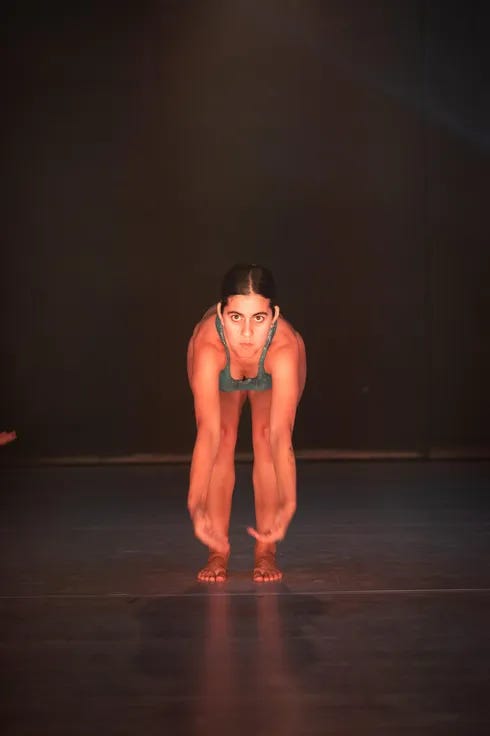
The goal – standing on the winners’ podium – sanctifies any means. And in fact, the strongest and most outstanding continue to perform and compete, even with fractures. At every moment, their private body is enslaved to the public-national body, while they naively aspire toward the goal or the momentary appeasement of the authority figure, always at the expense of their own wellbeing, until they reach almost total self-nullification.
With time and the progression of the taming process, they’re no longer even sure if the way the doctor touches them is legitimate. Is this invasion of their body, which they have already experienced for years in various (and legal) ways, a different kind of invasion?
They grope for answers and ask one another, but don’t dare to complain. The same goes for that coach, who’s always there, by the pool, touching the bottoms of the ten-year-old girls as a matter of routine. And they, whose basic expression, which they learned right from the start, is the perpetual smile – characteristic of the artistic swimmer – why would they suddenly cry or complain?
The gap between the external and the internal is part of the essence of the sport itself, even before we speak about these girls, who were sexually exploited. This gap, which enables the growing harm to the young body and mind, is illustrated by Polka and the dancers in a powerful and chilling manner. From the start, there’s something creepy about this sport, at least in the eyes of an outside observer. On one hand, the hyper-precise dance movements, the glittering swimsuits – all this beauty is unsettling. In reality, it’s accompanied by long moments of breathlessness and an obligation to smile all the time.
In my opinion at least, artistic swimming is the exact opposite of art. Art is supposed to express emotion, rebellion, individuality. Artistic swimming expresses blind obedience, a representation of beauty that in practice is total robotism. Perhaps one could say the same about classical ballet, but the element of water, which is absent from the dry stage, intentionally highlights the suffering, sacrifice, and objectification, through a dance that’s always restricted by the rules of time and predetermined movements, formulated in some professional charter that the choreographer must adhere to. The waterless stage and the gestures of the dancers gasping for air emphasize psychological and physical suffocation in a painful grotesque.
Silencing the female voice is an ancient and fundamental value in patriarchal society. While watching, I thought of the women border spotters who repeatedly warned of the many dangers before October 7. They faced contempt, silencing and dismissal, and were subsequently murdered. Polka reads to the audience the speech of Simone Biles, who left competitive gymnastics, chillingly describing the constant split between body and soul, the lot of an international star gymnast, who composed a stinging indictment against an entire culture of exploitation, disguised as a radiant smile.
The message against the exploitation of girls and women strikes like an arrow, precisely because of the modesty with which it is presented. A delicate cry, as if still choked by pool water and chlorine, from someone who still wants to believe in goodness and beauty. It’s the message of the good girl, almost drowning from an excess of guilt, pain and a desire to be loved and to please.
“Podium” delivers a statement relevant not only to parents of ambitious girls. It’s a must- see play for everyone, teenage boy and girl, and for every parent who thinks there’s any kind of beauty in sacrifice. Polka’s love for this specific sport is clearly visible in the play, which makes it even more moving, heartbreaking and courageous. It is not good to die and to be injured for our country, in any form – not even artistically.