
Palestinian Union of Latin America (UPAL) — August13, 2026
There are stories that should not pass as just another news item, because they reveal far more than their own words suggest. Among them is the initiative launched by Italian philosophy professor Eugenio Mazzarella, calling for the Nobel Peace Prize to be awarded to the children of the Gaza Strip—an initiative that has already received the signatures of thousands of Italian citizens, religious leaders, municipalities, trade unions, academics, and others.
At first glance, it may appear to be a noble humanitarian initiative. But in reality, it places the world before a far more painful question: What does it mean that the children of Gaza need a Nobel Peace Prize for the world to recognize their humanity and the tragedy they are living through?
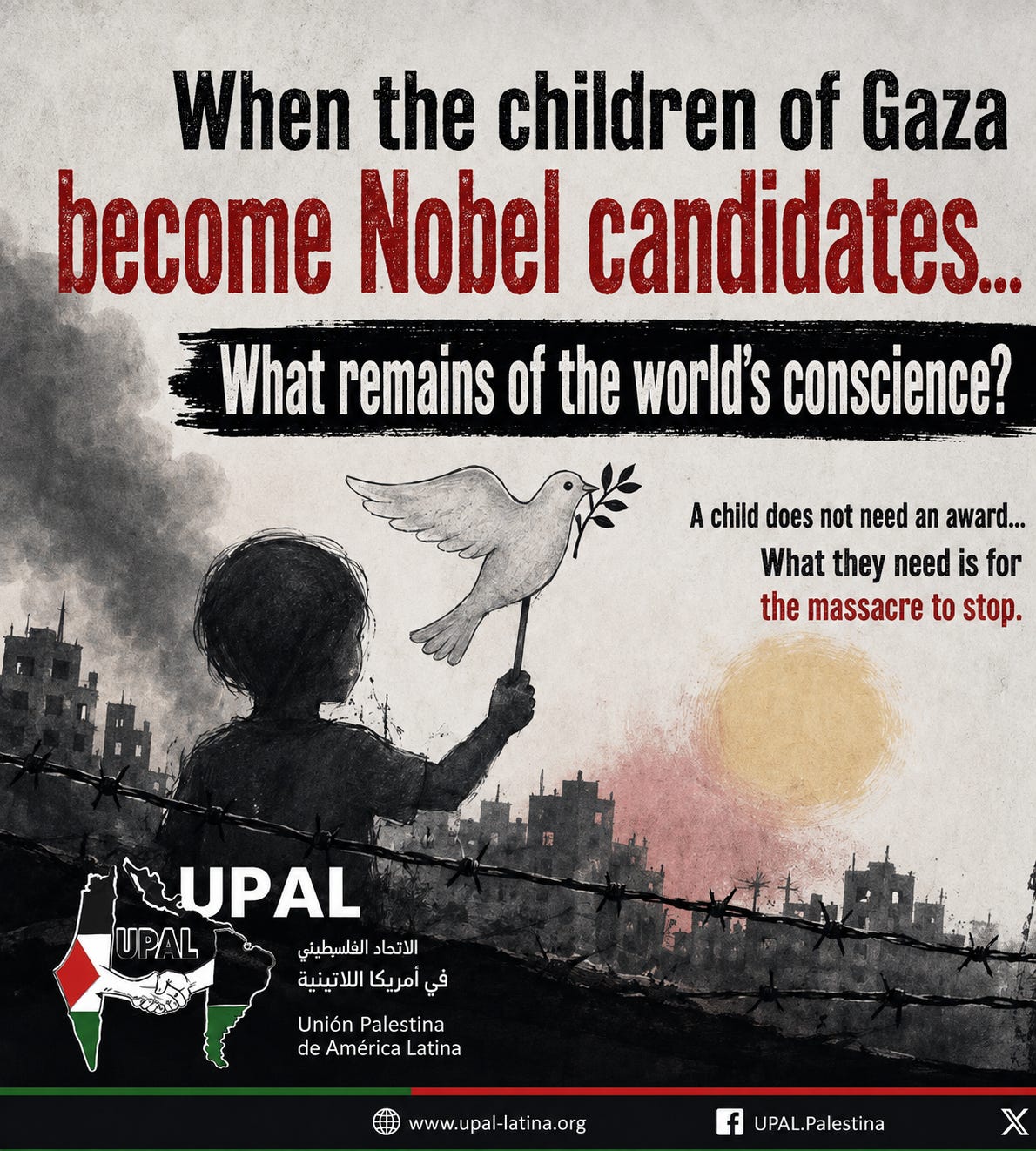
Children do not need awards.
A child who has lost his or her family or home does not need a medal.
A child living under bombardment, blockade, and hunger does not need a certificate from an international institution proving that he or she deserves to live.
What that child needs is for the killing to stop.
And this is where the contradiction that must not be lost amid the emotion lies. When the tragedy of Gaza’s children reaches Italian universities, newspapers, churches, trade unions, and municipalities, it means that the reality of that tragedy can no longer be hidden. But moral recognition, however important, cannot substitute for political and legal responsibility.
The children of Gaza are not dying because of a natural disaster. Nor because history suddenly decided to be cruel to them. They are living under war, blockade, destruction, and political and military decisions for which those responsible must be held accountable. Therefore, the real question is not: Do the children of Gaza deserve the Nobel Peace Prize? The real question is: When will the world act to stop what is being done to them?
Turning victims into a symbol of peace may be moving, but it carries another danger if everything ends with the symbol. The world does not need more heartbreaking images, more statements expressing concern, or more declarations saying “enough” while the same reality continues.
Gaza does not need more sympathy as much as it needs action.
It needs protection for civilians, an end to the killing and destruction, the lifting of the blockade, guaranteed access for food, medicine, and humanitarian assistance, accountability for those who have committed crimes, and an end to the system of impunity that has allowed Palestinian lives to be treated as less valuable in the calculations of international politics.
Above all, the children of Gaza should not have to be the exception that awakens the world’s conscience while the root of the problem remains outside the debate: the occupation of a Palestinian people and the denial of their national, political, and human rights, together with the continued treatment of occupation as though it were a natural reality rather than a political and legal situation that must end.
From Italy, this initiative says something of enormous importance: the official narrative can no longer monopolize the image of Gaza, and growing sectors of European society are beginning to see the children of the Strip as victims who deserve protection, not as statistics in the evening news.
That development deserves recognition.
But from the Palestinian Union of Latin America, we say clearly: we do not want the children of Gaza to become the protagonists of an awards ceremony. We want them to be alive in their homes, in their schools, on their playgrounds, and alongside their families.
We do not want a Palestinian child to receive an award because he or she survived a bombing; we want that child never to be bombed in the first place.
We do not want a girl to be honored because she lost her parents; we want her parents to remain by her side.
We do not want the world to remember Gaza’s children after their deaths; we want a world that protects them while they are alive.
For this reason, the Italian initiative must not be the end of the road, but the beginning of a deeper question: if thousands of Italians can say “enough,” why can’t European governments say it as well?
Why can universities speak, trade unions protest, municipalities sign petitions, and religious leaders raise their voices, while some governments continue to provide Israel with political, military, or diplomatic cover?
And why does the killing of children become a humanitarian tragedy when it concerns Gaza, while legal and political responsibility is pushed into the background?
The world is facing a real test—not an emotional one.
Because peace is not something handed out as a prize.
Peace is a right.
And freedom is not a medal.
Freedom is a right.
Protecting children is not an act of solidarity.
It is a legal and moral duty of the international community.
Therefore, at UPAL, we welcome every Italian, European, and Latin American voice that rejects the killing of Gaza’s children, and we consider these voices part of a growing global movement of conscience that continues to expand despite every attempt to silence it.
But we go further:
Enough killing children.
Enough blockade.
Enough starvation.
Enough destruction.
Enough impunity.
And enough double standards when it comes to human rights.
If the world sees in the children of Gaza something worthy of the Nobel Peace Prize, then above all it must see what those children deserve: life, freedom, security, and dignity.
Because the greatest prize a child in Gaza can receive is not a medal hanging from his or her chest.
It is to wake up tomorrow… and not hear the sound of bombing.
All our publications are free and Copyleft. They may be republished, in whole or in part, under following conditions:
→ keeping the title and content
(text, images, editor’s or translator’s notes, boxes)
→ crediting the author(s) and/or translator(s)
→ inserting a clickable link to the source.
Any monetization or commercial use of these publications is prohibited and will be subject to legal action.