When China Says No
Nvidia came to Beijing to sell its H200 chips; China chose Huawei and technological autonomy.


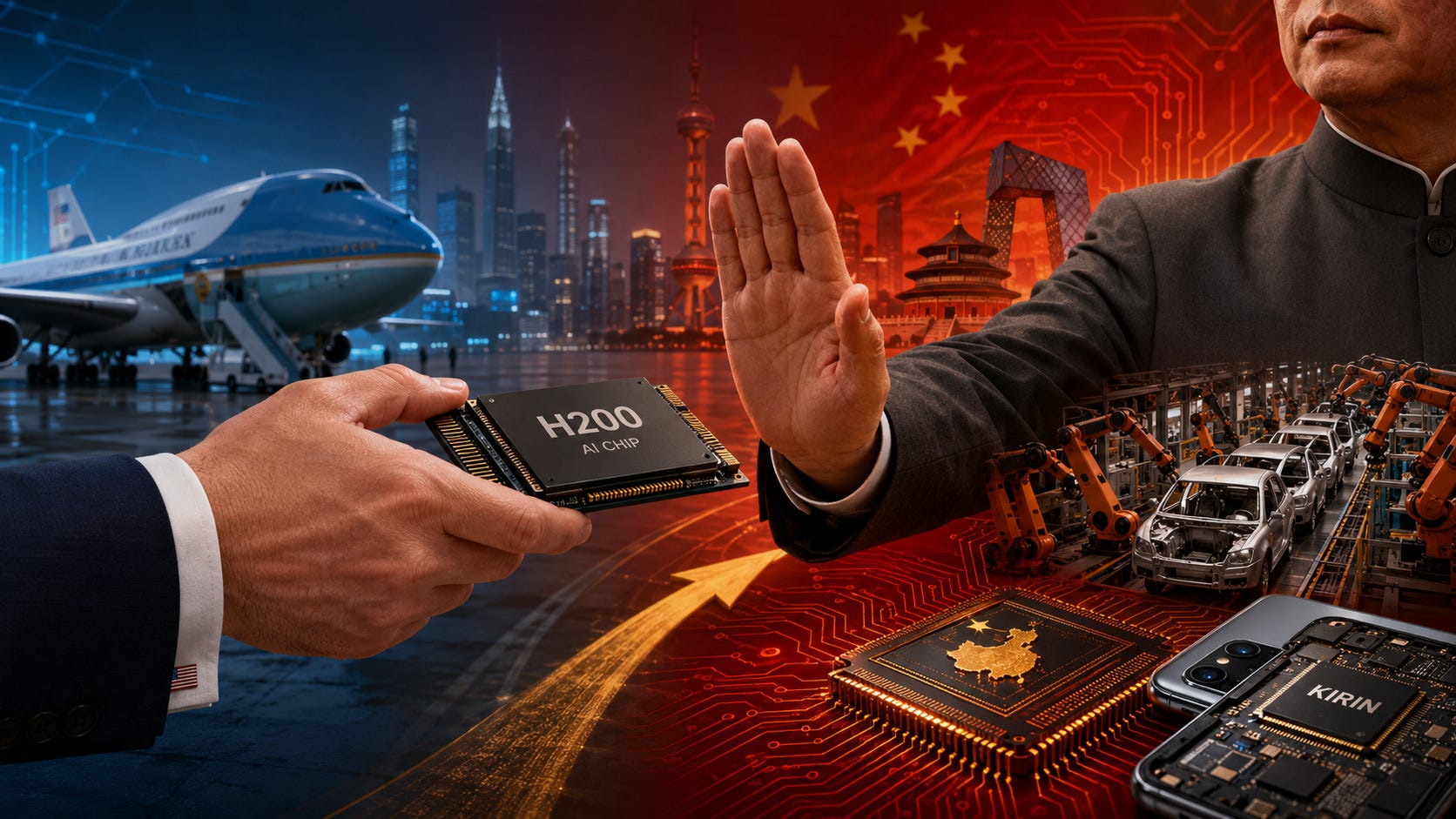
An excellent Asia Times article by Tony Pan (Nvidia flew to Beijing with Trump to sell but China said no) describes a scene that, on its own, sums up the current industrial moment: Nvidia arrives in Beijing, with Washington’s political green light, to offer its H200 chips to Chinese tech giants. And Beijing refuses. Officially, for security reasons. Strategically, to assert a technological sovereignty that is no longer negotiable. China is now pushing Huawei and domestic suppliers to take over, to the point where the Chinese market now accounts for only 9% of Nvidia’s revenue. The direction of technology transfer is reversing: it is no longer the West bringing its know-how, but China beginning to set the standards.
This refusal perfectly illustrates what we call “BYD-ization”: the Chinese product no longer merely captures market share at low cost; it establishes itself as the new benchmark in performance, cost and time-to-market. The latest signals confirm this shift.
In Germany, officials close to Volkswagen are now openly discussing the possibility of producing in local plants models developed and designed in China, with platform transfers as early as 2027. This is no longer a distant hypothesis: it is an operational solution for filling assembly lines struggling to keep pace with Chinese competition, especially in electric vehicles and embedded software.
On the chip front, a Huawei-related leak points to a Kirin 2026 Pro whose performance could rival Apple’s A19 processor, manufactured by TSMC on a 3 nm process. While Huawei still depends on Taiwanese and South Korean foundries for production, the gap in design capability has now narrowed to less than 18 months, and the Western lead in architectures and system integration is shrinking rapidly.
Nor does this movement concern only China, the United States and Germany. In Japan and South Korea, carmakers and electronics manufacturers are watching these developments closely, aware that the next cycle of competitiveness will depend on the ability to integrate, or not, innovations coming from China.
The end of Tony Pan’s article raises the real challenge of this transition. Political leaders in the West may try to slow the spread of Chinese innovations through customs barriers, punitive tariffs and protectionist reflexes. This is largely the language heard among European officials.
But industrial companies are already thinking differently. They look at costs, timelines, platforms, software, batteries, the need to fill their factories and to integrate viable technologies. Some have already made the move: Stellantis, for example, is integrating Chinese platforms through Leapmotor to feed its European plants, a perfect illustration of this operational turn. Others, in Southeast Asia, are beginning to import not finished products, but Chinese technology licences.
In short, Western industrial companies are looking for operational solutions in a world already transformed by Chinese innovation. Those that overcome their reflexes of competitive fear will be able to benefit from this wave. The others risk defending industrial borders behind which there will soon be little left to produce, or to protect.
Asia Times, Tony Pan, Nvidia flew to Beijing with Trump to sell but China said no, June 29, 2026
All our publications are free and Copyleft. They may be republished, in whole or in part, under following conditions:
→ keeping the title and content
(text, images, editor’s or translator’s notes, boxes)
→ crediting the author(s) and/or translator(s)
→ inserting a clickable link to the source.
Any monetization or commercial use of these publications is prohibited and will be subject to legal action.