
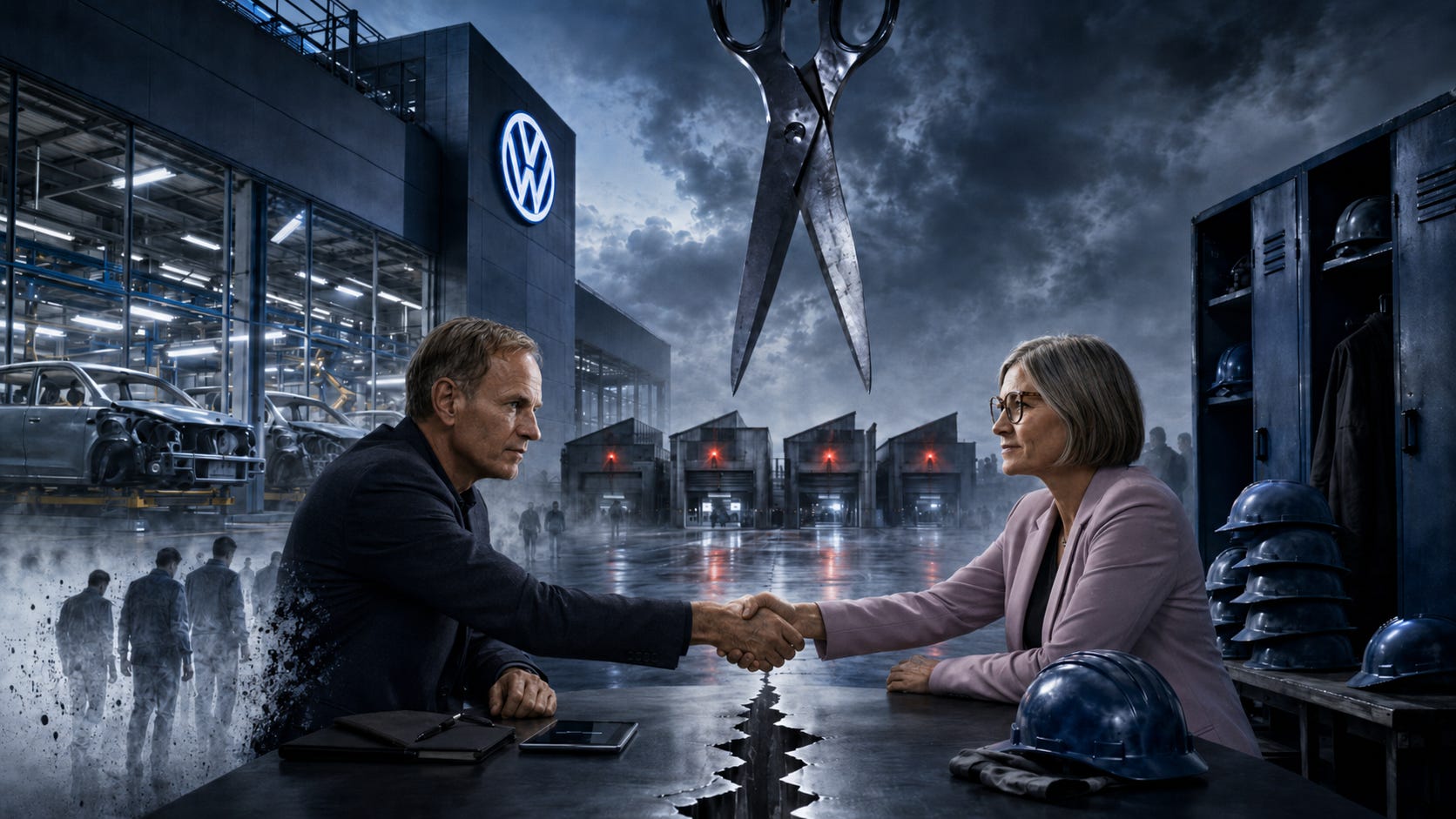
Meeting on 3 September 2026, Volkswagen’s supervisory board unanimously approved the “Future Plan 2030,” which brings the total number of planned job cuts to 100,000 by the end of the decade — around 15% of the group’s global workforce. This figure combines 50,000 new job losses worldwide with the 50,000 already agreed in Germany since 2024, mainly at the Volkswagen brand. After nearly two years of open tension, marked by demonstrations in Wolfsburg and Zwickau and a union petition signed by more than 200,000 people, management and employee representatives reached a compromise that avoids — at least for now — the head-on clash feared since the summer. The vote does not settle everything: the fate of four major German plants — Emden, Zwickau, Hanover and Audi’s Neckarsulm plant — remains unresolved, pushed back to deadlines ranging from 2031 to 2034.
A Compromise Negotiated Step by Step
Friday’s vote was preceded, the day before, by a meeting of the board’s steering committee, ahead of the plenary session of the group’s supervisory body in Wolfsburg. Within it, employees and shareholders hold equal weight, and staff representatives have, through the German system of co-determination, decisive influence over questions concerning industrial sites — an arrangement that has long limited management’s ability to push through rapid restructuring.
Christiane Benner, president of IG Metall and deputy chair of the supervisory board, welcomed an agreement reached after fierce negotiations aimed at finding good solutions to this crisis situation. Daniela Cavallo, chair of the group works council, for her part highlighted a plan intended to prepare Volkswagen’s future without measures imposed unilaterally on employees. For automotive expert Ferdinand Dudenhöffer, the group has above all secured, at this stage, a more presentable compromise than the painful public disputes of the past two years.
What the Plan Provides For
Beyond the scale of job cuts, the “Future Plan 2030” thoroughly reshapes the group’s industrial model. Volkswagen plans to cut its model range in half by 2035 and reduce the complexity of its offering by 75%, by consolidating technical platforms and software architectures to eliminate duplication. The stated financial target is an operating margin of 9% in 2030, up from barely 3.8% in the first half of 2026, backed by €135 billion in planned investment between 2027 and 2031 in plants, research and new technologies. The group also acknowledges overcapacity of more than 500,000 vehicles a year in Europe, a direct consequence of competitive pressure from China and falling demand on the continent.
Governance itself is to be “simplified,” although the precise details have not been spelled out. The most sensitive project on this front — spinning off the Volkswagen brand into a separate company — continues to run into opposition from the works council and the state of Lower Saxony, who see it as a threat to the co-determination rights guaranteed under the special law governing the group’s governance, adopted in 1960.
Four Plants in Limbo
Two closures have already been decided: the Dresden plant, and the end of car production at Osnabrück, planned for 2027. The fate of four other sites, however, remains open. According to information from WirtschaftsWoche picked up by Reuters in early September, the management board proposed to the supervisory board that the following be shut down by 2034:
• Emden, which currently produces the ID.4 and ID.7, with closure envisaged for 2031;
• Zwickau, which assembles the ID.3, ID.4, ID.5, the Audi Q4 e-tron and the Cupra Born, and employs around 9,200 people; its closure is likewise envisaged for 2031, the plant already running two shifts instead of three for lack of sufficient orders;
• Hanover, dedicated to the assembly of commercial vehicles, with a 2032 deadline;
• Neckarsulm, the Audi plant that produces the A5, A6, A8 and e-tron GT, targeted for 2034.
These four sites alone would account for around 40,000 jobs. The group’s CEO, Oliver Blume, has acknowledged that he currently sees no sufficiently competitive use for these facilities for the 2030s, while stressing that no closure has been formally decided at this stage. The 3 September vote validated the financial direction and the overall scale of job cuts, but postponed the site-by-site decisions: the most explosive point in the file has yet to be settled.
Union Mobilization That Weighed on the Outcome
The social climate around this issue grew markedly tenser over the summer. In July, employees carrying IG Metall flags demonstrated outside the historic headquarters in Wolfsburg and in Zwickau, while union negotiator Thorsten Gröger warned that attacking employees and co-determination risked triggering a major social conflict. A petition organized by IG Metall, demanding that no layoff plan be implemented without a matching investment plan, gathered more than 200,000 signatures within days. Union demands centered on three points at the time: a guarantee that sites would be maintained until 2030, the preservation of dual vocational training, and a share of the value created by new onboard software.
This pressure had a direct bearing on the final shape of the plan, with management forced to abandon any brutal, unilateral announcement in order to secure the supervisory board’s unanimous approval in early September.
What Comes Next
The 3 September compromise rules out, for now, the most radical option management had considered in the event of deadlock: convening an extraordinary general meeting of shareholders, floated for October. At such a meeting, unions would have had no voting rights, while the Porsche-Piëch family (53.3% of the votes) and Qatar (17%) could together have come close to the 75% qualified majority needed for major structural changes — at the risk of triggering strikes.
The social calendar does not stop at the 3 September vote, however. 26 September will see a national day of action organized by the DGB trade union confederation and IG Metall against social cuts in industry, an initiative that goes beyond the Volkswagen case alone but fits the same context of sectoral tension. On the industrial front, the end of car production at Osnabrück will take effect as early as 2027, while the proposed deadlines for Emden and Zwickau (2031), Hanover (2032) and Neckarsulm (2034) open a multi-year window in which further site-by-site negotiations are expected. The 2030 horizon also remains the target date for the 9% operating margin goal, and 2035 for halving the model range.
The unanimous vote secured in Wolfsburg gives Volkswagen clear, publicly stated financial and strategic goals, and gives the unions guarantees against immediate closures and the preservation of co-determination. The fate of the four still-threatened plants remains open, put off to a later reckoning.
Sources
• France 24, « Restructuration historique chez Volkswagen : 100 000 suppressions de postes d’ici 2030 », 3 septembre 2026. https://www.france24.com/fr/%C3%A9co-tech/20260903-restructuration-historique-chez-volkswagen-100-000-suppressions-de-postes-d-ici-2030
• France 24, « La menace d’un conflit social majeur plane chez Volkswagen », 9 juillet 2026. https://www.france24.com/fr/info-en-continu/20260709-volkswagen-fronde-syndicale-face-%C3%A0-un-projet-de-restructuration-in%C3%A9dit
• Agence France-Presse (via Bourse Direct), « Volkswagen obtient un accord pour mener sa plus vaste restructuration », 4 septembre 2026. https://www.boursedirect.fr/fr/actualites/categorie/economie/volkswagen-obtient-un-accord-pour-mener-sa-plus-vaste-restructuration-afp-004f13831922c2e75dd27962025ddaec7b61f298
• France Épargne, « Volkswagen : quatre usines allemandes menacées d’ici 2034 », 1er septembre 2026. https://www.france-epargne.fr/news/volkswagen-propose-la-fermeture-de-quatre-usines-allemandes-vote-decisif-le-4-septembre
• Path to Park, « Le vote du conseil d’administration de VW pourrait tester une solution pour contourner les vetos des syndicats », 1er septembre 2026. https://www.pathtopark.fr/le-vote-du-conseil-dadministration-de-vw-pourrait-tester-une-solution-pour-contourner-les-vetos-des-syndicats/
• Autoactu.com (AFP), « La menace d’un conflit social majeur plane chez Volkswagen », 10 juillet 2026. https://www.autoactu.com/actualites/la-menace-d-un-conflit-social-majeur-plane-chez-volkswagen
• L’Automobiliste, « Coup de tonnerre : Volkswagen coupe 15 % de ses effectifs mondiaux », 4 septembre 2026. https://lautomobiliste.fr/04/09/2026/volkswagen-coup-tonnerre-coupe-15-effectifs-mondiaux/
• Forococheselectricos (d’après WirtschaftsWoche/Reuters), « Volkswagen prepara la mayor reestructuración de su historia », 2 septembre 2026. https://forococheselectricos.com/noticias/volkswagen-cierre-4-plantas-20260902-41982.html
• IG Metall, fiche biographique de Christiane Benner. https://www.igmetall.de/presse/ig-metall-vorstand/christiane-benner
VW Supervisory Board Meeting: Escalation Averted—Executive Board Must Now Do Its Part
Joint statement on the occasion of today’s VW Supervisory Board meeting by Christiane Benner, First Chair of IG Metall, and Daniela Cavallo, Chair of the General and Group Works Council of Volkswagen AG:
“The confrontational approach and the Executive Board’s communication over the past few weeks were counterproductive. Both have led to great uncertainty among the workforce across the entire Group. In this situation, the employee representatives, together with the State of Lower Saxony, have once again taken responsibility, prevented a dangerous escalation of the conflict, and paved the way for viable solutions. To achieve this, all parties moved toward one another.
A spin-off of the core Volkswagen Passenger Cars brand and the VW components division is off the table, and the attack on the co-determination structures has thus been successfully repelled. No plant has been abandoned, and contrary to several media reports, no plant closure has been finalized. Rather, concrete solutions must now be developed for all locations—and we continue to hold the Executive Board explicitly responsible for this.
We expect the Executive Board to now do its part based on the compromise reached today and to present results promptly. It must finally get the necessary investments off the ground, drive innovation forward, and secure long-term employment. We will hold the Executive Board accountable on these points.
We recognize the challenges facing the company and are prepared to take responsibility and do our part. We have demonstrated this once again today. The work is only just beginning. However, what we will never accept—now or in the future—is placing the burden solely on the employees.”
All our publications are free and Copyleft. They may be republished, in whole or in part, under following conditions:
→ keeping the title and content
(text, images, editor’s or translator’s notes, boxes)
→ crediting the author(s) and/or translator(s)
→ inserting a clickable link to the source.
Any monetization or commercial use of these publications is prohibited and will be subject to legal action.