

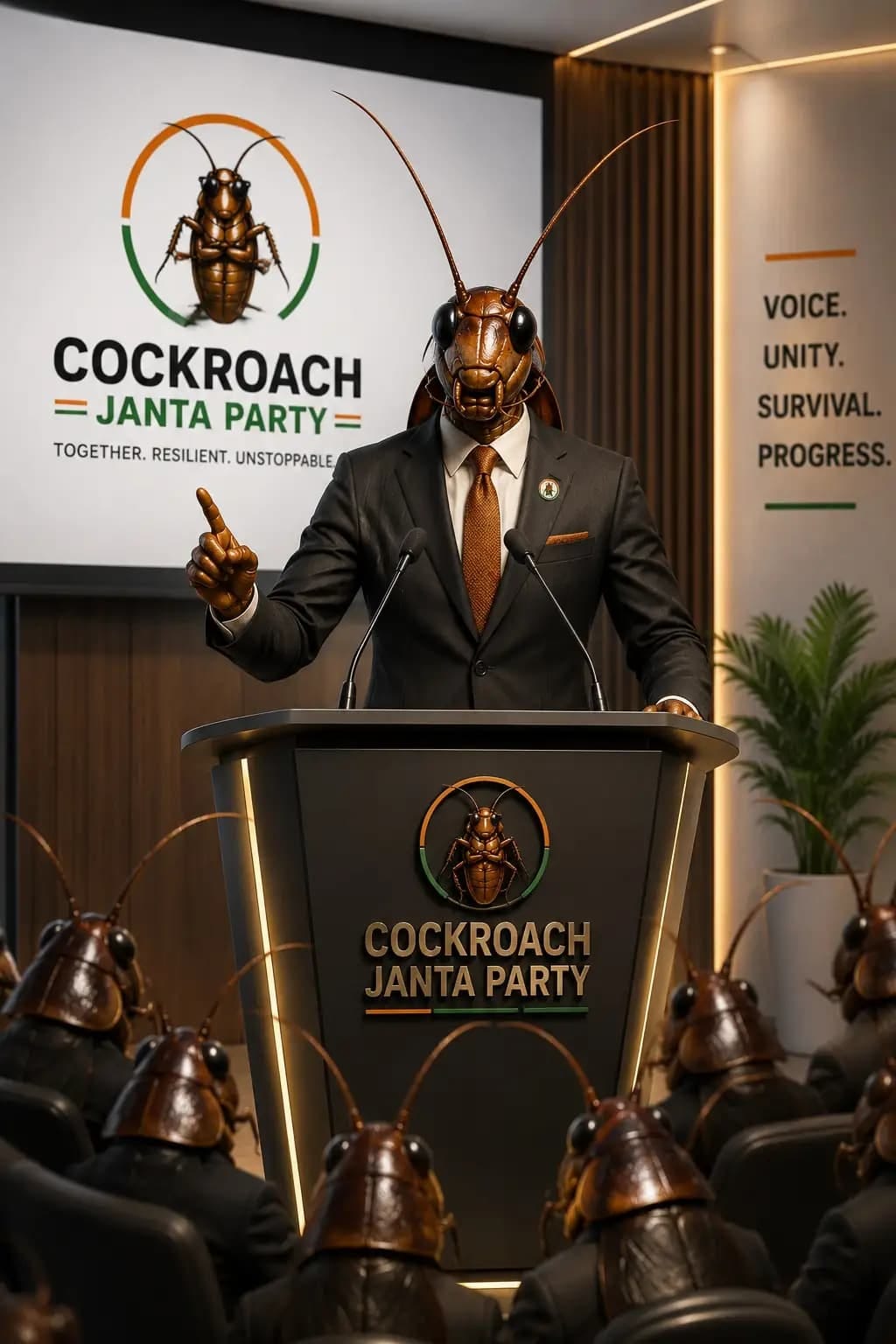
Editor’s Note: The Eurasia Review article we reproduce below— “The Cockroach Movement,” dated May 22, 2026 — shifts register but not diagnosis. It recounts the viral birth of the Cockroach Janta Party, literally the People’s Party of Cockroaches, a movement of unemployed Indian youth that, in five days, gathered fifteen million followers on Instagram after a Supreme Court judge compared jobless graduates to cockroaches. What could have remained a fleeting media storm has become a revelation: the “voice of the lazy and unemployed” is in fact that of a generation that studied, followed the rules, and then watched the system betray them. With over 70% of its members aged 19 to 25, the CJP is less a joke than a social verdict.
This anger does not emerge from a void. It extends — and embodies — the three dimensions of the latent crisis we have been documenting for months. The first was social and energy-related: the surge in cooking gas prices driving poor workers out of factories. The second, agricultural and climatic: El Niño and fertilizer shortages threatening harvests and food prices. The third, technological and material: AI-driven automation and dependence on Chinese components weakening skilled employment and the productive apparatus. Today’s article shows what these fractures produce when they converge in the daily lives of 20- to 24-year-olds, whose unemployment rate hovered around 44–45% in 2025. India’s growth, celebrated for its 6.8% GDP, has not created jobs for them. Education, meant to be the social ladder, no longer protects: 6.5% of secondary and higher education graduates are without work, and women graduates face unemployment rates of 40–44% in some states. Exam corruption (the NEET scandal) adds insult to injury: the places promised by merit are stolen even before the test. Abhijeet Dipke, the CJP founder now based in Boston, personifies the brain drain that these figures encapsulate.
The article links this revolt to the state of Indian democracy: a country ranked 157th out of 180 for press freedom, where media prefer to comment on GDP projections rather than give a voice to families selling their land to pay for coaching institutes. The Cockroach Movement does not merely fill a political void; it makes audible what part of the media and institutional ecosystem is striving to stifle.
Our previous note of May 13 concluded that India manages crises one after another, as they escalate. The emergence of the CJP signals that ad-hoc crisis management is no longer enough: the crises are morphing into a structured protest, carried by a generation that has learned to survive everything — like the cockroach thrown in their face. Those fifteen million Instagram followers may not be a revolution. But they are proof that Indian society, undermined by inequality and lack of opportunity, has now found a name, an emblem, and a volume that can no longer be ignored. /EN
The Cockroach Movement
Eurasia Review, Nimra Khalil, The Cockroach Movement – OpEd, 22 mai 2026
English - Deutsch – Italiano - Español - Français- Português

When India’s Chief Justice Surya Kant compared unemployed young people to cockroaches last week, he probably expected outrage, maybe an apology cycle, and then silence. What he got instead was fifteen million Instagram followers in five days, a logo of a cockroach on a mobile phone, and a movement that has already overtaken the ruling Bharatiya Janata Party’s own social media presence. The Cockroach Janta Party was born, and its viral rise is not a joke. It is a verdict.
The CJP calls itself the “Voice of the Lazy and Unemployed.” Its membership criteria include being chronically online and able to rant professionally. The irony is sharp and deliberate: these are not the qualities of people who gave up. These are the qualities of a generation that studied hard, followed the rules, and then watched the system fail them, and decided to say so loudly.
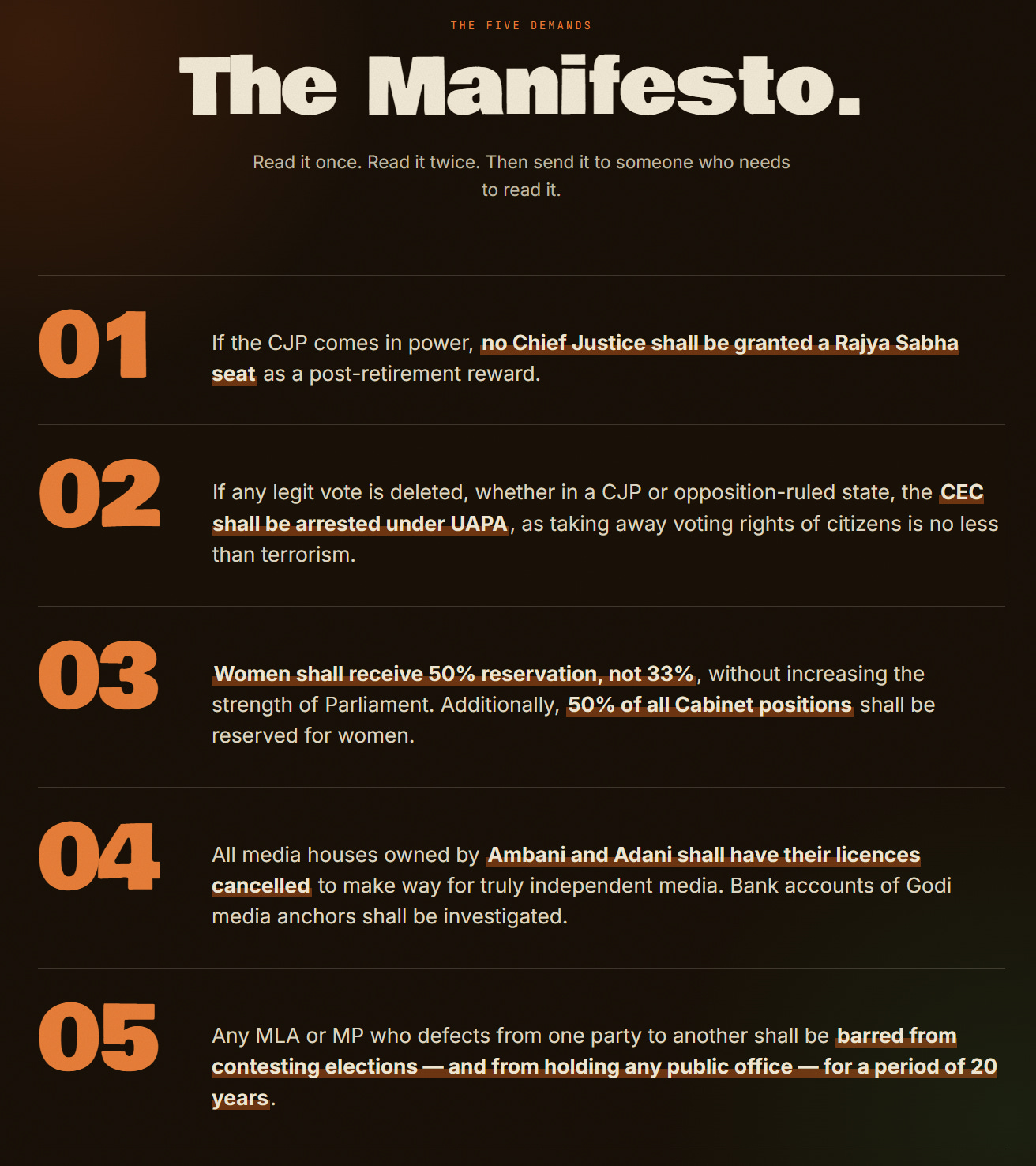
THE MANIFESTO.
(The Five Demands)
Read it once. Read it twice. Then send it to someone who needs to read it.
01
If the CJP comes in power, no Chief Justice shall be granted a Rajya Sabha seat as a post-retirement reward."
Explanation for a non‑Indian: In India, it is customary to appoint former chief justices to Parliament after their retirement. This demand calls for the abolition of that privilege.
02
If any legit vote is deleted, whether in a CJP or opposition-ruled state, the CEC shall be arrested under UAPA, as taking away voting rights of citizens is no less than terrorism.
Explanation for a non‑Indian: The CEC is the official in charge of conducting elections. The UAPA (Unlawful Activities (Prevention) Act) is an extremely stringent anti‑terrorism law, often criticised for its misuse. The manifesto threatens the Election Commission with the harshest law on the statute book in the event of electoral fraud or vote suppression.
03
Women shall receive 50% reservation, not 33%, without increasing the strength of Parliament. Additionally, 50% of all Cabinet positions shall be reserved for women.
Explanation for a non‑Indian: India has a (somewhat older) law that reserves 33% of seats for women in local and regional councils, but not in the national Parliament. This demand calls for an even higher quota – half of the government – to achieve genuine parity.
04
All media houses owned by Ambani and Adani shall have their licences cancelled to make way for truly independent media. Bank accounts of Godi media anchors shall be investigated.
Explanation for a non‑Indian: Mukesh Ambani and Gautam Adani are India’s two most powerful billionaires, owning media empires (newspapers, TV channels, etc.) often accused of supporting the current government. “Godi media” is an Indian political expression that literally means “media on the lap” – servile journalists who sit at the feet of power to please it.
05
Any MLA or MP who defects from one party to another shall be barred from contesting elections — and from holding any public office — for a period of 20 years.
Explanation for a non‑Indian: In Indian politics it is very common for politicians to change parties during a term in exchange for favours or money. This manifesto proposes an extremely heavy penalty (a 20‑year ban) to curb the practice.
India’s government would prefer you focus on the GDP number. At 6.3 to 6.8 percent projected growth for 2025-26, the economy is, by global standards, performing well. Prime Minister Narendra Modi has made this the centrepiece of his legacy, a rising India, a confident India, a India that will be the world’s third-largest economy by 2030. The headline growth figures conceal an economy that has failed to deliver broad-based opportunity.
Growth for Whom?
The latest data from the Centre for Monitoring Indian Economy tells a different story from the government’s headline figures. Youth unemployment among those aged 20 to 24 hovered around 44 to 45 percent for much of 2025, levels that are substantially worse than before 2014, when the current government came to power. Even the more conservative official measure, the Periodic Labour Force Survey, puts youth unemployment at 9.9 percent for the 15-to-29 age group, more than three times the general rate. In urban areas, the picture is bleaker still, with youth unemployment reaching 14.7 percent.
Education, which was supposed to be the great equaliser, has become an additional cruelty. Unemployment among Indians with secondary education and above stands at 6.5 percent, meaning that staying in school does not protect you from joblessness; it often just delays it at greater personal cost. For women, the numbers reach extremes: female youth unemployment hits 41 percent in Goa and 44 percent in Kerala, and nearly 40 percent among degree-holding women in Jammu and Kashmir.
This is the country the CJP’s 400,000 members signed up to criticise, more than 70 percent of them between the ages of 19 and 25.
Meanwhile, the wealth generated by India’s growth has flowed in a strikingly narrow direction. According to the Centre for Financial Accountability, the top one percent of Indians now control more than 40 percent of national wealth, while the bottom 50 percent survives on just 15 percent of national income. Between 2019 and 2025, the wealth of India’s richest 1,688 individuals grew by 227 percent, from roughly 31 lakh crore rupees to 88 lakh crore rupees. Household debt in the same period nearly doubled. India’s Gini coefficient for wealth concentration, at 0.74, now matches the United States, the comparison few in Modi’s government would welcome.
This is not coincidence. It is the result of policy choices: a growth model built around services and consumption, which generates GDP growth but not the mass employment that manufacturing once provided; tax structures that have concentrated gains at the top; and a persistent failure to invest at scale in the quality of education and job creation that an aspirational generation was promised.
When the System Eats Its Own Children
Nothing illustrates the institutional rot more clearly than the NEET examination scandal. In May 2024, approximately 2.4 million young Indians sat for NEET-UG, the sole nationwide gateway to medical education. The question paper had already been sold. In Bihar, police arrested 13 people who had allegedly charged students up to 50 lakh rupees, roughly $60,000, for advance access to the exam. A student whose family had sold land and taken on debt to fund coaching died by suicide after the NEET-UG 2026 exam was similarly cancelled over another paper leak.
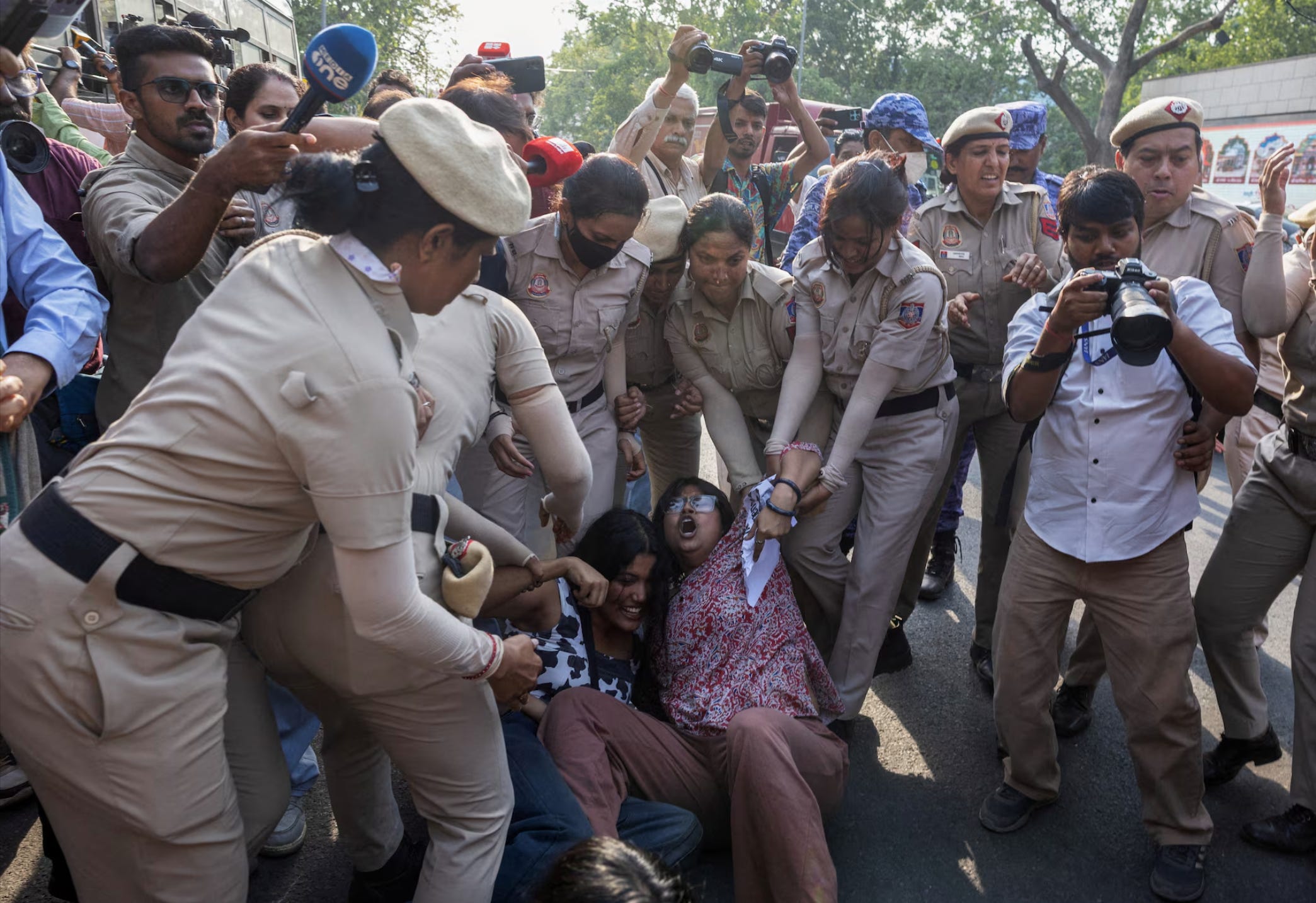
This is the system the Chief Justice was defending when he called unemployed youth cockroaches for holding “fake and bogus degrees.” The more honest question is: who ran the institutions that produced those degrees? Who administered the examinations that were leaked? Who built the economy that cannot absorb two million medical aspirants, let alone the hundreds of millions beyond them?
The CJP’s 30-year-old founder, Abhijeet Dipke, now based in Boston after leaving India two years ago, put it plainly to Reuters: “The youth of India has largely vanished from mainstream political discourse. Nobody is talking about us. Nobody is listening to our issues or even trying to acknowledge our existence.”
The brain drain embedded in that quote is itself data. Dipke is one of countless educated young Indians who concluded that the country’s future was not going to include them, and left.
A Democracy That Stopped Listening
India is, by law and by election, a democracy. It is also, by press freedom metrics, one of the more constrained media environments in the world. In the 2026 World Press Freedom Index published by Reporters Without Borders, India ranked 157th out of 180 countries. a six-place decline from 2025, and lower than Bangladesh, and Nepal. RSF cited rising violence against journalists, highly concentrated media ownership, and outlets with “increasingly overt political alignment.” The political indicator sub-score placed India 160th globally.
This matters for the CJP story for a specific reason: if India’s mainstream media were functioning as an accountability mechanism, it would not have taken a viral meme movement to put youth unemployment, exam leaks, and financial insecurity onto the national agenda. These issues have been visible for years. They were made invisible by a media ecosystem that found it more comfortable to broadcast GDP growth projections than to interview the families selling land to send their children to coaching institutes.
The CJP’s platform, covering everything from media independence to demanding that half of parliament seats be reserved for women, reads less like a party manifesto and more like a list of things that a functioning press should already have been demanding of government.
What the Cockroach Symbolises
It is worth pausing on the name itself. The cockroach, in popular imagination, is the creature that survives everything, nuclear winters, institutional failure, elite contempt. When the Chief Justice reached for that image as an insult, the young people it was directed at heard something different: a description of what they had already become. Resilient, persistent, impossible to exterminate.
Dipke cautioned against comparison to the Gen Z-led protests in Bangladesh and Nepal that recently toppled governments. That caution is worth respecting, movements that begin on Instagram do not automatically become political revolutions. Whether the CJP converts fifteen million followers into sustained pressure, or becomes a case study in the limits of digital dissent, remains to be seen.
But the underlying conditions that created it are not going away. Artificial intelligence is already beginning to displace entry-level roles in India’s back-office and services sectors, the employment buffer that absorbed millions of educated workers who could not find manufacturing jobs. The exam pipeline is leaking. The housing market is pricing out a generation. The media is concentrated. The wealth is concentrated. And a Supreme Court judge, speaking from the heights of the institution designed to protect citizens, reached for the word “cockroach.”
India’s government should be less concerned about fifteen million Instagram followers and more concerned about what those fifteen million people are describing. They are not wrong about what they see. They are just the first generation willing to say so at a volume that cannot be ignored.
Why “Janta” and not “Janata”?
A linguistic break that is no mistake
If, in official or historical vocabulary, you hear of the “Janata Dal” (an Indian political party from the 1990s) or the Bharatiya Janata Party (Narendra Modi’s BJP, or Indian People’s Party), that name means “The People” in classical, respectful Hindi.
But the CJP (Cockroach Party) deliberately uses “Janta”:
Janta is a popular, colloquial variant, often considered “misspelled” in standard Hindi.
The choice is strategic: by using it, the CJP rejects the old historical parties (the “Janatas”), which it accuses of being corrupt, slick and out of touch.
The intended image: Janta sounds like the voice of the street, of chaos, of raw, working-class India. It is a word that smells of tarmac, not the plush corridors of Parliament.
The parallel with their name: just as “Cockroaches” (the English term used in everyday Indian speech rather than the Hindi word tilchata) claims the image of a resilient, invisible insect, Janta claims the image of a noisy, imperfect and unpredictable people.
In short: when the “Cockroaches” say Janta, they are saying: “We are not yesterday’s politicians. We are the real people, without the manners.”
All our publications are free and Copyleft. They may be republished, in whole or in part, under following conditions:
→ keeping the title and content
(text, images, editor’s or translator’s notes, boxes)
→ crediting the author(s) and/or translator(s)
→ inserting a clickable link to the source.
Any monetization or commercial use of these publications is prohibited and will be subject to legal action.