
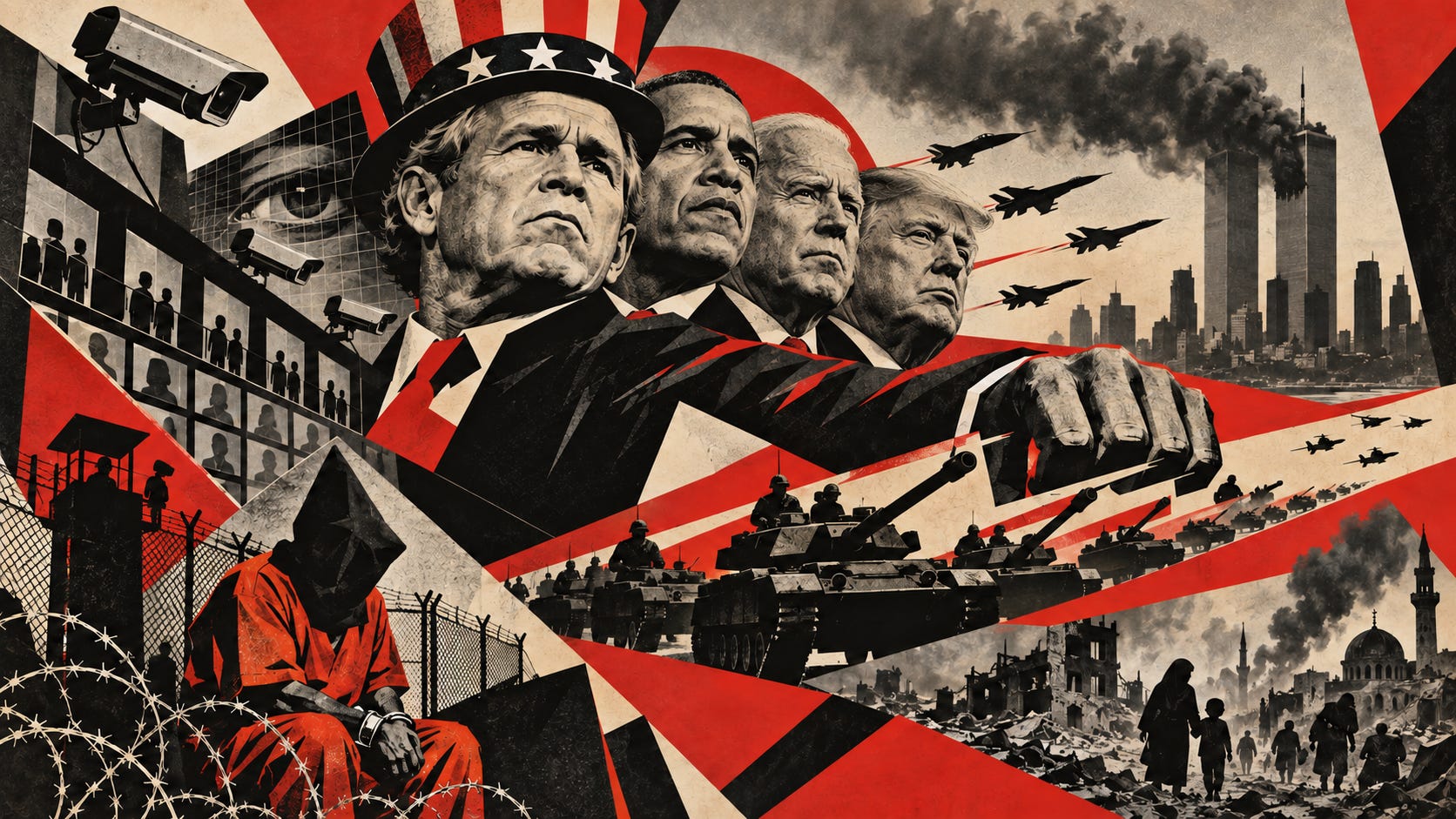
“This century was one year old.” It was a Tuesday, and those who lived through it, closely or from afar, still remember it as if it were yesterday. Suddenly, on every screen on the planet, huge plumes of smoke were seen rising from the Twin Towers of the World Trade Center in New York. In the Global South, from Mexico City to Kuala Lumpur by way of Nablus, the reaction of the populations who make up the majority of humanity was one of jubilation, sometimes public and loud, sometimes quiet and private. The Big Apple was finally living through a hell until then reserved for the wretched of the earth. In Paris, a child born under the tent of a makeshift camp set up by Malian families seeking housing, facing the town hall of the 18th arrondissement, had been given the first name Osama, in honor of bin Laden, identified as the mastermind of the operation. Faced with this, the right-thinking classes of the First World proclaimed, along with Jean-Marie Colombani: “We are all Americans” (Le Monde editorial of September 13, 2001)
Twenty-five years after the September 11, 2001 attacks, one may well ask what they truly changed in the world, and how far their reach really extends.
CONTENTS
● What September 11 Changed
● Legal and Security Consequences
● The Military Commissions Act
● Geopolitical Consequences
● Links to Genocides and Asymmetric Wars
● USS Maine, Pearl Harbor, the Gulf of Tonkin, September 11: A Common Mechanism
● A Few Final Words (For Now)
● Boxes: The Khalid Sheikh Mohammed File & What Became of the Guantánamo Detainees?
What September 11 Changed
The most lasting change concerns the legal and security architecture built in the months following the attacks: the Patriot Act, mass surveillance, indefinite detention, targeted killings, Guantánamo. International law itself was redefined, with an expansion of the right to self-defense under Article 51 of the UN Charter to cover attacks by non-state actors, and the development of the so-called “unwilling or unable” host-state doctrine, which authorizes the use of force on the territory of a third state deemed unable or unwilling to act against a threat. This legal order continues to structure conflicts far removed from the context of 2001.
Legal and Security Consequences
● The USA PATRIOT Act (October 2001): a considerable expansion of the surveillance and investigative powers of federal agencies
● Creation of the Department of Homeland Security (2002)
● Opening of the Guantánamo detention center (January 2002) to hold suspects captured outside US territory, outside ordinary law and, in part, outside the law of war
● The CIA’s “black sites” program and the use of interrogation techniques amounting to torture (revealed in particular by the 2014 US Senate report)
● A massive strengthening of electronic surveillance, revealed later by the Snowden documents (2013)
● Passage of the Military Commissions Act (MCA)
The Military Commissions Act (MCA)
The MCA was a direct response by Congress and the Bush administration to a major judicial defeat. In its ruling on Hamdan v. Rumsfeld (June 29, 2006), the Supreme Court rejected the president’s creation of military commissions by mere executive order, recognized the right of detainees held by the United States at Guantánamo to challenge their detention before federal courts, and held that these commissions violated both the Uniform Code of Military Justice and the Geneva Conventions, in particular Common Article 3, which imposes minimum fair-trial guarantees even on combatants who do not qualify for prisoner-of-war status. The ruling also implicitly established that the CIA’s abusive interrogation techniques violated international law and that CIA personnel could be held criminally liable for these abuses, which spurred the administration’s determination to legislate quickly.
Passage and Content (2006)
The US Congress passed the Military Commissions Act on September 28, 2006, and it was signed into law by Bush on October 17, 2006. The text went well beyond simply creating military tribunals: it touched on the role of US courts in protecting detainees’ fundamental rights, the application of the Geneva Conventions in US law, and the criminal prosecution of abuses committed by US officials. Human Rights Watch
Among its most contested provisions:
● Suspension of habeas corpus: it barred detainees classified as enemy combatants, or awaiting a hearing on that status, from using habeas corpus to challenge their detention before federal courts
● A departure from ordinary military justice rules: the text authorized commissions whose procedures diverged from the standard rules of the Uniform Code of Military Justice, notably rejecting the right to a speedy trial and allowing a trial to proceed in the accused’s absence
● Presidential interpretation of the Geneva Conventions: the text gave the president the power to interpret for himself the scope of Common Article 3
● Admissibility of evidence obtained under coercion, under certain reliability conditions, which was one of the points most criticized by human rights organizations
Partial Invalidation: Boumediene v. Bush (June 2008)
The provision barring foreign detainees designated as enemy combatants from challenging their detention before federal courts was subsequently challenged successfully in Boumediene v. Bush, in which the Supreme Court ruled in 2008 that it unconstitutionally suspended the writ of habeas corpus. But, as the Center for Constitutional Rights points out, while Boumediene invalidated the habeas corpus provision, several of the MCA’s most problematic provisions remained in force, notably those governing the rules of evidence and the very functioning of the commissions. Encyclopedia Britannica
The 2009 Revision
Under the Obama administration, a revision (folded into the National Defense Authorization Act for 2010) tightened the rules on the admissibility of evidence obtained under coercion, strengthened defense rights (access to counsel, restrictions on the use of hearsay), and changed the terminology of “unlawful enemy combatant.” The institutional framework of the military commissions itself, however, was retained, and was not replaced by ordinary federal courts, contrary to what human rights advocates had hoped.
Relevance Today
It is precisely within this legal framework, that of the military commissions established by the 2006 MCA and revised in 2009, that the case of Khalid Sheikh Mohammed and his co-defendants is still unfolding, a quarter of a century after the events, with the trial having just been set for June 5, 2028 [see below]. The long-standing criticisms of the admissibility of evidence potentially linked to torture, mentioned above about the procedural deadlock, find their direct origin in the architecture set up by this text.
Geopolitical Consequences
Geopolitically, the US response unfolded in two waves. The first centered on the invasion of Afghanistan and then Iraq, and on the overhaul of internal and border security systems around the world. The second, after the Arab Spring and the emergence of ISIS, combined the expansion of military campaigns in the Middle East with massive migratory flows toward Europe and the United States. The political backlash that followed in the West (xenophobia, migration restrictions, the rise of “cross-cutting” populisms) is the direct echo of this second wave.
The war launched in 2001 was never formally brought to a close. It expanded as US troops invaded Afghanistan and then Iraq in 2003, while counterterrorism operations spread across the Middle East, Africa, and elsewhere. The human cost remains considerable on both sides: several million dead and displaced in the countries targeted, tens of thousands of US soldiers killed or scarred for life.
For the Arab-Muslim world and, more broadly, for the Global South, the most lasting effect is perhaps not this or that war but the normalization of a “war on terror” vocabulary taken up by numerous states to justify the repression of their own opponents. This transfer has fueled, well beyond al-Qaeda, a persistent distrust of the international order dominated by Washington.
The clash-of-civilizations scenario predicted by some as early as 2001 did not come to pass. The jihadist movement outlived its founders, its caliphate, and most of the forecasts of its demise, but it shifted toward Africa rather than sustaining a planetary war of religion, and it ceased to be the organizing priority of the foreign policy of major and middle powers. The world that emerged has, contrary to the expectations of 2001, once again become a world of rivalries between states: the United States, China, Russia, India, and various regional powers.
Links to Genocides and Asymmetric Wars
Three types of links, of different natures, connect September 11 to the mass violence of the last two decades.
A Direct Lineage: Iraq, the Islamic State, the Yazidi Genocide.
The 2003 invasion of Iraq, decided in the name of the war on terror, caused the collapse of the Iraqi state, the dissolution of its army, and the political exclusion of the Sunni minority, fertile ground for the insurgency from which al-Qaeda in Iraq, and then the Islamic State (ISIS), was born. In 2014, ISIS waged a campaign of extermination, sexual enslavement, and forced displacement against the Yazidis of Sinjar, formally recognized as genocide by a UN commission of inquiry, the European Parliament, and several national parliaments. The war launched in response to September 11 here directly engendered, through a fairly traceable chain of events, one of the most documented genocides of the century, perpetrated by one of the non-state actors born of the post-invasion chaos.
A Spread of Vocabulary and Political License.
After 2001, the label of counterterrorism became an available language that several states adopted to legitimize repression already brewing or under way against minorities. China explicitly invoked this rhetoric to justify the mass internment of Uyghurs in Xinjiang, which the United States, Canada, and several parliaments have described as genocide, a characterization Beijing disputes. Myanmar presented its 2016 and 2017 operations against the Rohingya as a response to insurgent-type attacks. In November 2019, Gambia, acting with the support of the Organisation of Islamic Cooperation, brought a case against Myanmar before the International Court of Justice under the Convention on the Prevention and Punishment of the Crime of Genocide. The United States, for its part, formally designated these atrocities as genocide in 2022. The Court rejected Myanmar’s jurisdictional objections in 2022, held hearings on the merits in January 2026, and is expected to hand down its judgment sometime this year.
A Doctrinal Legacy Directly Invoked Today: Gaza.
Since 2001, a legal-military arsenal has taken shape: expanded self-defense against non-state actors, the “unwilling or unable” host-state doctrine, targeted killings, war against groups embedded within civilian populations. Israel explicitly linked its conflict with Palestinian factions to this vocabulary in the immediate aftermath of September 11, and this framework is directly invoked in the debate over Gaza today. South Africa brought a case before the International Court of Justice at the end of December 2023 under the Genocide Convention. The Court ruled in January 2024 that it was plausible that Palestinians have a right to protection from acts of genocide, and ordered provisional measures. Israel disputes the Court’s jurisdiction and rejects the characterization, presenting the conflict as a self-defense operation against an organization it describes as terrorist. The case remains at the written-pleadings stage, with Israel having filed its counter-memorial in March 2026, a reply and rejoinder expected through 2029, and no ruling on the merits expected for several years. Amnesty International, several UN special rapporteurs, and some genocide-law scholars believe the threshold has already been crossed, including after the October 2025 ceasefire; the United States supports Israel’s position in the proceedings. This is an unresolved dispute. The fact that both sides are contesting precisely on the conceptual terrain forged after 2001 (self-defense against a non-state actor, the threshold of genocidal intent, proportionality in dense urban areas) illustrates this doctrinal continuity.
The Spread of Asymmetric Warfare.
Beyond the cases labeled genocide, September 11 established as the dominant model warfare against non-state armed groups blended “like fish in water” into civilian populations: Yemen, the Sahel, Somalia, Syria, Libya, Sudan. This paradigm normalized drone strikes, collateral damage, and a loose reading of the principle of distinction in humanitarian law — a weakening of civilian protections that several legal scholars consider one of the most lasting and least discussed consequences of the era opened in 2001.
USS Maine, Pearl Harbor, the Gulf of Tonkin, September 11: A Common Mechanism
Each of these four episodes served as the official trigger for a decision to go to war or to escalate significantly, reached in haste and with minimal political or parliamentary oversight, on the basis of an initial account that later proved incomplete or inaccurate.
The USS Maine, a US warship sunk in 1898 in the port of Havana, then under Spanish sovereignty, was immediately attributed by the Hearst and Pulitzer yellow press to a Spanish mine, under the slogan Remember the Maine. Congress voted to enter the war against Spain on this basis. Later technical investigations, notably the one conducted under the authority of Admiral Hyman Rickover in 1976, concluded that the explosion was very likely accidental — a fire in a coal bunker having reached a munitions magazine — with no connection to Spanish sabotage. This is the clearest case of a causal narrative fabricated after the fact to justify a war that part of public opinion and the press already wanted.
The first Gulf of Tonkin incident, on August 2, 1964, a real clash between the USS Maddox and North Vietnamese torpedo boats, did indeed take place. The second, on August 4, on the basis of which Congress passed the resolution authorizing Johnson to wage war without a formal declaration, rests on sonar and radar data now considered by most historians, on the basis of declassified NSA documents, to have been misread. The attack did not happen as reported to Washington, and some officials already doubted it at the time.
Pearl Harbor and September 11 fall into a different category. In both cases, these were real attacks carried out by a clearly identified foreign actor, documented in extremely fine detail by independent inquiries (congressional commissions on Pearl Harbor, the 9/11 Commission, NIST reports on the collapse of the towers). Theories claim that the Roosevelt administration knew in advance and let it happen, so as to tip a public opinion largely opposed to US entry into the war, but these remain minority views and rest on evidence far weaker than that documenting the fabrication of the second Tonkin incident or the misattribution of the Maine explosion. Their character as orchestrated events continues to give professional and amateur historians (and citizens) plenty to chew on.
The true common thread between these four episodes lies in their mechanism. All of them served to accelerate and legitimize, in urgency and emotion, courses of action that segments of the state apparatus had already begun to prepare or to want well before the event itself occurred: US colonial expansion in the Caribbean was already being discussed before the Maine explosion; entry into the war against the Axis was becoming increasingly likely before Pearl Harbor despite the dominant isolationism in public opinion; the escalation in Vietnam had already been planned by the Johnson administration before Tonkin; and the interest of certain circles within the Bush administration in regime change in Iraq predated September 11.
A Few Final Words (For Now)
Above all, September 11 supplied a vocabulary and a legal-military arsenal that various actors continue to mobilize for their own ends, well beyond the initial context. This legacy weighs directly on certain conflicts (Iraq, Gaza), more indirectly on others (Xinjiang, Rakhine[1], and for a time Darfur). It belongs to a longer series of US casus belli whose political function has always mattered more than the accuracy of the initial account. In 2026, more than ever: “No, we are not all Americans.”
The Khalid Sheikh Mohammed File
Identity and Profile
Khalid Sheikh Mohammed (KSM), a Pakistani raised in Kuwait, was one of Osama bin Laden’s principal lieutenants within al-Qaeda. He presented himself before a military tribunal as responsible “from A to Z” for the September 11 operation, and also claims responsibility for other operations, including al-Qaeda-linked attacks in Bali and Kenya, as well as the murder of American journalist Daniel Pearl in Pakistan.
Capture and Detention
Capture. March 2003, in Rawalpindi (Pakistan). The photograph taken on the night of his arrest, disheveled and in white pajamas, remains his best-known image.
CIA detention (2003-2006). Held in secret CIA prisons, notably in Poland, where he was subjected to waterboarding 183 times over the course of four weeks.
Transfer to Guantánamo. September 2006, where he has been held ever since.
Charges
Charged, along with his co-defendants, with “terrorism” and the murder of nearly 3,000 people (the precise figure used by the prosecution is 2,753 victims) in the attacks carried out on US soil.
Co-defendants at the 2028 Trial
Four men will be tried together, among the very last 15 detainees at Guantánamo: Khalid Sheikh Mohammed; Walid Muhammad Salih Mubarak bin Attash; Mustafa Ahmed Adam al-Hawsawi; and Ali Abdul Aziz Ali, also known as Ammar al-Baluchi.
Procedural History
June 2008. A first military trial opens; KSM refuses court-appointed counsel and states that he wants “to be a martyr.”
January 2009. Barack Obama, newly inaugurated, requests the suspension of all military commission proceedings.
May 2012. Formal arraignment of the five original defendants.
May 2016. Revelations that a US Army colonel deliberately destroyed evidence intended for KSM’s defense.
2019. Judge Shane Cohen sets an initial trial date of January 11, 2021, a date that will never be met.
2024. Plea agreements are negotiated: KSM and two co-defendants plead guilty in exchange for life imprisonment, which would spare them the death penalty.
August 2024. Defense Secretary Lloyd Austin revokes these agreements, under pressure from Republican critics and victims’ families.
July 2025. A US appeals court definitively invalidates the plea agreements.
August 26, 2026. Military judge Michael Schrama rejects the January 11, 2027 date proposed by the prosecution, deeming it unrealistic, and sets the trial for June 5, 2028.
The Central Legal Knot
The two-decade-long procedural deadlock essentially comes down to a single question: are confessions and incriminating evidence obtained under torture or coercion admissible? The defense demands their outright exclusion; the judge ruled that this question had to be settled before any trial could open, which accounts for the postponement to 2028.
What Became of the Guantánamo Detainees?
The Scale of the Phenomenon
Since the center opened on January 11, 2002, some 780 men and teenagers have passed through it, almost all Muslim, from roughly fifty countries. The population peaked at around 660 to 680 detainees in 2003, before beginning a nearly continuous decline.
The Four Main Trajectories
1. The very large majority were transferred or released without trial
More than 750 of the roughly 780 men ever detained were ultimately returned to their country of origin, or resettled in a third country when such a return was deemed dangerous for them. Detention periods ranged from a few years to more than two decades for some. This movement occurred in highly uneven waves depending on the administration.
Under George W. Bush. More than 500 releases.
Under Obama (2009-2017). The population fell from 242 to 41 detainees, with 197 additional transfers.
Under Trump, first term. A near-total halt to transfers: only a single detainee transferred in four years.
Under Biden. A new wave of transfers, with a notable gesture in January 2025: eleven detainees sent to Oman just days before the end of his term, bringing the population down to 15 men.
2. Only a handful were ever tried
Contrary to the image often associated with Guantánamo, very few detainees actually appeared before the military commissions. Some were convicted by guilty plea as early as the 2000s; the most emblematic case remains that of Ali Hamza al-Bahlul, sentenced to life in 2008, some of whose charges were later invalidated on appeal. The case of Khalid Sheikh Mohammed and his co-defendants illustrates, by contrast, the extreme slowness of this judicial mechanism.
3. Indefinite detention without charge for some
This is the most legally contested category: men never formally charged with a crime, but held in detention under the law of war (law-of-war detention), on the basis of “enemy combatant” status rather than a criminal proceeding.
4. Deaths in detention
Nine deaths have been recorded over the years within the center, including several suicides, among them the triple suicide of June 2006, which sparked fierce international controversy.
The Current Situation (2026)
Guantánamo entered its 25th year of existence in January 2026. Fifteen men are held there today, aged roughly 46 to 64, from Afghanistan, Indonesia, Iraq, Libya, Pakistan, Saudi Arabia, Somalia, and Yemen among other countries, along with a stateless Rohingya man and a Palestinian. Their legal statuses fall into three groups: a small number formally approved for transfer and awaiting its execution, a larger group charged or convicted under the military commissions, including the four defendants in the September 11 case, and a handful held indefinitely without charge or any recommendation for release.
Failed Attempts at Closure
Obama, from his inauguration in January 2009, had ordered the center’s closure, a goal never achieved, largely because of restrictions passed by Congress barring the transfer of detainees to the US mainland. Biden took up this goal again at the end of his term, without fully achieving it either.
A Recent and Separate Use of the Base
Since 2025, the second Trump administration has also been using part of the Guantánamo base as a temporary transit site for migrants awaiting deportation, an arrangement entirely separate from the “war on terror” detainees, with occupancy that has so far remained well below the announced capacity (several hundred spaces, for a project initially presented as potentially reaching 30,000).
[1]Rakhine (formerly called Arakan) is a state in western Myanmar (Burma), on the Bay of Bengal, bordering Bangladesh. Its capital is Sittwe. It is a kingdom that existed independently for centuries before being annexed by the Burmans in 1785, which explains a regional identity that remains marked today. Its population is predominantly Buddhist and ethnically Rakhine, but it also included a significant Rohingya Muslim minority, concentrated in the north of the state near the Bangladeshi border. It was this minority that Myanmar’s 1982 citizenship law stripped of nationality, rendering it stateless, and that the Myanmar army targeted during the 2016 and 2017 operations referred to in the article: more than 700,000 people fled to Bangladesh, where most have since lived in vast camps near Cox’s Bazar. It is this same campaign that is the subject of the Gambia v. Myanmar case before the International Court of Justice.
All our publications are free and Copyleft. They may be republished, in whole or in part, under following conditions:
→ keeping the title and content
(text, images, editor’s or translator’s notes, boxes)
→ crediting the author(s) and/or translator(s)
→ inserting a clickable link to the source.
Any monetization or commercial use of these publications is prohibited and will be subject to legal action.