

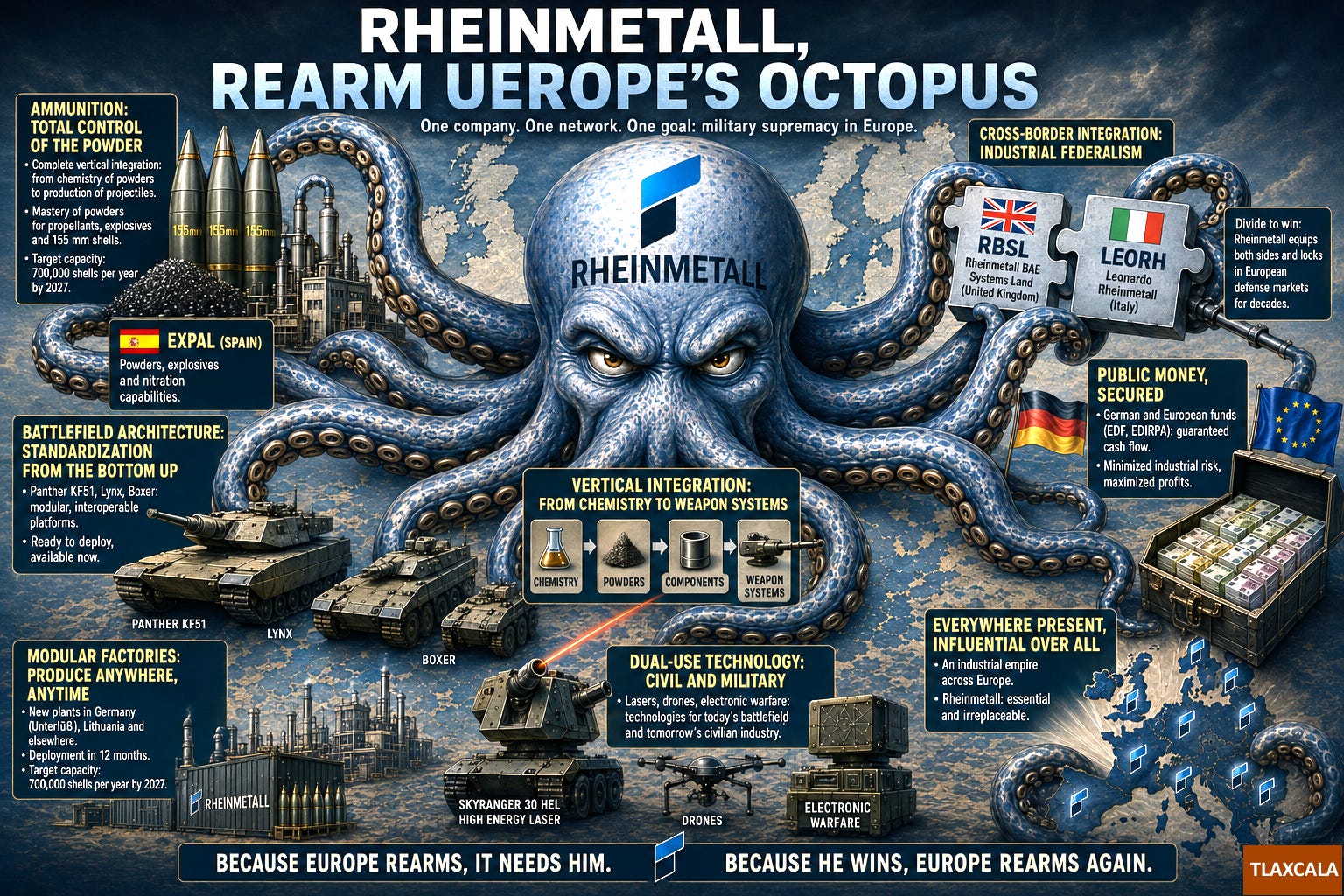
DOSSIER-PORTRAIT OF RHEINMETALL
Place within the ReArm Europe/Readiness 2030 framework.
All production sites.
Rheinmetall’s offensive products: a small catalogue
Rheinmetall and Israel
Mobilisations against Rheinmetall
Bonus
V. Rheinmetall’s Role in the ReArm Europe/Readiness 2030 Framework
The ReArm Europe plan (renamed READINESS 2030), presented by the European Commission in March 2025 and endowed with €800 billion, places Rheinmetall in an undisputed leadership position on the continent and elevates the group from the status of a mere supplier to that of an “army general staff architect.”
Before 2022, Rheinmetall was an equipment manufacturer. Today, it is the integrator that dictates current and future standards: in the short term, it absorbs budgets allocated to ammunition; in the medium term, it locks in armoured vehicle platforms; in the long term, it imposes its electronic and laser architectures.
Its dominance is such that other European industrial players (KNDS, Leonardo) are forced to cooperate with it on pain of being excluded from NATO-led tenders. Rheinmetall captures a disproportionate share of the €800 billion, not because it is the cheapest, but because it is the only one offering a fully intra-European supply chain (avoiding dependencies on the US, South Korea or Israel), which precisely matches the geopolitical DNA of “Readiness 2030.”
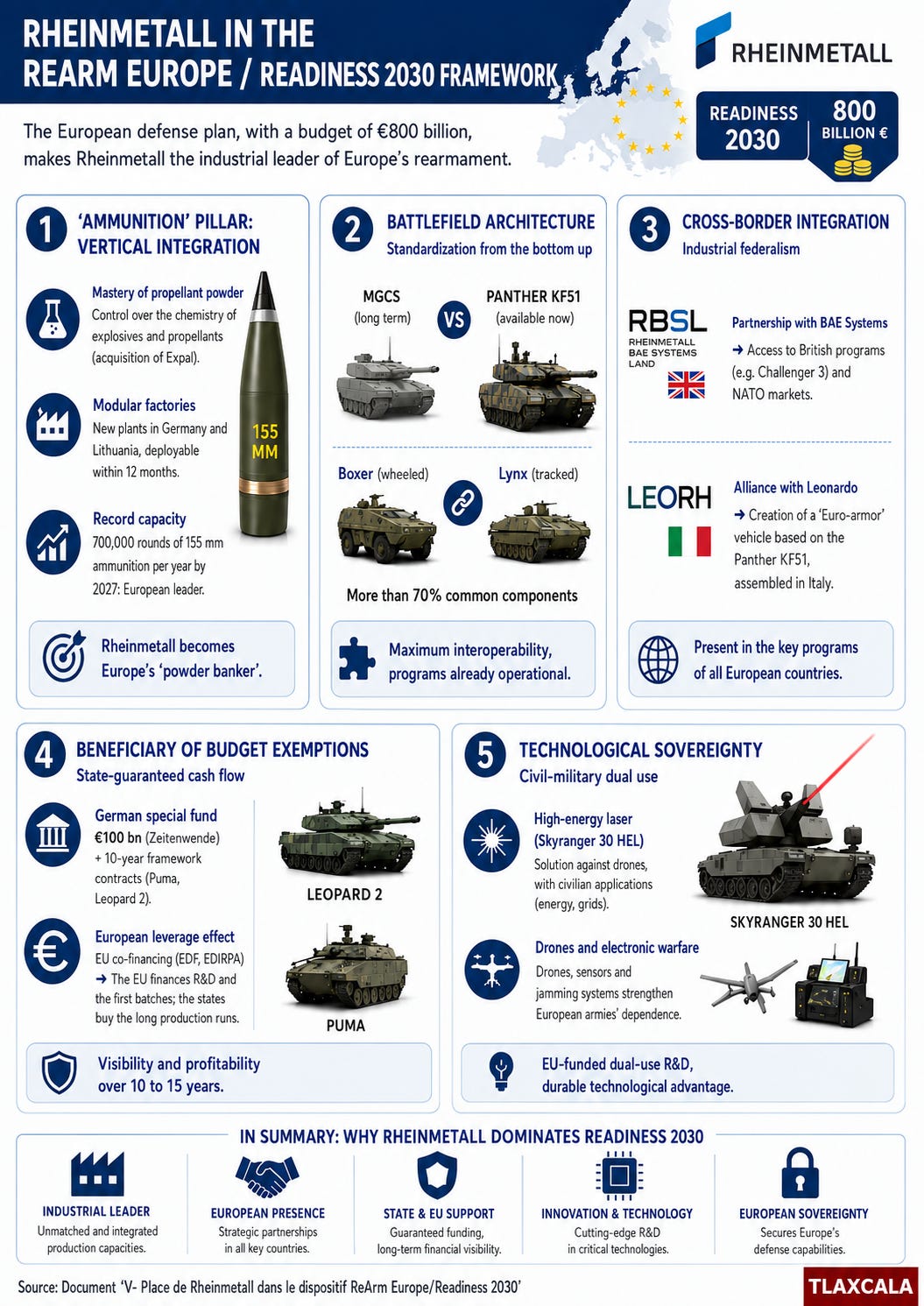
1. “Munitions” Pillar: Vertical integration as a trump card
The propellant powder bottleneck: In a high-intensity conflict (such as in Ukraine), the shortage of propellant powder and explosives is the limiting factor, far more than steel. Rheinmetall has understood that to produce 155 mm shells, one must master nitrocellulose chemistry.
The acquisition of Expal (Spain): This purchase targets not only production lines but also historical patents for double-base powders and nitration capacities. This gives Rheinmetall exclusive access to production capacities outside Germany, thereby bypassing local administrative red tape.
New plants (Unterlüß and Lithuania): The group is not simply expanding factories; it is building “modular plants” (in containers) that it can deploy within 12 months. This enables a production ramp-up to 700,000 shells per year by 2027 – a capacity greater than that of all its European competitors combined (Nammo, Nexter, BAE). It becomes Europe’s “powder banker”, without whom the Readiness 2030 plan is merely wishful thinking.
2. Battlefield Architecture: Standardisation from the bottom up
The MGCS vs. Panther KF51 duel: Officially, Rheinmetall is a partner in the MGCS (with KNDS). Unofficially, the group is pushing its Panther KF51 as a “ready-to-use” alternative to the MGCS, which will not arrive before 2040. ReArm Europe, by facilitating joint procurement, creates a market for the Panther right now.
The Boxer and Lynx as “Lego bricks”: The European plan promotes interoperability. The Boxer (wheeled) and Lynx (tracked) share more than 70% of their electronic components and powerpacks. In Italy, under the A2CS (Armored Infantry Combat System) programme with Leonardo, Rheinmetall imposes its Lynx as the reference chassis. This locks in the Italian market for 20 years, as any future evolution will have to be compatible with the technical standard imposed by Rheinmetall.
3. Cross-border integration: “Industrial federalism”
The European plan encourages strategic joint ventures. Rheinmetall is the champion of this model. It pursues a strategy of “multi-nationalisation” to absorb national budgets while meeting European criteria for industrial returns (offsets).
RBSL (Rheinmetall BAE Systems Land – UK): By partnering with British BAE, Rheinmetall enters through the back door into the British Challenger 3 programme (it supplies the turret). This allows it to capture British funds outside the EU while using this plant to produce armoured bridge-layers for NATO.
LEORH (Leonardo-Rheinmetall): This is the geopolitical masterstroke. By signing this agreement, Rheinmetall absorbs Leonardo’s armoured vehicle branch (the heir to Oto Melara). Objective: to create a “Euro-tank” (Italy’s future main battle tank) based on the Panther KF51, but assembled in Italy. This splits the European stage into two blocs: KNDS (France-Germany for the MGCS) and LEORH (Italy-Germany for the Panther). Rheinmetall exploits Franco-Italian rivalries to ensure that, regardless of which programme wins, its powertrain and fire-control system will equip both camps.
4. Beneficiary of budgetary exemptions: State-guaranteed “cash flow”
The national safeguard clause activated by ReArm Europe allows Germany to place massive orders without debt limits. The Bundeswehr’s €100 billion special fund (Zeitenwende), combined with European funds, guarantees outlets for 10 to 15 years for Rheinmetall’s high-end products.
The national safeguard clause: In Germany, the “debt brake” (Schuldenbremse) is circumvented through the activation of Article 109 of the Basic Law in the event of a military threat. Concretely, the Zeitenwende special fund (€100 billion) is already budgeted. Rheinmetall has signed 10-year framework contracts for the maintenance of the Puma and Leopard 2, guaranteeing it a floor turnover (approx. €2.5 billion/year) independent of political uncertainties.
The European leverage effect: ReArm Europe allows states to use European funds (via the EDF and EDIRPA) to co-finance group purchases. Rheinmetall structures its bids so that the EU pays for R&D and the first production batch, while states pay for the long series. This reduces its financial risk and allows it to invest in massive forging and foundry capacities (for the 130 mm cannons) without impacting its profitability.
5. Technological sovereignty: Civil-military duality as a bulwark
The plan finances dual-use R&D. Rheinmetall is investing heavily in the high-energy laser (Skyranger 30 HEL), drones and short-range air defence – sectors flagged as priorities by the EU in the European Defence Fund.
The high-energy laser (Skyranger 30 HEL): This is not just a weapon; it is a mobile power plant. By mastering cooling and high-capacity battery power generation, Rheinmetall is filing patents usable for both combat drones and civilian smart electricity grids. ReArm Europe targets this sector because it is the only solution against low-cost drone swarms.
Drones and warfare electronics: The Readiness 2030 plan requires open systems (OSD – Open Standard Digital). Rheinmetall has acquired AI start-ups (such as Helsing in part) to integrate autonomous decision-making capabilities into its turrets. This allows it to charge not for tonnes of steel but for software licences (OTA updates) over the lifespan of armoured vehicles, transforming its business model into that of a defence software publisher.
Synthesis: From supplier to “General Staff Architect”
Before 2022, Rheinmetall was an equipment manufacturer. Today, it is the integrator that sets the standards:
It absorbs munitions budgets (short-term flow).
It locks in armoured platforms (medium-term flow).
It imposes its electronic and laser architectures (long-term flow).
Its dominance is such that other European industrial players (KNDS, Leonardo) are forced to cooperate with it on pain of being excluded from NATO tenders. Rheinmetall captures a disproportionate share of the €800 billion, not because it is the cheapest, but because it is the only one offering an entirely intra-European supply chain (avoiding US, South Korean or Israeli dependencies), which corresponds precisely to the geopolitical DNA of “Readiness 2030”.
The limit of this model: This concentration of capabilities on a single actor creates a “single point of failure” risk [see note below]. If a Rheinmetall plant is bombed or catches fire, 60% of European artillery capabilities collapse. The EU, by making Rheinmetall its champion, has knowingly accepted this systemic risk to gain immediate responsiveness.
Note
A “single point of failure” designates a unique element whose failure causes the collapse of an entire system (= “putting all one’s eggs in the same basket”). In the case of Rheinmetall, this group has become this single link in the chain for European artillery. If its powder plant explodes, Europe loses 60 to 70% of its capacity to produce 155 mm shells. If a hacker paralyses its onboard software, all Boxer and Lynx armoured vehicles spread across several countries become blind and immobile. If its specialised foundry for 130 mm cannons is damaged, the future Panther tank is delayed by two years. The EU is fully aware of this risk, but believes it has no choice. Before 2022, Europe had no large-scale production capacity whatsoever and relied entirely on the Americans, Israelis and South Koreans. It therefore prefers to have a concentrated capacity rather than zero capacity. In peacetime, a single plant is simpler and cheaper to finance, and in wartime, it is hoped that anti-aircraft shields will suffice to protect it. This is the risky bet of “putting all its eggs in the same basket” that Europe is currently making with Rheinmetall.
All our publications are free and Copyleft. They may be republished, in whole or in part, under following conditions:
→ keeping the title and content
(text, images, editor’s or translator’s notes, boxes)
→ crediting the author(s) and/or translator(s)
→ inserting a clickable link to the source.
Any monetization or commercial use of these publications is prohibited and will be subject to legal action.