
Tahar Lamri (bio), 7-4-2026
Translated by Tlaxcala
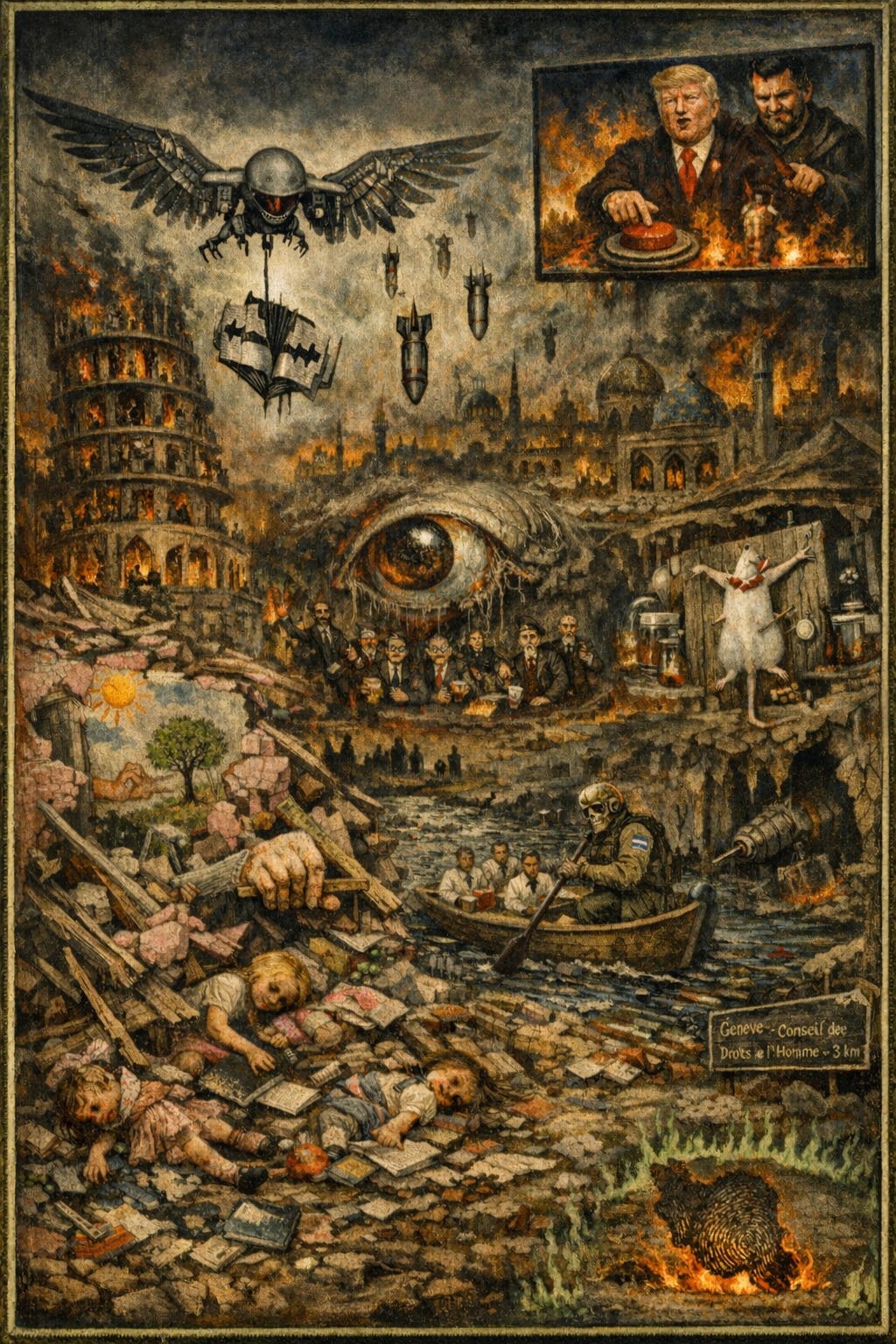
“Death and destruction from the sky, all day long”. This is not a script for a dystopian movie. It is Pete Hegseth, United States Secretary of War, on March 4, 2026, during a Pentagon press conference. Trump followed on April 2: “We will take them back to the Stone Age, where they deserve to be”. These are not slips of the tongue; they are the doctrine.
Since February 28, when the aggression began with the bombing of a girls’ elementary school in Minab (170 girls dead, ages 7 to 12), the U.S. and Israel have systematically demolished Iran’s civilian, cultural, and scientific framework.
Over 600 schools and educational centers hit. This was stated by the Iranian Foreign Minister before the UN Human Rights Council in Geneva. It was confirmed by the UN Special Rapporteur on education: more than 230 children and teachers killed. More than 30 universities with direct attacks. Tehran University of Science and Technology: an entire building razed to the ground. The Faculty of Pharmacy in Shiraz. Isfahan University of Technology. Shahid Beheshti, one of Iran’s most prestigious universities: its Laser and Plasma Research Institute destroyed. Imam Hossein University (Tehran) hit, parts of the Science and Technology campus and the Veterinary Specialist Hospital campus of Urmia University also hit; the universities of Mashhad, Sanandaj and Ahvaz have also suffered extensive damage. The latest, on April 6, Sharif University of Technology in Tehran, Iran’s leading engineering school.
Then research centers and healthcare facilities. The Pasteur Institute of Iran, founded in 1920: razed to the ground. The WHO confirmed it: “rendered unable to continue providing health services.” The Tofigh Daru pharmaceutical factory, destroyed. Esfandyar Batmanghelidj, a researcher on sanctions and founder of the Bourse & Bazaar Foundation think tank, stated: “Iran produces 90% of the medicine doses it needs. Companies like Tofigh Daru produce ingredients and precursors used for a wide range of domestic drugs. The only reason to target this facility is to limit medicine production in Iran.” The next day, a second pharmaceutical plant, Daro Bakhsh Pharmaceutical Factory (Tehran). In total, according to the Iranian Deputy Minister of Health, over 190 healthcare facilities hit. Gandhi Hospital in northern Tehran was damaged, Khatam al-Anbiya Hospital, Motahari Hospital (major burns), Valiasr Hospital (Tehran) hit, Delaram Sina Hospital (psychiatric, Tehran) suffered significant damage, Imam Ali Hospital (Andimeshk, Khuzestan) damaged, Persian Gulf Martyrs Hospital (Bushehr) was put out of service. 21 medical emergency centers were damaged across the country and a Red Crescent warehouse was directly targeted, with relief containers, two buses and other emergency vehicles destroyed.
And then world heritage sites. Over 131 historical and cultural sites hit. In Tehran: Golestan Palace – the “Persian Versailles,” as UNESCO called it – with its Hall of Mirrors shattered. The Grand Bazaar was damaged in the attacks. It is much more than a shopping center: it is a living urban network weaving together commerce, religious life and social interaction, with a crucial historical role. Marble Palace (Kakh-e Marmar), Teymourtash House, Saadabad Complex damaged. Isfahan: Naqsh-e Jahan Square (UNESCO World Heritage, Safavid era), damaged by bombings, Chehel Sotoun Palace (of Forty Columns), with a four-hundred-year-old fresco split in half. Ali Qapu Palace (UNESCO World Heritage, Safavid era), damaged, Masjed-e Jame (Friday Mosque, UNESCO World Heritage, Iran’s oldest Friday mosque), a shockwave sent the iconic turquoise tiles crashing to the ground, and the calligraphy panels were displaced and destroyed, along with damage to the historic minaret area. The Grand Bazaar (UNESCO World Heritage, Safavid era), hit in the raids. Masjid-e-Atiq (great congregational mosque, 8th century, Abbasid era), one of the largest congregational mosques in Iran, whose first construction dates back to the 8th century under the Abbasid caliph Al-Mansur. The Buyids, Seljuks, Safavids and Qajars expanded and refined it over the centuries – a unique historical palimpsest was damaged. The prehistoric caves of Khorramabad Valley – evidence of human presence 63,000 years ago – fractured. UNESCO had communicated the coordinates of all sites before the attacks. It was useless. Then: Falak-ol-Aflak Castle in Khorramabad – Lorestan. Asef Vaziri Palace, Salar Saeed Palace, Khosroabad Palace in Sanandaj. The historic urban areas of Qom, Tabriz, Shiraz have also suffered damage. Added to this, 48 museums across the country have suffered damage, with collections and exhibition spaces hit.
More than a hundred American international law experts – professors from Yale, NYU, Harvard, former legal advisors to the government and armed forces – have signed a letter: “The attack is a clear violation of the UN Charter. The conduct of the war raises serious questions about potential war crimes.” The UN Independent Mission already speaks of acts that “may constitute crimes against humanity.”
This is not a war. It is a program of erasure. Targeting schools means targeting future memory. Targeting laboratories means targeting the capacity to heal. Targeting archaeological sites means targeting the roots of a people. Targeting universities means targeting the very possibility of a country getting back on its feet.
Trump said it explicitly. And he is doing it.
Europe’s silence is complicity.