
Ziad Medoukh, Gaza, October 25, 2026
Even survival is forbidden to us. Three years since this horrific aggression began, one year since the so-called ceasefire came into force, and the situation in the Gaza Strip is still tragic and dramatic.
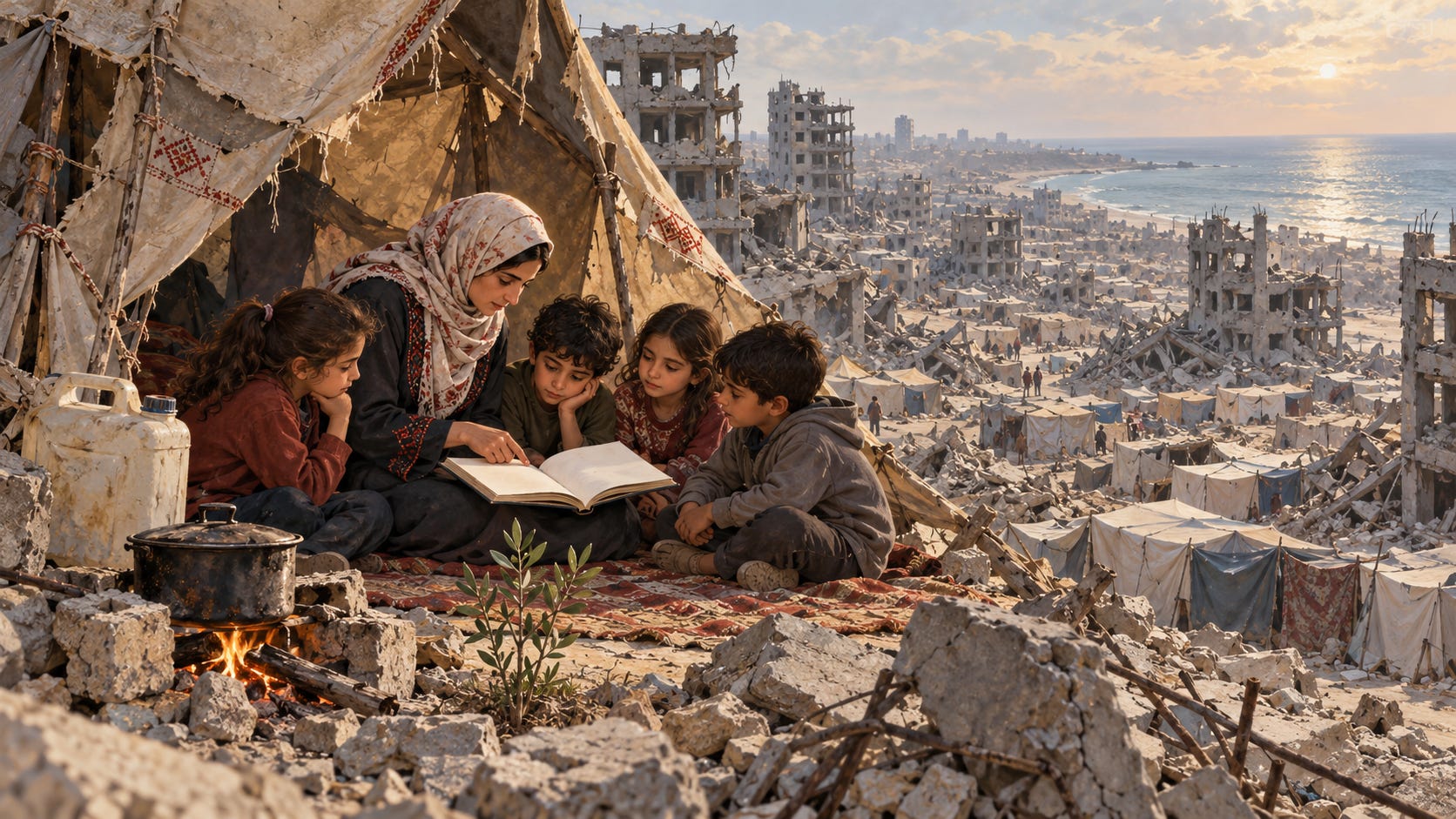
More than 2,300,000 Palestinians, abandoned by the official international community, are surviving in half-destroyed buildings or in torn tents, sometimes pitched on the ruins of their own homes. The provisional toll given by the Ministry of Health of the Palestinian Authority in Ramallah, and endorsed by international organizations, is terrible: 75,000 dead, including 22,000 children and 9,000 women, 150,000 wounded, and 10,000 missing, still under the rubble. Since this fragile ceasefire, nearly 1,600 dead and 6,000 wounded. I don’t know what to talk about. The dead, the wounded, the massive destruction, the shortage of everything? The forced displacement, the anguish, the fear, the worry, the insecurity, the lack of any prospect?
Everything in Gaza is horrific. The situation keeps getting worse for all Palestinians in Gaza. It is true that the bombing is less intense at the moment, but it goes on. The occupation bombs anywhere, at any time. By its own account it is going after activists, militants, leaders of armed factions or political parties, but when it fires on a car carrying five or six people, civilians always fall. Strikes hit a medical center, a market, a clinic, any apartment, any house, and so, inevitably, always civilians. The international community and the media, sadly, say nothing about it.
Personally, I am surviving like every Palestinian in Gaza. My house was completely destroyed, and my brother was murdered along with his wife and children. I have lost many members of my family: cousins, relatives, colleagues, friends, neighbors. Every household has its dead, and a family member held prisoner by the occupation, about whom nothing is known. Eighty-five percent of Gaza’s inhabitants live in tents. Those who can afford it pay a fortune to rent a small room, an apartment or a small house. These homes are fragile, and they are targeted. Even survival is forbidden to us, because the occupation does not leave us in peace: it either bombs or destroys; it bars trucks from entering for the private sector, and those of the overwhelmed international organizations. The health system has completely collapsed. Fifteen major hospitals have been hit. Only a few clinics and medical centers are still running, and only thanks to the determination of doctors and nurses working with very little. Medical equipment does not get through, and when it breaks down, spare parts are hard to find. So everything is forbidden. A single crossing, Kerem Shalom in the south of the Strip, is partially open. Between 150 and 200 trucks pass each day carrying useless things: potato chips, cookies, cakes, sodas and other fizzy drinks. Meanwhile the essentials, such as tents, medical supplies, fruit, vegetables, meat, chicken, school supplies, kitchen utensils, cooking gas, fuel and gasoline, do not get through. That is why everything is extremely expensive in Gaza, which has become the most expensive city in the world. A 10-kg cooking gas cylinder costs €400; before the aggression it cost barely €40. That is one concrete example. If you have the means, you buy it; if not, you have to cook over a wood fire. In this devastated city we suffer from shortages of everything: medicine, drinking water, electricity, food and the rest. It is horrific! In winter, the situation will be dramatic for people living in tents, because they are damaged and the new, sturdier tents still are not allowed in.
My own experience is a little different, because I write and I bear witness for the media. Over the past three years I have published four books in French, two personal narratives and two poetry collections, but even if I wrote dozens, even hundreds, I could never describe this horrific reality exactly. All the articles, all the testimonies of Palestinian journalists, of activists in international organizations, of foreign doctors who managed to come and treat patients, all our testimonies are nothing compared with reality. As for me, I have been ill for the past three months. First it was knee trouble. The doctors advised me to go to swimming pools, but all the pools are destroyed. Going to the beach is hard. I haven’t set foot there in three years, because there are tents everywhere and the Israeli navy fires on anyone who approaches the sea, even fishermen. I had to rub olive oil on my knee, because the creams and ointments the doctors recommended are ineffective. The medicines that come in for international organizations are either impossible to find or expired, and therefore useless. Then I had trouble breathing. I couldn’t get a chest X-ray because there are no medical machines. I was told to have my heart checked. I had two ultrasound scans; they were fine, but the tests are incomplete, because not only is the necessary medical equipment missing, but the materials and supplies those machines need cannot enter Gaza either. Then my dental prosthesis fell out. I went to three different dentists and paid a great deal. But the prosthesis came loose every time, a week later. It can’t be repaired because the necessary materials aren’t available. It is very annoying, because I can’t eat normally. Getting treatment in Gaza is hard. I have suffered a lot. There is a slight improvement today, but I still have difficulty breathing. But my case is nothing compared with that of the 15,000 patients with chronic illnesses who are waiting to be evacuated.
The Rafah crossing is open only two days a week. Fewer than 30 sick people get out each day. At that rate, it would take four years to evacuate all of Gaza’s sick. We have to bear the unbearable. Last September 30, I lost my mother. She has left a great void. My mother was something enormous to me: she was a territory, a space, a homeland. She was Gaza to me. She raised me, she educated me, she helped me find my way in life and in education. My mother means everything to me: she is Gaza, she is Palestine. It is thanks to her and to my father, who passed away 22 years ago, that I have patience and respect for others. They showed me nonviolence, a love of education and of children, how to give and how to respect. Everything is terrible since my mother’s death. I am shattered, stunned, and I find it very hard to accept, but that is how it is. Fortunately, she lived at my home before she was hospitalized, and my wife, my children and I looked after her for two months. But then her health deteriorated, and she spent two weeks in the hospital until her death on September 30. At her burial and funeral there was an enormous crowd, because everyone loved her and she helped everyone. People came despite the bombing, despite the difficult conditions in Gaza, the transport, the getting around: thousands came to the house of mourning over three days, in Gaza City. I was also surrounded by thousands of people in the French-speaking countries and all over the world, who sent me messages or called me. Thank you so much, friends, for your support. It eased my suffering a little, but pain is pain. And so it is hard for me. Even now I can’t quite believe she is gone. She will always remain engraved in my heart and in my memory. It is hard to write and to tell. Until her last breath, she spoke of hope, of the future, of the liberation of Palestine, of the reconstruction of Gaza, and above all she gave us advice for walking the road ahead. May my mother rest in peace.
But despite the horrific situation, there are three positive elements.
First, education. Despite the destruction of nearly 320 schools and 15 major universities in Gaza, despite the killing of 10,000 professors, teachers, education staff and students since the start of this aggression, among them 1,450 university students and 295 university professors, classes have resumed at 730 educational points across the Gaza Strip: learning centers in damaged buildings, school tents, camps for the displaced, and schools where displaced people who had lost everything had taken shelter, but who agreed to go back to living in tents so that the children could continue their lessons. The school enrollment rate is currently around 87%, which is a positive sign. Education has become a form of nonviolent resistance and a sign of hope for the future. Even the university has resumed, often virtually.
The second positive aspect is the resilience of a population that has decided to stay and not to leave. A population that adapts and asks only to live, or to survive. The occupation imposes restrictions and obstacles, closes crossings, bans construction materials, blocks the entry of many goods, and keeps on bombing and destroying. But the population, with its remarkable determination and extraordinary patience, keeps on surviving in the hope of rapid political change.
The third is international solidarity. Despite the complicit silence of the leaders of the official international community, people are mobilizing. Personally, every day I receive photos and videos of demonstrations, rallies, screenings, films, debates and solidarity evenings all over the French-speaking countries, which show that the Palestinian cause will never be forgotten and that the people can influence policy and push governments to change their position. It began with the boycott and the ban on delivering weapons through European ports and airports. Popular mobilization in these countries says no to occupation and colonization, and yes to justice and peace in Palestine. Personally, I continue to look after educational centers, children, and students and graduates of French, with whom we organize psychological support activities for children. This year I managed to find small jobs for 10 French graduates, as French teachers and as French-speaking activity leaders in educational centers and in associations, with small stipends, thanks to the support of friends in solidarity in the French-speaking world, whom I want to thank for their support and encouragement. So we will carry on with our mission, even though conditions are difficult. The people of Gaza love life dearly. They will live in spite of everything, even if they sometimes feel forgotten, shut in, abandoned by the rest of the world. They adapt, hope for better living conditions and wait for political change and, above all, for a more active role for the international community in enforcing international law and justice in Gaza and in Palestine. In the meantime, in devastated Gaza, every day is a struggle to survive!
NAMES MENTIONED
Ziad Medoukh, Palestinian Authority, Gaza, Palestine, Ramallah, Rafah, Kerem Shalom, Algeria, Tizi Ouzou, France, Al-Aqsa University, Paris 8 University
TAGS
Gaza, Palestine, Gaza genocide, Ziad Medoukh, testimony, ceasefire, survival, humanitarian crisis, humanitarian aid, health system, medical evacuations, Rafah crossing, education, resilience, international solidarity, nonviolence, French-speaking world
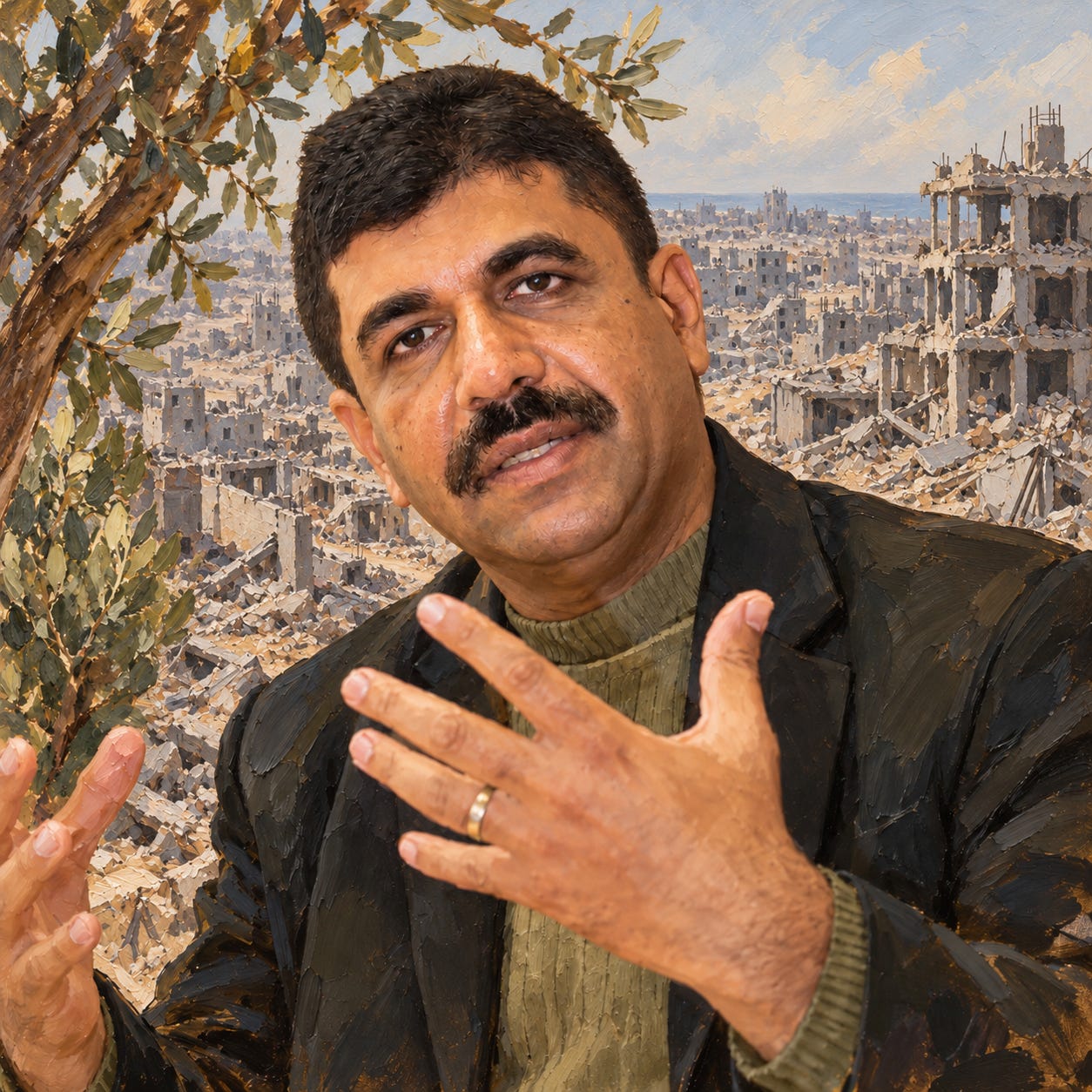
Ziad Medoukh (Gaza, 1966) is a Palestinian French teacher, poet and writer, with a doctorate in language sciences (Paris 8, 2009). His thesis dealt with the Internet and the teaching of French in Palestine. He says he learned French in Algeria, from Kabyles in Tizi Ouzou, during the “Black Decade.” He founded the French department at Al-Aqsa University in Gaza, which he heads, and he also coordinates the university’s Peace Center.
His work combines French teaching, poetry and the defense of nonviolent resistance. He has published many texts on Palestine and on Gaza in particular, as well as on nonviolence as a form of resistance. He writes his poems in French to share them with the French-speaking world.
In 2011 he became the first Palestinian citizen to be made a Knight of the Ordre des Palmes Académiques (Order of the Academic Palms). In 2014 the Cercle universel des ambassadeurs de la paix (Universal Circle of Peace Ambassadors) named him an ambassador. The same year he won first prize in the Europoésie competition, then the Prix de la poésie francophone (Francophone Poetry Prize) in 2015. He also received the prize of the Mouvement pour la Paix (Peace Movement) in France. In 2017 he was awarded the Jamnalal Bajaj Award for Promoting Gandhian Values Outside India.
Since October 2023 he has chosen to stay in Gaza. In late January 2024 he said he had lost his apartment, destroyed in early December, along with his computers, diplomas, published books, lecture notes and his library of 3,000 books in French.
Bibliographie sélective
Internet et l’enseignement du français en Palestine : défi ou nécessité ? [The Internet and the Teaching of French in Palestine: Challenge or Necessity?], doctoral thesis, Université Paris 8, 2009.
Gaza, terre des oubliés, terre des vivants. 70 poèmes de la paix palestinienne [Gaza, Land of the Forgotten, Land of the Living: 70 Poems for Palestinian Peace], L’Harmattan, 2012.
Chroniques d’un été meurtrier à Gaza [Chronicles of a Deadly Summer in Gaza], 2014.
Poèmes d’espoir dans la douleur. Choix de quarante poèmes pour Gaza, pour la Palestine, pour la Vie, pour l’Espoir, pour la Solidarité et la Paix [Poems of Hope in Pain: A Selection of Forty Poems for Gaza, for Palestine, for Life, for Hope, for Solidarity and Peace], 2016.
Être non-violent à Gaza [Being Nonviolent in Gaza], on the “Great March of Return” (c. 2020).
Les oliviers poussent encore à Gaza [Olive Trees Still Grow in Gaza], 2020.
Chroniques sous les bombes à Gaza. Récit de la 4e offensive israélienne (10-21 mai 2021) [Chronicles Under the Bombs in Gaza: An Account of the 4th Israeli Offensive (10–21 May 2021)], Culture et Paix, 2021.
Poèmes d’espoir à Gaza la dévastée [Poems of Hope in Devastated Gaza], 2024.
Gaza. Ma vie sous les bombes [Gaza: My Life Under the Bombs], 2024.
Cri d’amour pour Gaza. 50 poèmes de Gaza, de Palestine, pour la vie, l’espoir, la paix et la solidarité, en plein carnage [A Cry of Love for Gaza: 50 Poems from Gaza and Palestine for Life, Hope, Peace and Solidarity, in the Midst of Carnage], La Lucarne des Écrivains, 2025.
All our publications are free and Copyleft. They may be republished, in whole or in part, under following conditions:
→ keeping the title and content
(text, images, editor’s or translator’s notes, boxes)
→ crediting the author(s) and/or translator(s)
→ inserting a clickable link to the source.
Any monetization or commercial use of these publications is prohibited and will be subject to legal action.