
Mansoor Adayfi, Middle East Eye, September 10, 2026
Mansoor Adayfi was a student when the ‘war on terror’ turned him into a number. Twenty- five years later, he argues that the machinery behind his imprisonment has found new targets
Growing up as a child in Yemen, I never thought the day would come when I would share my story with a global audience. But little did I know that I would be caught in the violent crosshairs of the “war on terror” launched in the immediate aftermath of the 9/11 attacks. Prior to September 11, 2001, there was nothing extraordinary about my life. I grew up in a humble family, and only when I reached my teens did I begin to think about leaving my country.
When I was 18, I took the drastic step and left my village to finish school, armed with a dream of studying computer science abroad. For nearly a year, I asked the head of the institute where I studied and worked for a reference letter. He always told me, “Later.”
After the USS Cole was attacked in Yemen, the head of the institute was asked to write a book about al-Qaeda and the Taliban. He sent a former student who had fought the Soviets in Afghanistan to conduct research and asked me to accompany him. “Come back from this trip,” he promised, “and I will give you your letter.” We flew to Dubai, then Pakistan, and travelled overland to Afghanistan, eventually reaching Kabul, where an NGO was helping us with our research. I was still there when the towers fell in New York City. Soon after, while helping the NGO move supplies before fleeing the country, armed men stopped our car and abducted us.
We eventually ended up in the hands of a warlord who demanded $100,000 for our release. I didn’t know then that American planes were dropping leaflets across Afghanistan offering bounties for suspected al-Qaeda and Taliban fighters. Two weeks later, the warlord’s men came for me. Hooded and handcuffed, I remember little of what followed except violence, a truck, a helicopter, a plane, and finally an underground room. They hung me from the ceiling with a hood over my head. When they removed it, five rifles were pointed at me, red dots fixed on my chest. “Hello, Mr Adel,” a translator said, confusing me with an Egyptian general. “Do you know who we are, and why we are here?” Of course, I had no idea.
Weeks earlier, I had been conducting research in Afghanistan and was expecting to begin university at the end of the year. Now, I was accused of being an al-Qaeda leader, kidnapped by Afghan warlords and handed over to the CIA.
The beginning of my ordeal
While I was unlawfully detained at an air base in Kandahar, I could see US Air Force aeroplanes taking off and landing from the makeshift site. When an Air Force cargo plane landed, we knew that a group of prisoners would disappear. At the end of December 2001, around a hundred of us were held there, in wooden tents surrounded by barbed-wire walls three metres high. From the tents, I could see US Air Force planes taking off and landing from the makeshift site.
Read more
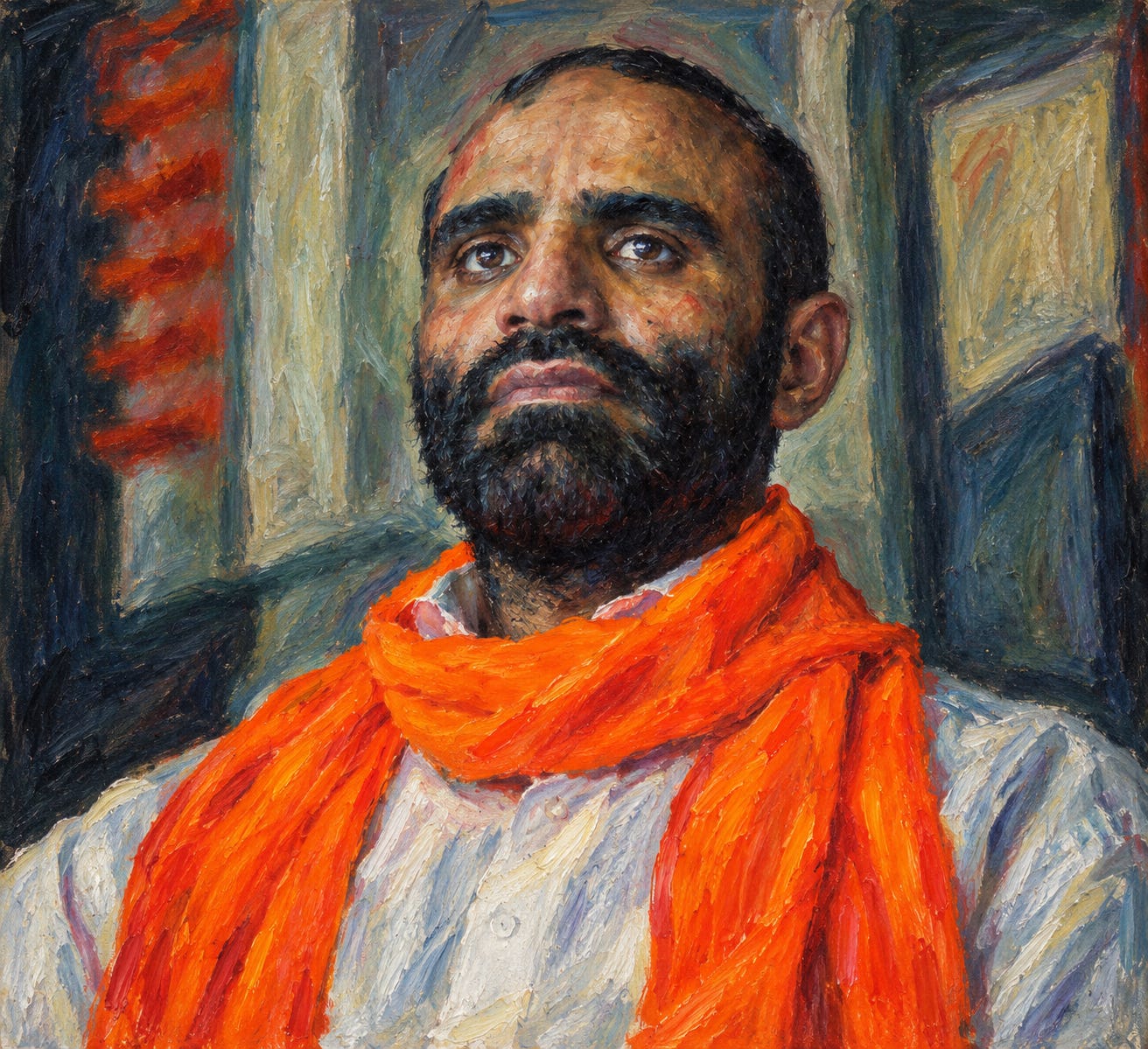
Mansoor Adayfi is a Yemeni writer, artist, and human rights advocate, born in a mountain village in Yemen. A shepherd and then a security guard in his youth, he moved to Sanaa to study computer science before traveling to Afghanistan on a research assignment at the age of 18-19. Abducted by Afghan fighters shortly after 9/11, he was sold to US-American forces, then transferred to Guantánamo, where he was held without charge or trial from 2002 to 2016 — more than fourteen years, under the designation “Prisoner 441.” There he led several hunger strikes and taught himself English.
Released in 2016 to Serbia under a bilateral agreement with the USA, he became de facto stateless, as Sanaa refused him a passport for a time (restored in 2023). He earned a bachelor’s degree in management (2021), whose thesis on the reintegration of former Guantánamo detainees gave rise to the Guantanamo Survivors Fund, which he co-founded. In 2021 he published his memoir, Don’t Forget Us Here: Lost and Found at Guantánamo (Hachette), awarded the Evelyn Shakir Non-Fiction Award (2022), followed in 2024 by the audiobook Letters from Guantanamo.
He now works as Guantánamo Project Coordinator for the NGO CAGE International and as a Visiting Fellow at the Human Rights Center of the University of Minnesota Law School (led by Fionnuala Ní Aoláin, former UN Special Rapporteur on human rights and counter-terrorism). He currently lives in Belgrade.
Read by the same author
Taking Marriage Class at Guantánamo
While imprisoned for 14 years, a young Yemeni man learns about love from a fellow detainee — and an iguana.
By Mansoor Adayfi
July 27, 2018
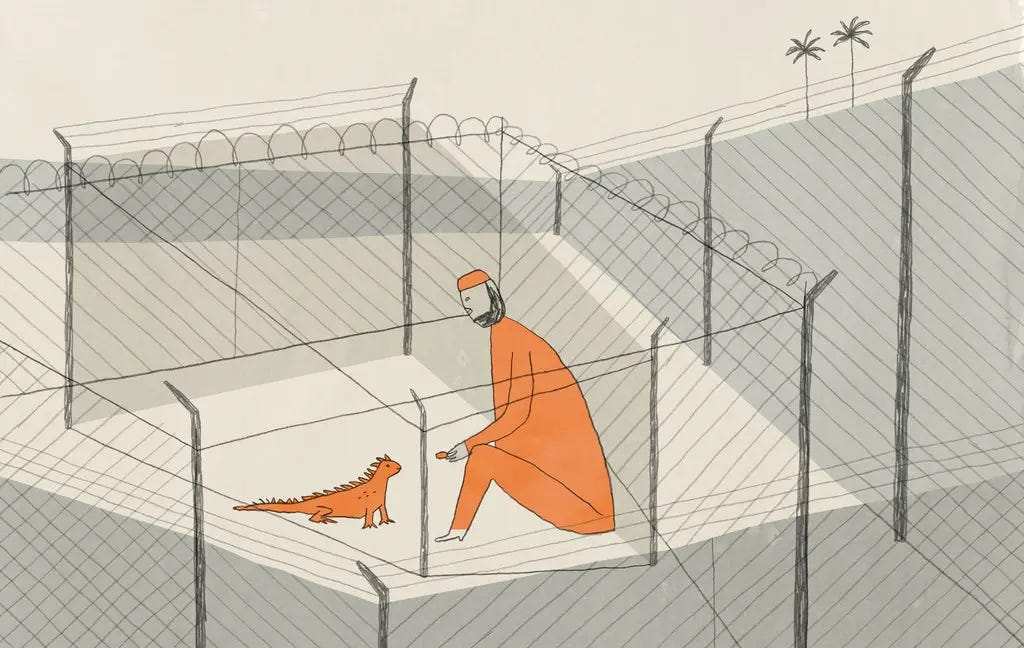
Until I was 35, the most significant relationship I’d had as an adult was with an iguana.
It wasn’t easy to meet anyone where I was for all of my 20s and nearly half of my 30s, at the prison camp at the Guantánamo Bay Naval Base in Cuba. After I arrived, I was put in an isolation cell, where huge fans outside of each cell ran day and night, making deafening noise to prevent us from talking to each other.
Even when we went outside for recreation, we were not allowed to talk to the other detainees. But outside we did meet new friends: the cats, banana rats, tiny birds and iguanas that came through the fences, asking to share our meals.
I had a good friendship with beautiful young lady, an iguana. She was so elegant. She used to come every day at the same time, and we would have lunch together. When I went on a hunger strike, I had no food to give her, and I was ashamed to stand there without food as she came up to me. Sometimes the guards punished us for sharing our meals with the animals, but they couldn’t stop me from talking to her.
She couldn’t talk back, but she was a good listener. As the years passed, our friendship grew into a strong bond.
Finally, after seven years of isolation, I was moved into a communal block where I could talk with my fellow detainees. I was born in a tiny village in the mountains of Yemen and was only 19 when I came to Guantánamo. I didn’t know much about the world; the world to me was my village. Now, my world was Guantánamo.
Until I was 12, I thought I had been born from my mother’s knee. I learned in school where babies really came from, but there was no dating in my society, so my knowledge remained theoretical. The same was true for most of us. Very few of us had been married or knew much about the relations between men and women.
Even so, talking about women was our favorite topic. Not in a bad way; as Muslims we are forbidden to talk about women in a bad way. But we talked about women because it relaxed us. When someone would tell a story about a woman, we all would listen. While being surrounded by men we imagined loving women.
We weren’t the only ones who missed women; the male guards did, too. There were very few female guards.
One of the older, married detainees saw that the single detainees were desperate to know about women, so he decided to teach us. We used to arrange classes and learn from each other anything that could be taught.
For example, a former chef taught a cooking class. He would say, “Now, I will add the onion to the hot oil — shhhh shhhh,” imitating the sound of frying onions because of course we had no onions or oil or stoves. He would make jokes, asking the students to please taste the dishes to test if they had enough salt or if they thought the meat was ready, even though there was no salt or meat.
I didn’t like that class. It just made me hungrier.
On our first day of marriage class, our teacher began by asking us each to say what we thought about how men should treat women. We agreed that men should have absolute respect for women, but many of the students said men always were, and always would be, superior to women.
Then the teacher asked: “If you were a woman, how would you answer my question? How would you want men to treat you?”
At first we started laughing, imagining each other as women.
“Look at Mansoor with hair all over his body,” one detainee shouted at me. “You would scare all of the men.”
“If I were a woman,” another said, “I would make you all dream, cry and spend all of your money — but none of your ugly faces would touch a single hair of mine.”
Our teacher let us joke for a while but then said, “Answer my question, ladies!”
I said that if I were going to choose someone to accompany me for the rest of my life, I would want a wife who was better than me.
One of the students tried to embarrass me by saying, “So will you let your wife be in charge? Should men just be like donkeys, serving women?”
I argued that men have been thought to be superior throughout history, but look where we are now. War follows war without end. Men never give birth to a single soul. They only take lives.
I said that all of us, guilty or innocent, were sitting around Guantánamo talking about marriage instead of experiencing it because of what men had done. I finished by pointing out that we all knew that when there was a female commander in charge of our guards, we lived more peaceful lives. When the commander was a man, we were more likely to be treated badly.
“Mansoor is biased toward women,” one detainee said with a laugh.
“If I were a woman,” another said, “I would marry you!”
As we kept meeting for marriage class, our teacher taught us about loving and being loved. He described what it would feel like when we saw and talked to the woman we loved. He told us how we would act on our engagement day.
And then we had an entire class dedicated to the biggest day in our lives, the marriage day. We pretended that one of the students was getting married, and we held a traditional Yemeni wedding celebration. We sang and danced as if it were a real marriage.
I have never been in love, but now I could feel its sweetness. Just like the cooking class, the marriage class made me hungrier. I regretted not being married before I came to Guantánamo. I felt there was a missing part of myself, and that part was a wife and family.
For a while I had in my cell a photo from a friend of his 10-year-old daughter. I made a frame out of scraps of cardboard with flowers surrounding it and hung the photo on the wall. Whenever visitors came into my cell, I would tell them she was my daughter.
When they looked surprised that I had a blond daughter and started asking more questions about the mother, I would say I had never met her, but still, I had a daughter just the same. I gave her an Arabic name, Amel, which means Hope.
One night the guards came in and pepper sprayed us and tore down everything in our cells. They threw away my Hope.
I could have stopped going to the marriage classes. I could have stopped dreaming about love. But the only thing harder than living a life without love is living a life without pain. Pain tells us we are alive. That we can still feel. Sometimes, pain is like love. Because I could imagine love, even without my photo, I still had hope.
When, after many years of not being able to speak to my family, I was allowed phone calls with them, there was talk of perhaps trying to arrange a marriage for me, and I was tempted to accept this hope. But in marriage class, we had discussed the problem of forced marriage in some countries. The idea of girls being sold like sheep hurt me. And so I declined the possibility of such an arrangement.