
India’s Gen Z and the Cockroach Janta Party have transformed outrage over exam paper leaks into a nationwide protest movement challenging Narendra Modi’s regime, and shaken an ingrained fear of his government and the Hindu Right
Neha Dixit, Himal, July 25, 2026
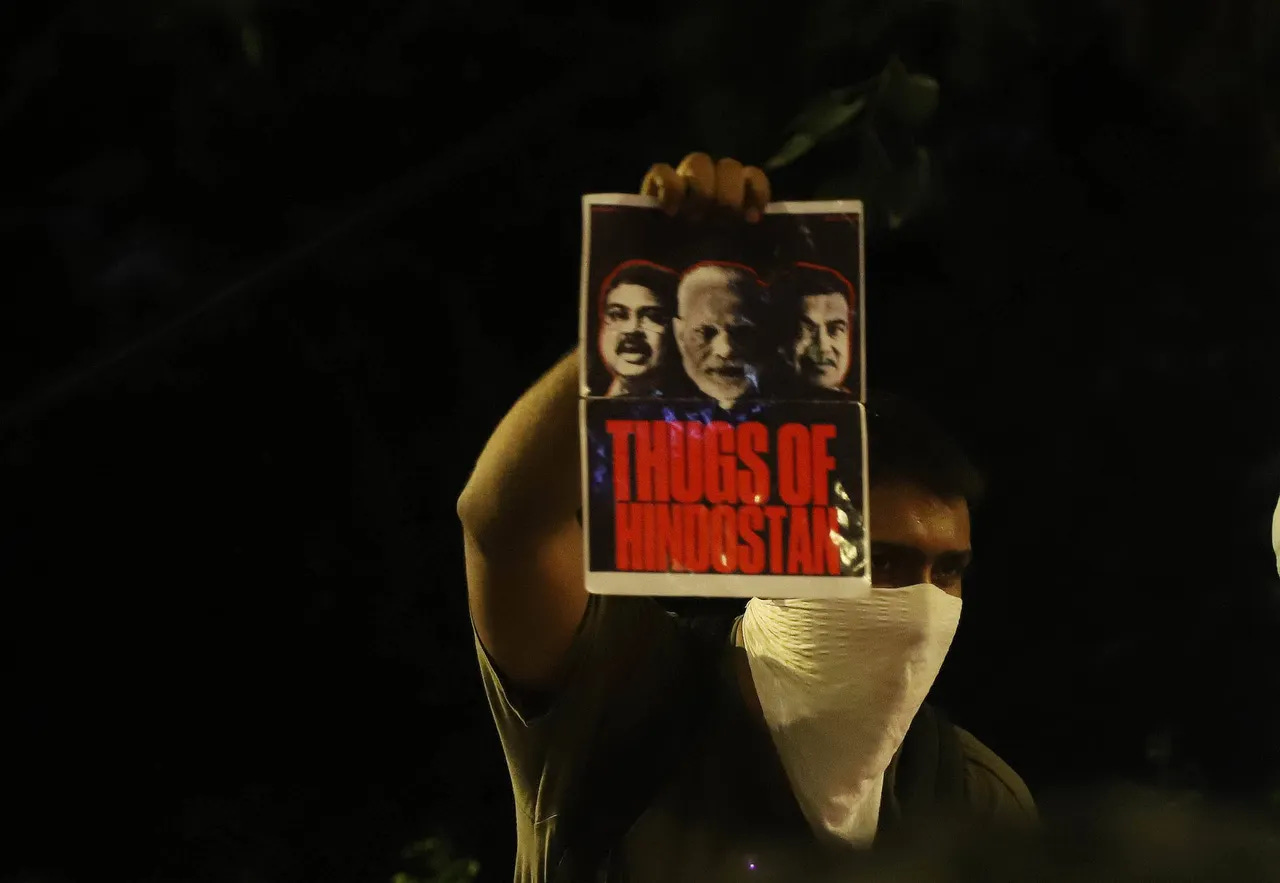
“IN MY MEMORY, I have only heard that people who speak against the Indian government are ‘anti-national’,” Pragya Gautam, a 20-year-old Dalit student from the Indian state of Uttar Pradesh, told me at a protest site in Jantar Mantar, in the heart of Delhi. She had taken an overnight train to the national capital, without informing her parents and carrying only INR 200 and her smartphone. “In the last week, I have realised that it is not those people but the Indian government itself that is anti-national.”
Gautam wants to become a doctor. For the past three years, she has been preparing for and trying to crack the National Eligibility cum Entrance Test (NEET), India’s unified examination for medical studies. She took the exam in 2024 and 2025, and appeared for it again on 3 May this year. She thought it went very well. “I was sure I would get through this time.”
Nearly 2.3 million students took the test, competing for about 130,000 medical college seats. On May 12, the National Testing Agency, which manages entrance exams and admissions for the ministry of education, announced that the NEET held on 3 May had been cancelled because the exam paper had been leaked. A retake was scheduled for 21 June. The NEET paper had also been leaked in 2021 and 2024.
Gautam’s parents had given her three years after she finished school to secure admission to a medical college or else get married. The retake was her fourth and final attempt at the exam. She had been staying at the protest site for a few days when I met her. “Had I not joined the cockroaches in Delhi,” she said, “I would have killed myself. ”
At least 12 NEET aspirants took their own lives between the cancelled test and the retake.
ON 15 MAY, four days after telling Indian citizens to avoid foreign travel for a year to help the country’s economy weather the effects of the ongoing crisis in West Asia, Narendra Modi, the prime minister, left for a diplomatic tour of five countries.
That same day, Surya Kant, the Chief Justice of India, while hearing a petition in the Supreme Court, declared, “There are youngsters like cockroaches, who don’t get any employment or have any place in the profession. Some of them become media, some of them become social media, RTI activists and other activists, and they start attacking everyone.” He likened these young people to “parasites in the system.”
Abhijit Dipke, a 30-year-old Dalit graduate, launched a satirical Instagram account for the Cockroach Janta Party (CJP), playing on the name of Modi’s own Bharatiya Janata Party (BJP). He wrote that anyone looking to join the CJP needs to be lazy, unemployed, always online and able to rant like a pro – integral traits in the popular stereotype of Gen Z, the generation that has come of age in roughly the last decade. In India, it numbers roughly 350 million people, and accounts for about a quarter of the population.
Within a week, the CJP’s Instagram account hit 10 million followers, surpassing the BJP’s following on the platform. The CJP launched a campaign demanding the resignation of the education minister, the BJP’s Dharmendra Pradhan. He had begun his career as an activist of the Akhil Bharatiya Vidyarthi Parishad, the student wing of the Rashtriya Swayamsevak Sangh (RSS), which is the parent body of the BJP, and had himself once taken part in major student protests against paper leaks – an endemic problem in India for many decades.
Read more

Neha Dixit is an independent journalist living in New Delhi, India. She has 18 years of experience in long form, investigative reportage with a focus on intersections of gender, politics, and social justice, in multiple mediums including online, print, and television in South Asia. She has been a contributing reporter for Al Jazeera, The New York Times, The Washington Post, Smithsonian, Foreign Policy, Caravan, The National, The Wire, Himal, and others. Website