
Luis Lema, Le Temps, 16 September 2026
For forty years, the Haaretz columnist has documented Palestinians’ lives in the West Bank. Ahead of the October 27 elections, he has no illusions: “Israel offers 50 shades of right-wing politics.”
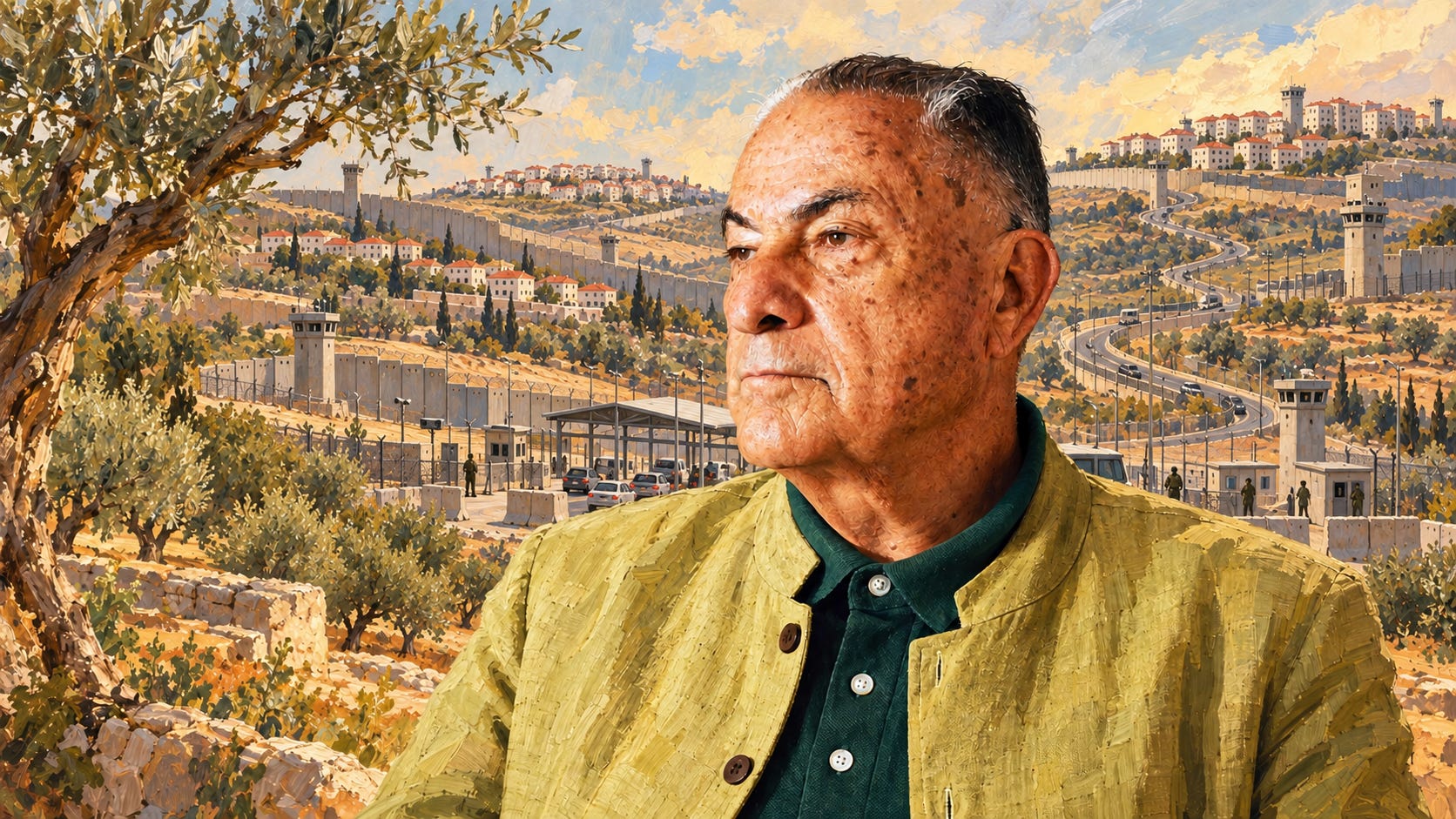
For four decades, the Israeli journalist Gideon Levy has kept the Palestinian tragedy alive in the columns of Haaretz. Since the Hamas attack of October 7, 2023, and the destruction of Gaza, he has not once been invited onto the Israeli television sets that are otherwise teeming with debates. Yet he continues his work, highly critical of the Israeli authorities. Invited to Geneva by the Swiss Press Club, the Graduate Institute, and ICAM, he is giving a lecture on Thursday, September 17 [see video below].
A recent investigation published by your newspaper showed that Benjamin Netanyahu had been informed before October 7 that the attack was imminent. Did that cause a stir in Israel?
It is true, that investigation shows that Benjamin Netanyahu knew about the attack. But what seems even more important to me is that it establishes that Netanyahu refused to reach an agreement with Hamas, despite its overtures. In plain terms, that means all these tragedies could have been avoided! It is all the more striking because this has happened again and again in Israel’s history. We saw it in 1973, when [Egyptian President] Anwar el-Sadat was pleading for a settlement.
Israel said “no,” and we had the Yom Kippur War. Here, it is the same pattern. The Arabs, in this case Hamas, make a fair offer and Israel answers: no, only war, nothing but war. In other words, we do not want any settlement, neither with Hamas, nor with the Palestinian Authority, nor with Hezbollah, nor with Iran: we want war.
Added to this, in recent days, is the film “NAZA,” which triumphed at the Venice Film Festival by detailing the methods of the Israeli army in Gaza and the little regard it has for Palestinian civilians. The uproar has only intensified...
You can say that: in recent days Israel has been gripped by hysteria as never before. To the point that some want to strip the filmmakers of their citizenship, while others say they are ready to kill them and their families. It is not only the far-right sectors, but society as a whole that is against them, and practically no one has stood up to support them. In reality, the angrier and more hateful people become, the more fascist and McCarthyist their attitudes become, and the more we understand that something is burning under their feet. If these people were truly convinced that our actions are right, they would not be in such an aggressive state. I think it is actually a very healthy process, even though it is very ugly. It also reveals the true face of Israeli society. In an almost magical way, this film has managed to break the silence, break the disconnection from reality, break the denial.
You know this isolation of the authors of “NAZA” too. For nearly forty years, notebook in hand, you have gone to meet and listen to Palestinians. Apart from your Haaretz colleague Amira Hass, you are practically the only person doing this in all Israel...
We now have one or two other, younger journalists who are also doing this. But indeed, in this respect I feel more alone than I have ever felt. Israel changed a great deal on October 7. Radically. Toward Palestinians, this translates into a worsening of the feeling that they are not even human beings. The cheapest thing in Israel is the life of a Palestinian. Whether you are a soldier or a settler, nothing is easier than shooting a Palestinian. You know that nothing will happen to you. If you shoot a dog, you run more risks, both with the legal system and in the eyes of Israeli public opinion.
Do you still go to the West Bank?
I go there every week, even though there are now 900 checkpoints that make any movement very difficult. I find tricks, I cheat here and there. Now the only danger comes from the settlers, whose violence is getting worse week after week. I try to avoid them and generally have no contact with them. But they can appear anywhere, on any road, and start smashing the car and beating people. With soldiers standing by and doing nothing, you are entirely at their mercy.
Is this the direct result of the prolonged occupation of the West Bank?
The longer an occupation lasts, the more brutal it becomes if it wants to put an end to resistance, which also grows. History is full of cases that confirm this rule. In an occupation like this one, which has a very clear objective of ethnic cleansing, this cannot be done without brutality. It even requires extreme and often barbaric brutality. There is no other possibility.
So it is the prolonged occupation of Palestine that lies at the root of all this violence?
You know, I would not have put it this way some time ago, but Zionism, which led us to believe that this land was empty of inhabitants, never envisaged doing anything together with the Palestinians. It was always “them or us.” I was raised in a Zionist home, and this process of understanding was very long for me. But I understood that the two-state solution was lost. And then I began to believe in a single democracy between the river and the sea. In my view, this single state is already there, in fact, but it is an apartheid state, and it still has to be transformed into a democracy. Once a Jewish state exists, Zionism’s only role is to maintain Jewish supremacy. I cannot identify with an ideology that believes in supremacy, whether national or religious.
Elections are scheduled for October 27. Can the situation change?
One thing is clear: Netanyahu will not have a majority to form a government, and I think he knows it. The question is whether the opposition will manage to do so by allying with the Arab parties, because otherwise we are heading for months of uncertainty and new elections. But in truth, I do not expect much from this vote, since there is no left-wing opposition. I once wrote that Israeli politics is 50 shades of right. Do not expect any change from Israel; it will not happen. I do not like calling on the world to impose sanctions against my country, but I see no other solution. Israelis must understand that there is a price to pay for continuing in this direction.
Some hopes nevertheless seem to rest on Gadi Eizenkot. People say he is the opposite of Netanyahu...
No, he is not his opposite. He is more honest, that is certain. He manipulates less, he lies less, but when it comes to his positions, there is no difference. Europe tends to reduce everything to the prime minister’s personality. It does not want to hate Israel; it really wants to love us and clings to every opportunity. But Israelis will not wake up one fine morning and say: “Oh, what we are doing is vile, let us put an end to it.” Neither Yitzhak Rabin nor anyone else wanted to give Palestinians the right to self-determination and to have a state. Long before October 7, the entire peace process was intended only to make things easier, to make the occupation softer, more convenient, less brutal. But that is not the problem. The problem is the existence of the occupation, not its face.
MENTIONED NAMES
Amira Hass, Anwar el-Sadat, Barack Obama, Benjamin Netanyahu, Gadi Eizenkot, Gideon Levy, Luis Lema, Yitzhak Rabin
TAGS
Gideon Levy, Luis Lema, occupied West Bank, Zionihilism, Negazionism, Zionist apartheid, one democratic state solution, Zionist settlements, Zionist apartheid, October 7, Palestine/Israel, Gaza genocide, Haaretz, Le Temps
Luis Lema is a Swiss international reporter and editorial writer of Spanish origin, and a journalist in the international section of the daily Le Temps. His career spans more than thirty years covering conflicts around the world.
1992: begins as correspondent in Madrid, as Spain hosts the Barcelona Olympic Games and the Seville Universal Exposition.
2000: appointed correspondent in Jerusalem; he covers the Middle East at the time of the Oslo Accords, then becomes a war correspondent during the Second Intifada, an experience from which he would draw the book Covering Disaster.
2008-2013: correspondent in the United States, a period marked by the election of Barack Obama.
He later returned to the international desk of Le Temps, where he is now one of its mainstays.
He received the 2026 Jean Dumur Prize, awarded by the Friends of Jean Dumur, who praised writing that is “sharp,” “sensitive and clear-sighted,” and a tenacious commitment to keeping attention focused on the Israeli-Palestinian conflict.
All our publications are free and Copyleft. They may be republished, in whole or in part, under following conditions:
→ keeping the title and content
(text, images, editor’s or translator’s notes, boxes)
→ crediting the author(s) and/or translator(s)
→ inserting a clickable link to the source.
Any monetization or commercial use of these publications is prohibited and will be subject to legal action.