Doha Chams, Al Araby Al Jadid, September 11, 2026
Original : صور خاطفة
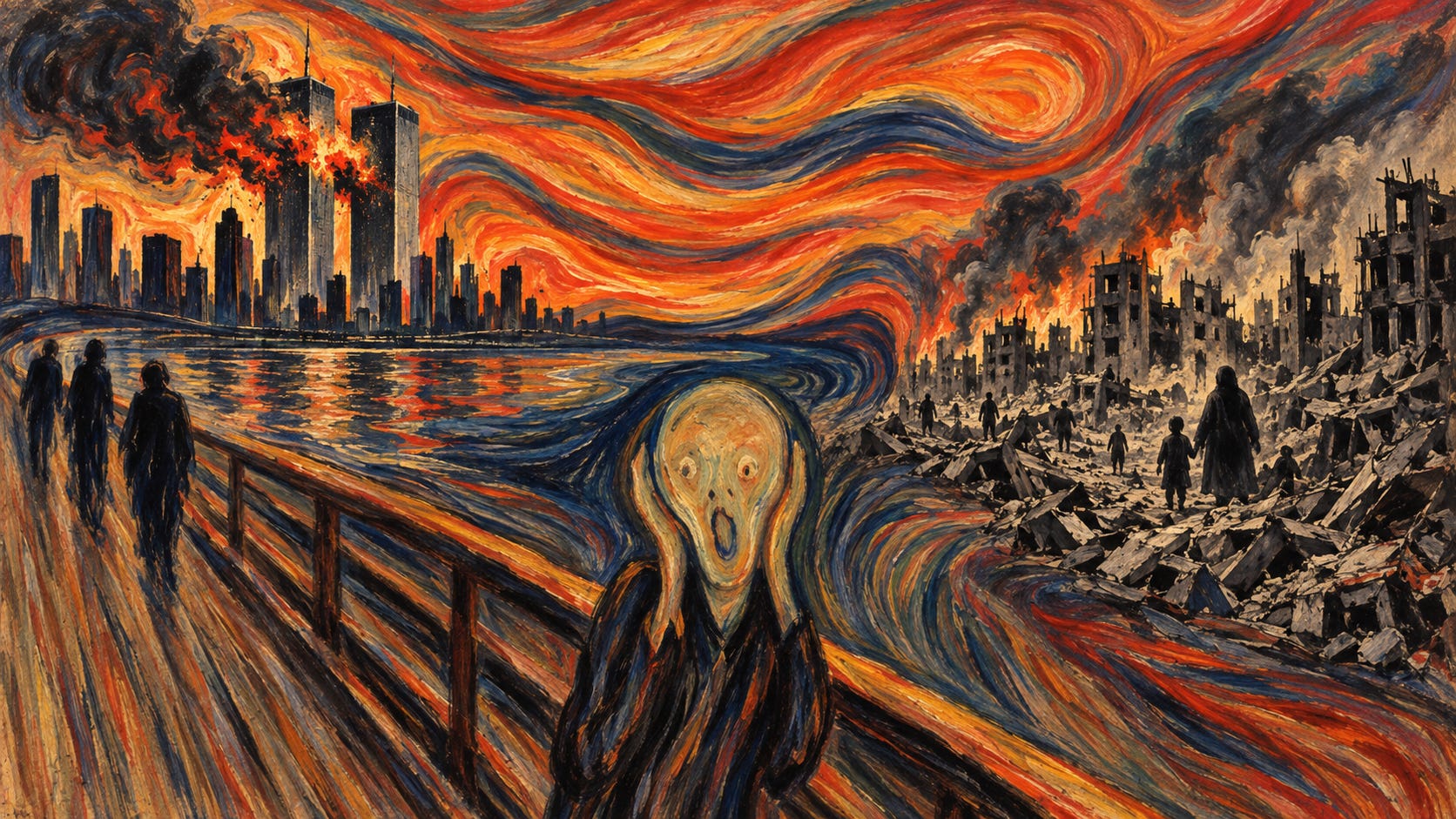
1
The moment I caught sight of it, I quickly looked away, without giving my eyes even a second to take in the details. That fleeting glimpse of the image, which made my heart contract, left me with the impression that it might be a photograph of a mass execution: a row of people standing directly behind a row of people kneeling with their backs turned to them. The impression lasted only a moment, perhaps even less, before I noticed the matching uniforms of those standing and kneeling and realized that the image I had feared and recoiled from seeing was, in fact… a football team!
I was stunned. Good God: how could the possibility of a mass execution have occurred to me after nothing more than a fleeting glance, without my thinking even for a moment that it might be a football team? How could I have assumed, merely from the way the people were arranged in the photograph, that it depicted a violent mass execution? People adopt exactly the same arrangement on countless occasions: commemorative school photographs at the end of the academic year, like those we see in old family albums; gatherings at weddings, when everyone cannot fit into the frame and some kneel in front of others. And in the case of a football team, the pose is entirely conventional: people kneeling in front of others standing directly behind them. So where had that image of a mass execution come from, when there were not even guns pointed at the heads of those kneeling? How had it managed to outrank all the other possibilities and interpretations stored in my mind?
The speed with which I browse — or rather the haste with which I turn the page — probably has something to do with it. I have become quick to avoid looking at what I assume are harmful images, giving myself no time to understand what they show: images of violence by settlers and soldiers in Israel, images of homes being blown up and human remains pouring out of social media platforms and television screens, drowning us in unbearable horror. I recoil from looking at them in an attempt at self-defence. I avoid the images and content myself with reading the news. That is how I try to protect my soul from images of violence that now fill my restless sleep. But the consequences, it seems, are already enormous and dangerous. Has my visual memory become contaminated to this extent? And my soul? Is this what happens when genocide has been broadcast live for three years?
2
September 11. Foreign television channels in particular bring back the images of that day. Civilian aircraft flying into the World Trade Center towers, the idol of capitalism in New York. The image is astonishing. Today, it could be fabricated with artificial intelligence. But what makes it unique, and what left us stunned by it, is that it really happened. You remember that day twenty-five years ago. It was noon, or a little later in the afternoon. The time difference. You remember receiving the news in the newspaper office, you and your colleagues frozen in front of the screens, as though unable to believe what was happening. Mixed emotions. America, which rules the world from behind its geographical walls, was suffering the greatest breach of its security. You remember the newspaper’s front page the following day, and how the editor-in-chief gave it the English headline “Apocalypse Now,” borrowing the title of Francis Ford Coppola’s famous US-American film about the Vietnam War.
Today you return to the image with different feelings, feelings that lead you to ask moral questions about the right to hate, about revenge in the absence of justice, about how, at one and the same time, you can save yourself from injustice and save your humanity from the desire to gloat. How can you distinguish the real criminal from the real victim, and how can that distinction prevent you from turning into a monster? How can you save yourself from injustice while also saving your humanity from the urge to rejoice in someone else’s suffering? How do you distinguish between criminal and victim so as to protect yourself from becoming a monster?
You return to the image with three years behind you of America and Israel running rampant, leaving mountains of destruction, corpses and horrific crimes against civilians that have gone unpunished — indeed, crimes which the planet, with all its legal and international institutions, has proved incapable of punishing. You watch the French and English news. In the morning, they replay the famous footage of the aircraft entering the two towers, then broadcast a report on how the authorities concealed the truth about air pollution in New York, which led to a terrifying rise in cancer cases among city residents after the towers collapsed and released carcinogenic substances whose existence the authorities had covered up, committing yet another crime. Today, in the midst of genocide, we can see in this iconic image a new message that was not so clearly “visible” when it was first broadcast, perhaps because the horror of the spectacle overwhelmed everything else: a message about revenge, about the hatred accumulated by the actions of that country’s authorities across the planet. The image almost seems to shout: “Yes, we can.”
3
The image comes from the skies over Gaza. The source: television news. The Flood takes to the air aboard homemade craft, built from whatever can be found in Gaza, imprisoned and besieged for two decades amid the world’s indifference. Those aircraft fly across the enemy’s barriers and into the land it occupies. The enemy is stunned. The image becomes imprinted on its collective unconscious: danger coming from the sky, from precisely the place it believed it alone controlled and dominated. The world looks on open-mouthed in astonishment at the scene, at this will to resist, at this imagination. Necessity is the mother of invention, no doubt. Hatred too. Smiles spread across the faces of the oppressed. Resistance is possible. Yes, it is possible. Always possible.
4
Among the rubble and the tents, children invent their games. Poverty and circumstance take them back to the games their parents once played. They rediscover games that require no equipment — equipment that no longer exists in devastated Gaza. They skip rope among the ruins. They play “X,” a game needing nothing more than one leg, a stone and squares drawn in the dirt. Some of them hop on one leg — the leg that Adidas failed to see when it filmed its disgraceful advertisement with a soldier of the genocide.
Others gather paper, string and reeds and make paper aircraft. Their aircraft rise into the sky. A sky that belonged to the occupier is reclaimed by kites flown by children deprived of everything, children who create birds out of nothing so that they may play with them. The madmen go mad with rage. The sky, like the air, cannot be fenced off. What did the Israelis see when they caught sight of those kites? What memory came immediately to mind? Did they remember the homemade aircraft of the Flood that swooped down on them while they were unawares? Or did they remember their terror on October 7, become angry with themselves, and pour that anger onto the children’s kites? Did they imagine they were drones coming to take revenge on them? Perhaps. I do not know. But they know: the children will grow, and the aircraft will grow too. Inevitably.

Doha Chams is a Lebanese journalist and blogger living in Beirut.
All our publications are free and Copyleft. They may be republished, in whole or in part, under following conditions:
→ keeping the title and content
(text, images, editor’s or translator’s notes, boxes)
→ crediting the author(s) and/or translator(s)
→ inserting a clickable link to the source.
Any monetization or commercial use of these publications is prohibited and will be subject to legal action.