Erri De Luca in Jerusalem: Normalizing the Unacceptable
A Neapolitan “intellectual ornament” for a State under suspicion


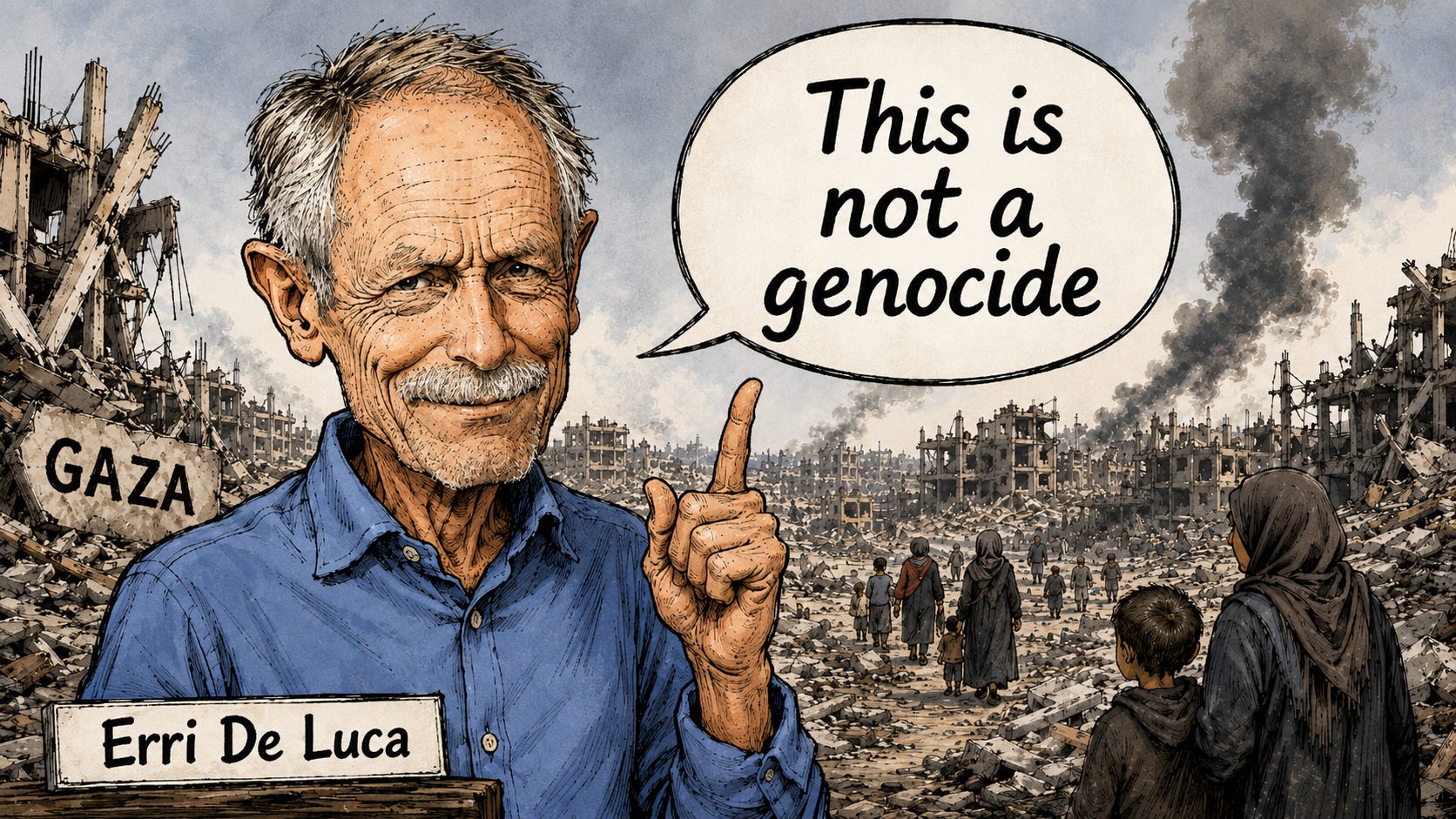
Translator’s note: On May 25, 2026, Italian writer Erri De Luca opened the International Writers Festival in Jerusalem with a video conversation with Professor Uri S. Cohen titled “From Naples to Jerusalem,” using the upcoming Hebrew publication of his book “The Story of Irene” as a pretext. South African Nobel laureate JM Coetzee had declined the invitation, explaining his refusal as follows:
“For the past two years the state of Israel has been conducting a genocidal campaign in Gaza that has been vastly disproportionate to the murderous provocation of 7 October 2023. This campaign, conducted by the IDF, appears to have had the enthusiastic support of the vast majority of Israel’s population. For this reason it is not possible for any considerable sector of Israeli society, including its intellectual and arts community, to claim that it should not share in the blame for the atrocities in Gaza.”
The Neapolitan writer holds a completely different opinion: the term “genocide” arouses in him a “profound grammatical anger,” as Omer Lachmanovitch writes in Israel Hayom. Below are two translations: an article by Italian lawyer and author Riccardo Taddei, an open letter to De Luca from writer and journalist Carlo Gubitosa. You can read the interview De Luca gave to Israel Hayom here: Erri De Luca defies Europe’s anti-Israel literary tide: ‘Genocide? It is a distortion’.-FG, Tlaxcala
Erri De Luca in Jerusalem
Riccardo Taddei, Comune-Info, May 25, 2026
Erri De Luca declares himself a Zionist in Israel Hayom — the daily newspaper founded by Sheldon Adelson as a tool to support Netanyahu — and states that calling what is happening in Gaza “genocide” is “a historical and verbal distortion”. He does this on May 25, 2026, while the confirmed death toll in Gaza exceeds 70,000, even as the very reality and the International Court of Justice have recognized the plausibility of the genocidal risk and issued provisional measures that Israel has ignored with the complicit silence of the West. He does this on the eve of his departure for the International Writers Festival in Jerusalem, the same festival from which J.M. Coetzee, a Nobel laureate, withdrew to adhere to the cultural boycott. De Luca goes in the opposite direction. And he does so with the certainty that his gesture will be presented by propaganda as an act of intellectual freedom, not as a choice of sides.
This is not the first time. Already in the interview with Peter Gomez on the television program ‘Confessione’ a few months ago, the scenario was the same. Asked about Gaza, De Luca spoke of “war within inhabited areas,” “movement of the population from north to south and south to north,” the need not to apply the word genocide to a situation he frames as an urban conflict, like Mosul, like Raqqa, like Mariupol. And above all, he said: “I feel the absence of other mobilizations. There are none for Ukraine, none for Iran.” In other words: the problem isn’t Gaza, the problem is your selective sensitivity. A classic maneuver: shifting the gaze from the perpetrator to the consistency of the observers.
The semantic ruse of “minimal” Zionism
De Luca’s rhetorical maneuver is as sophisticated as it is dishonest.
He redefines (incredibly for anyone who knows history) Zionism as “the simplest and most fundamental recognition of the Jews’ right to a national homeland.” Anyone who believes in the two-state solution, he argues, is already a Zionist without knowing it. A definition so broad that it empties the word of all historical content and makes it acceptable to anyone.
But Zionism was not born as a philosophical abstraction about the self-determination of peoples, as De Luca tries to make it seem. It was born as a political project of colonizing an inhabited land, theorized by Herzl, carried out through the Nakba of 1948, the ethnic cleansing of more than 700,000 Palestinians from their homes, documented by Israeli historians like Benny Morris and Ilan Pappé. Hannah Arendt denounced it. Albert Einstein signed a public letter in which he defined Begin’s party — the direct ancestor of Likud — as fascist in its methods and ideology. These were Jews. They knew Hebrew. They knew history. De Luca knows ancient Hebrew, translates the Bible, frequents the sources. He knows how to read this too.
Redefining Zionism as synonymous with “coexistence” in 2026 — when the 2018 Nation-State Basic Law constitutionally enshrines the exclusively Jewish character of the State, when settlers occupy the West Bank with the army’s protection, when Gaza is being systematically demolished neighborhood by neighborhood — this is not philosophy. It’s propaganda with a literary face.
“‘Genocide’ is a distortion”: against whom?
De Luca rejects the use of the word genocide, calling it a “historical and verbal distortion,” and argues that the number of civilian casualties is a consequence of contemporary urban wars fought in densely populated areas. The argument is: if Israel wanted to exterminate a people, it had a fixed target, yet it repeatedly moved the population. So, it’s not genocide.
This reasoning has a technical name: it is the fallacy of the end justifying the means.
It presupposes that an operation can only be defined as genocidal if the one carrying it out explicitly declares it as a goal. But the 1948 Convention does not require an admission of intent; it requires proof of the systematic effect and the deliberate destruction of the living conditions of a group. The Israeli thesis — that the forced displacement of the population proves the army’s good faith — is exactly the one De Luca adopts. This is not independent analysis. It is the official Tel Aviv narrative clothed in literary authority.
The International Court of Justice is not composed of pro-Gaza activists: it is the UN’s highest judicial body, and it ruled the violation of the Genocide Convention plausible. Independent UN experts spoke of “extermination as a method of warfare.” Doctors Without Borders documents the systematic destruction of hospitals. De Luca decides to side with the narrative of Israel Hayom. A choice. Not a truth.
De Luca built his public persona on the courage of uncomfortable positions. He defended the sabotage of the TAV high-speed railway in court. He wrote “The Contrary Word” as an act of militancy. In 2013, he was signing No Tav appeals, writing political pamphlets, and turning every interview into an act of activism. Back then, literature and politics were inseparable; they were even the same thing.
Today, when it comes to Gaza, literature must “remain free from political pressures.” The principle is invoked precisely when it suits those who welcome him.
But there’s a more substantial problem. When De Luca defended the No Tav movement, he was taking sides against the Italian State, against big economic interests, against the judiciary. He took personal risks. Today, by declaring himself a Zionist in a right-wing Israeli newspaper and participating in a festival funded by the Jerusalem Foundation, he sides with the most powerful government in the region, with the most advanced military apparatus in the Middle East, with Western governments that finance and arm Israel despite international rulings. This is not courage. It is conformism dressed in rebel clothes.
Speaking to Gomez, De Luca said he “felt the absence of mobilizations for Ukraine and Iran,” adding that he personally brings aid to Ukraine with a used van. Noble. But the argument of universal consistency — “why Gaza and not Ukraine?” — is the oldest trick to avoid answering for what is happening in Gaza. Mobilizations for Ukraine exist; they have the support of governments, the media, the European Union. Gaza is bombed with Western weapons while Western governments discuss sanctions they do not apply. The disproportion in public outrage precisely reflects this structural imbalance — not the hypocrisy of the protesters.
De Luca’s presence at the festival is described by Israel Hayom as “an act of moral alignment against the prevailing winds.” The newspaper knows exactly what it is buying: not just any writer, but a voice that comes from the radical left, from Lotta Continua, from militant operaismo. A voice that sounds authentic to those who want to be reassured. Every time an intellectual with this profile declares himself a Zionist and denies the genocide, the hasbara machine — Israeli institutional propaganda — can say: “See? It’s not a right-left issue. It’s a matter of intellectual honesty.” De Luca is valuable precisely for this. The function he performs is normalizing the unacceptable under the seal of literature. Israel wants international culture to continue circulating normally — festivals, prizes, translations, meetings — as if nothing were happening. Cultural normalization is part of the strategy, and Netanyahu has stated this explicitly on several occasions.
The beauty of one’s prose does not guarantee the clarity of one’s political judgment. When that judgment covers 70,000 dead with the word “distortion” and offers itself as an ornament to a festival funded by those waging this war, it must be said without periphrasis: this is not intellectual courage. It is a choice. And every choice, at this level of consciousness, carries with it a responsibility that no poetic metaphor can absolve.
Neither Erri De Luca nor his propagandists.
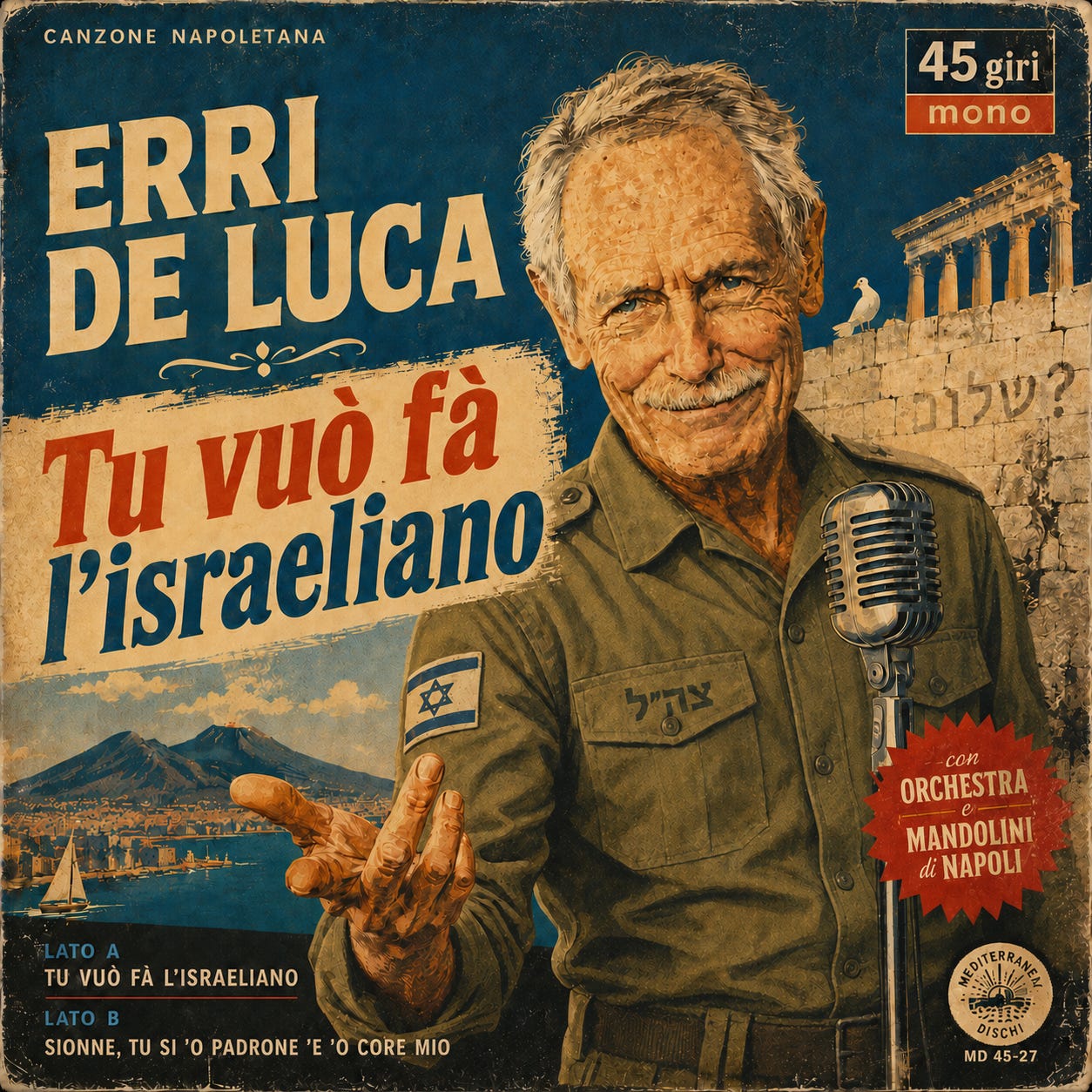
Dear Erri De Luca, in order not to serve as an “intellectual ornament”, take a look at anti-Zionist thought
Carlo Gubitosa, Altreconomia, May 27, 2026
Writer and journalist Carlo Gubitosa has written a letter to Erri De Luca following his statements on the genocide in Palestine and the meaning of Zionism, which are unsustainable on legal, political, scientific, and historical grounds. “Denying legitimacy to anti-Zionist thought by passing it off as anti-Semitic, warmongering, or illiberal thought, which incites wiping a nation off the map, reveals a pattern of thinking very similar to that of those who criminalized your free opinions on the TAV in Val di Susa, denouncing you for ‘ inciting crime’ .”
Dear Erri De Luca, I read in the pages of il Riformista that you have announced that you do not wish to collaborate “with any event or forum where genocide is spoken of in reference to Gaza”, as you identify with the definition of “Zionist” and therefore would not be capable “of sitting in the same room or sharing a stage with people who wish for Israel to be wiped off the map.”
This has confused me quite a bit, because during these three years of bombing triggered by one day of crimes, I have learned to distinguish among Zionists those who are open to dialogue with supporters of universal human rights, but I have learned even more easily to distinguish among anti-Zionists those who have no desire whatsoever to wipe off the map (within the borders established by international law and not by military power relations) the State of Israel which already exists, is recognized by the community of nations represented at the UN, is defended by its nuclear warheads and the most powerful army in the world.
You declared that you do not want to serve as an “intellectual ornament” for those who use the word “genocide” in relation to what has been consummated in the State of Palestine, because in your opinion the use of this term “is not based on facts or observations, but on a clear desire to insult Israel and wound its legitimacy.”
The only fact, or rather the only interpretation of facts, that you have brought to support your thesis is that “if the Israeli army’ s goal were the extermination of a people, it had a perfectly immobile target, given that the entire population was concentrated inside the city. The fact that Israel repeatedly moved the civilian population, from North to South and from South to North, to move it away from active combat zones, makes this accusation empty.”
I, who am not as expert in international law as you, before “emptying the accusations” feel the need to delve deeper. There is a report from last September 16th from the United Nations Human Rights Council, which analyzes Israel’ s conduct in Gaza within the framework of the International Convention on the Prevention and Punishment of the Crime of Genocide, where it is documented that the forced deportation of the bombed-out people is not a kind concession by the aggressor but further proof of the damage inflicted on the population as a whole, since deportation, as well as inhuman and degrading treatment, insecurity, precariousness, and the unsanitary living conditions to which refugees are forced, can cause serious physical and mental harm, and under international law there is no need even for this harm to be permanent.
But it is not a clash over facts or interpretations of the law to which I want to invite you today: I would prefer a meeting between legitimate opinions based on truth and mutual respect.
The first truth is that extremist fanatics who would like to wipe the State of Israel off the map, against all historical, legal, political, and military evidence that guarantees its existence, are only a tiny minority of those who use the term “genocide” in relation to war crimes and crimes against humanity committed in the State of Palestine (recognized by 81% of UN member states, with the exception of Euro-Atlantic Western countries).
These crimes have been recognized as such by the International Criminal Court, which has issued arrest warrants against the current head of government of the State of Israel and a former Minister of Defense, also for using starvation as a weapon of war, because it is not enough to move the bombed-out people away from the bombing zones if they then die of hunger.
The extremist minority that wants to wipe the State of Israel off the map, which I always see mentioned in newspapers but have never personally encountered in years of marches, debates, and other anti-colonialist initiatives, is certainly smaller, bloodless, and more irrelevant than the violent minority that supported armed struggle from the left in the context of political struggles for social progress in Italy, without, however, preventing intellectuals like you from interacting with the human and cultural wealth that came from that political area where many things mixed.
And that is why I invite you not to be afraid to participate in events or forums where genocide is spoken of in reference to Gaza, because debate based on respect for others and the truth is always enriching, because your opinions are worth as much as those of the UN, and because in those types of events you will not find excited people who want to wipe entire nations off maps only to be arrested five minutes after saying these things from a stage, but people who fight against suprematism and colonialism that have distorted the principles of freedom and self-determination from which Zionism sprang, people who might prove interesting even for those who define themselves as Zionists like you, if in addition to the recognition of Israel’ s rights there is room in your reasoning for the rights of other peoples.
By participating in these events you will discover, to your great surprise, that today there are also many Israelis, Jews, and Holocaust survivors among those who agree with the UN and dozens of other experts on the genocidal nature of the war crimes in Gaza.
The second truth regarding respect is that which is due to the opinions of those you accused of merely wanting “to insult Israel and wound its legitimacy,” with a turn of phrase that amounts to a not-too-veiled accusation of anti-Semitism thrown at all anti-Zionists and at those who have convinced themselves in good faith that a genocide is being committed in Palestine.
Staying within the realm of documentable facts and respectable opinions, that a “plausible genocide” is being committed in the State of Palestine is confirmed by the International Court of Justice of the United Nations, which has ordered “provisional measures” to prevent genocide, to prevent it from moving from “plausible” to an already consummated genocide. Provisions that have never been respected by the aggressor State, as if a family investigated for child abuse refused the court’ s order to place the child in temporary foster care with another family, to prevent further abuse that the court considers plausible, also to avoid making the weakest party in the protection procedure pay for the slowness of bureaucracy, in case plausible abuse becomes overt.
Moving from the legal to the political, scientific, and historical level, that the genocide is overt and not just plausible is confirmed by various UN reports drafted with the contribution of dozens of special rapporteurs: UN report A/79/384 “Genocide as colonial erasure”, UN report A/80/492 “Gaza Genocide: A Collective Crime”, UN report A/HRC/59/23 “From the economy of occupation to the economy of genocide”, and report A/80/365 of the United Nations Special Committee to Investigate Israeli Practices Affecting the Human Rights of the Palestinian People and Other Arabs of the Occupied Territories.
Also convinced that the war crimes in Palestine have genocidal characteristics are Josep Borrell, former High Representative of the Union for Foreign Affairs and Security Policy, and former President of the European Parliament; Israeli Holocaust scholar and former Tsahal member Omer Bartov; Israeli Holocaust scholar Amos Goldberg; Holocaust survivor Aryeh Neier, co-founder of Human Rights Watch; Holocaust survivor Stephen Kapos, 87 years old, persecuted in Hungary by the Nazi regime; Haim Bresheeth, son of Shoah survivors and founder of the Jewish Network for Palestine; Géraldine Hornberg, spokesperson for the French Jewish Union for Peace; Israeli journalist Gideon Levy, whose parents fled in 1939 from the Nazis who killed his grandparents; David Grossman, born in Jerusalem in 1954, one of the most important living Israeli writers; Israeli historians Lee Mordechai, Ilan Pappé, and Avi Shlaim; the International Association of Genocide Scholars and its president Melanie O’ Brien; the Israeli NGO Physicians for Human Rights Israel; the Israeli NGO B’ tselem which published the report “Our Genocide”; and Amnesty International, to whom in more civil and less hostile times than ours would have been granted the final word on human rights and international law.
Dear Erri, by identifying with the definition of “Zionist,” you reject a trial of intentions because not all Zionists are automatically superimposable on supporters of Zionist colonialism and Israeli nationalist suprematism, and from your point of view this is understandable. But then from the same point of view, your trial of intentions against anti-Zionists is not understandable, because those I have listed so far are only a tiny part of the respectable and estimable people who, by doing serious analyses based on documented facts, certainly do not want to deny the right to exist of the State of Israel, but at the same time challenge a genocide documented by the UN and deny the legitimacy of its colonial expansionism, its war crimes that cannot be legitimized by other crimes, and the openly genocidal and suprematist discourse expressed by members of the Israeli government.
Denying legitimacy to anti-Zionist thought by passing it off as anti-Semitic, warmongering, or illiberal thought, which incites wiping a nation off the map, reveals a pattern of thinking very similar to that of those who criminalized your free opinions on the TAV in Val di Susa, denouncing you for “inciting crime.”
Looking up the definition of “Zionism”, the De Mauro dictionary describes it as a “Jewish political and cultural movement […] that proposed the rebirth in Palestine of an independent state inspired […] by the specific national-cultural values of the Jewish world”, but also as the “policy of closure implemented by the Israeli government towards the self-determination movement of the Palestinian people”. That is why, by comparing the vocabulary and talking with friends passionate about Israeli culture and history, I have come to understand that the word “Zionist” covers a very broad semantic space, ranging from nostalgia for one’ s own homeland [sic, Transl. N.] to the colonial annexation of another’ s homeland, from Anne Frank to Hind Rajab, from the turrets firing on fugitives in the extermination camps to the snipers shooting at refugees queuing for bread in Gaza.
That is why, in this very broad semantic space, I do not believe a discussion is possible without clarifications and specifications, and I prefer to speak of “Zionist suprematism” and “genocide certified by the UN” rather than speaking generically of Zionism and genocide, to clarify my references and make myself understood even by those who see values in their own interpretation of Zionism and do not recognize, as I do, the genocidal nature recognized by the United Nations for the war crimes committed in Palestine.
But the effort to understand each other without demonizing must be reciprocal: hence my invitation not to boycott events where genocide is spoken of in reference to Gaza, and to confront the questions that today afflict anyone who defines themselves as a Zionist without having lost the ability to read the history of their time and critically interpret the current events in which they are immersed. By associating with pacifists, defenders of universal human rights, anti-colonialists, anti-Zionists, and other people who think differently from you, you will meet people capable of asking good questions, outside the apparent security and easy answers of identity, ethnic, and national affiliations.
We could ask ourselves whether after the historic, moral, and political victory of Nelson Mandela it makes sense to talk about fighting a South African apartheid that has already been abolished, or whether we should instead move to a higher plane, where we fight to free all the nations of the world from racism, and put to good use the lesson of South Africa. Similarly, now that the State of Israel exists, is recognized, is defended by the world’ s largest army and by atomic weapons, does it still make sense to speak of Zionism at the risk of being misunderstood, ignoring the crimes committed in the name of Zionist suprematism?
Overcoming the historical and political limits of identity definitions, I see the possibility of starting from the values you associate with Zionism to make a qualitative leap from Israeli nationalism to UN multilateralism, from rights demanded to rights recognized for one people to universal human rights, from one nation to the community of nations, from national war of defense to international peace, from the invocations of biblical catastrophes of the Old Testament against enemy peoples evoked by the Israeli head of government to the provisions for human progress of the United Nations Charter.
We could easily overcome Zionism, without denying the values you and others recognize in this cultural and political orientation and without getting lost in the labyrinth of history and news to decide whether it is a good or bad thing: it would suffice to recognize for all peoples, Palestinians included (and not only for the people designated as “chosen” in the Bible), the same right to homeland, security, self-determination, and defense (even unarmed and nonviolent) within the borders of their own State that Zionism recognizes for the Israeli people, putting to good use the lesson of the twentieth century for the benefit of all, to truly say that “never again” applies to everyone, and that on the planet there is no more room for imperialisms, colonial wars, “voluntary” deportation plans of indigenous populations where the quotation marks are a moral obligation.
Can we accept that certain words born from noble ideals such as communism, socialism, Christianity, and Zionism have been tarnished by the gulags, corruption, crusades, colonialism, and crimes committed in the name of those noble principles, losing their meaning until becoming an object of harsh criticism for young people and those with the most sensitive consciences? Can we be communists critical of Stalinism, socialists critical of Craxism, Christians critical of clerico-fascism, anti-Zionists critical of extremism, and Zionists critical of a genocide? This is the challenge awaiting those who want to defend a cultural heritage and a political identity without being tainted by its aberrations. I am grateful to my friends who call themselves Zionists while being critical of Zionist colonialism, for having accepted this challenge to transcend, in their dialogue with me, the comfortable identity categories in which we all settle.
If you too wish to seize the opportunities for debate, dear Erri, I must put a provocative question to you as a litmus test of your claimed identity as a Zionist and denier of a genocide certified by experts: after being invited with full honors to the International Writers Festival in Jerusalem, as a supporter of rights already acquired by the [Jewish] population of the State of Israel, would you have been an equally welcome guest if you had publicly committed to supporting the same right to existence, freedom, and security within their own borders for the peoples colonized and bombed by the State that hosted you? Does the life of the citizens of the State of Palestine count as much as the life of the [Jewish] citizens of the State of Israel? Should universal human rights be claimed everywhere with the same determination?
And if the difference between applause and booing is decided based on unilateral support for an ethnicity, for which selective and exclusive rights are claimed while denying them to other ethnicities (such as the right to kidnap people in international waters, the right to bomb civilian infrastructure, the right to block humanitarian aid), if by getting to the heart of the matter one makes choices of side and value based on an ethno-supremacist criterion, in your opinion, in Israel were you applauded only as a freethinker for the rights of Israelis, or also as an “intellectual ornament” of a colonialist regime that wants to deny the rights of Palestinians?
All our publications are free and Copyleft. They may be republished, in whole or in part, under following conditions:
→ keeping the title and content
(text, images, editor’s or translator’s notes, boxes)
→ crediting the author(s) and/or translator(s)
→ inserting a clickable link to the source.
Any monetization or commercial use of these publications is prohibited and will be subject to legal action.