
November 1932: Joseph Goebbels and Walter Ulbricht organise a joint insurrectionary transport strike in Berlin, directed against the “social fascism” then in power (Social Democrats branded the “main enemy” by Comrade Stalin).
September 2026: the Sahra Wagenknecht Alliance (BSW) and the Alternative for Germany (AfD) make common cause to get rid of the Christian Democratic government in Saxony-Anhalt, the most disadvantaged Land in reunified Germany.
Could Ulrich Siegmund be a postmodern Joseph Goebbels, and Sahra Wagenknecht a 21st-century Walter Ulbricht?
Questions and historical parallels the day after the Sunday, 6 September vote, in which Saxony-Anhalt’s electorate renewed the Land parliament.
Introduction
The ongoing reshaping of Germany’s political landscape, particularly acute in eastern regions such as Saxony-Anhalt ahead of the September 2026 elections, revives a specific historical framework: that of the Querfront (the “cross front”). The concept refers to the tactical convergence, in November 1932, of the Communist Party (KPD) and the National Socialist Party (NSDAP) during the wildcat transport strike (BVG), which sought to paralyse the Weimar Republic in its capital — then the world’s fourth-largest metropolis and an industrial stronghold of a large, strong and diverse working class.
Today, the frequent alignment of votes in the Magdeburg Landtag between the Alternative for Germany (AfD) and the Bündnis Sahra Wagenknecht (BSW) revives that historical memory: an alliance of extremes against the traditional centrist parties.
1932: The BVG strike, or the extremes’ absolute cynicism
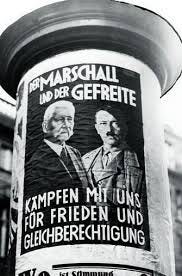
In November 1932, the Weimar Republic was living out its final weeks amid a climate of latent civil war and total economic crisis. It was in this explosive context that, from 3 to 7 November, a wildcat strike broke out among employees of the Berliner Verkehrsgesellschaft (BVG), Berlin’s public transport company.
Officially, the movement protested a wage cut. Unofficially, the stakes were highly political. It was co-led by the Revolutionäre Gewerkschafts-Opposition (RGO) (the KPD’s trade union, led by Walter Ulbricht) and the Nationalsozialistische Betriebszellenorganisation (NSBO) (the NSDAP’s workers’ wing, run by Joseph Goebbels).
For four days, communists and Nazis blocked Berlin’s streets together, collected funds in the same tins, and assaulted strikebreakers. The shared goal was not to improve workers’ conditions but to paralyse the state, discredit the republican social-democratic trade union movement (ADGB), and topple the government of Franz von Papen. The alliance was purely tactical, fuelled by a shared hatred of liberal democracy. History would go on to expose the KPD’s tragic blindness: convinced that the slogan “After Hitler, it will be our turn” would come true, the communists were instead among the first to be interned in Nazi concentration camps as early as February 1933.
2026: The Saxony-Anhalt laboratory, or parliamentary convergence
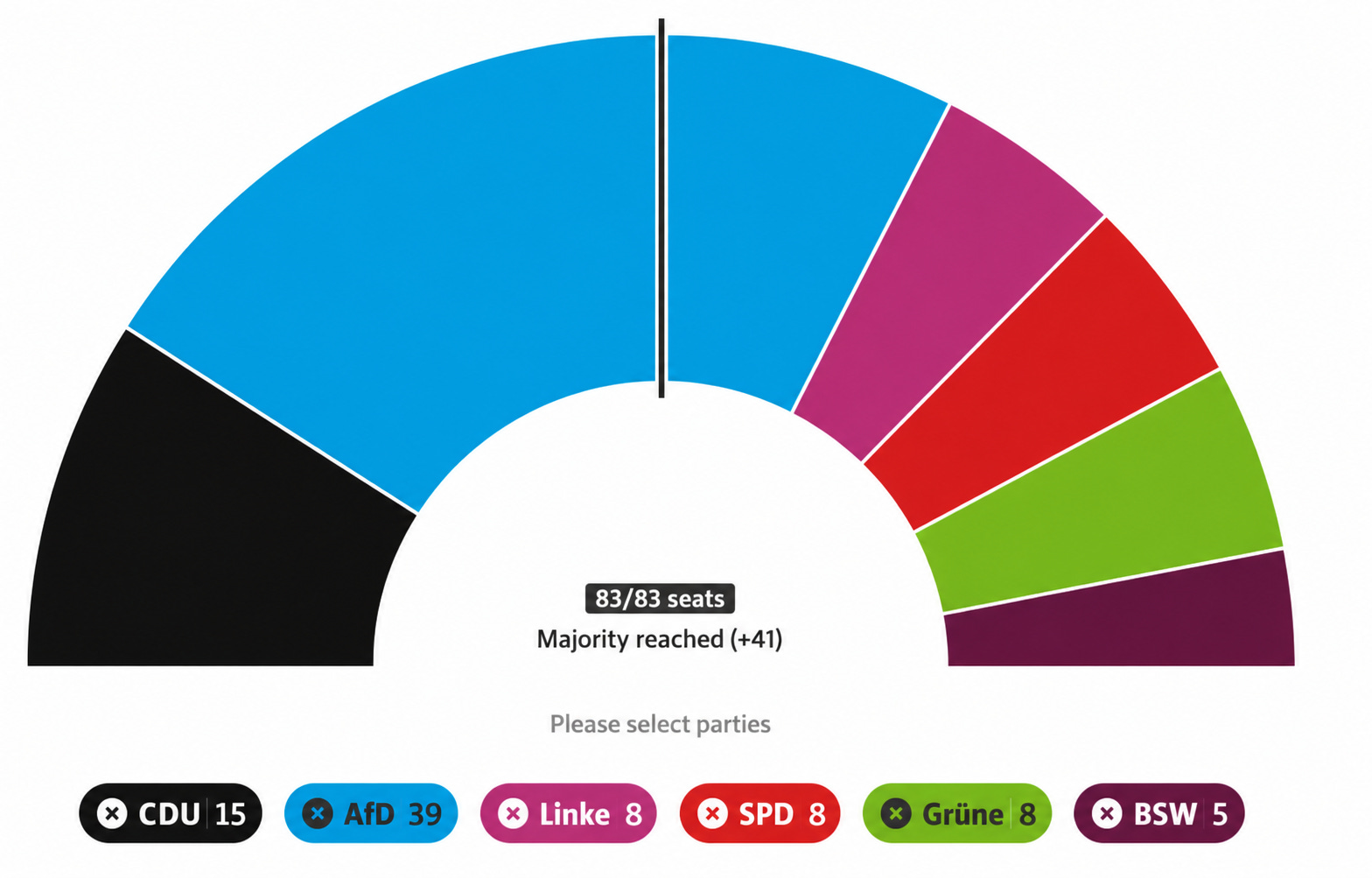
Nearly a century later, Saxony-Anhalt has become a mirror of Germany’s new political fault lines. In the regional elections of 6 September 2026, the governing bloc led by Sven Schulze (CDU) was hit by a twin populist surge. The AfD, led by Ulrich Siegmund, won with 43.8% of the vote — an unprecedented result for a party classified as far-right in a regional election under the Federal Republic — while the BSW, with 5.3% of the vote, narrowly cleared the 5% threshold needed to enter the Landtag.
Symbolic of this rout, Sven Schulze himself lost his direct mandate in his Magdeburg III constituency, beaten by AfD candidate Christian Mertens (35.2% against 31.7%). According to provisional results announced overnight by the Landeswahlleitung in Halle, the CDU collapsed to 17.2% of the vote (down from 37.1% in 2021), ahead of the SPD (9.3%), the Greens (8.9%) and Die Linke (8.6%); the FDP, on 2.6%, dropped out of the Landtag. Turnout, at close to 80%, reached a historic high for the Land.
In the Magdeburg Landtag, the interaction between these two forces has not taken the form of shared barricades, but of a systematic voting alignment. The BSW and the AfD regularly join forces on key issues:
• Foreign policy: Joint votes for resolutions demanding an end to military aid to Ukraine and the restoration of energy links with Russia.
• Society: Identical votes demanding accountability for the government’s handling of the Covid-19 crisis, or blocking funding for public broadcasters (MDR/ARD).
• Immigration: Strong rhetorical convergence in favour of drastically capping the right to asylum and of using payment cards rather than cash for refugees, so as to prevent them sending money to their country of origin.
Numerical parallels and divergences
• Ultimate goal and relationship to the system:
◦ 1932 (KPD-NSDAP): A revolutionary and subversive drive aimed at the violent overthrow of the Weimar Republic’s institutions and the establishment of a dictatorial regime.
◦ 2026 (AfD-BSW): An institutional, systemic strategy focused on capturing electoral discontent. The Alternative for Germany (AfD) won the Saxony-Anhalt election with 43.8% of the vote — an unprecedented result for a party classified as far-right in a German regional election — without, however, reaching an absolute majority of seats (42 of the 83 required).[1]
• Methods of action:
◦ 1932 (KPD-NSDAP): Recourse to illegal, violent and paramilitary action, marked by sabotage and direct armed clashes with the police.
◦ 2026 (AfD-BSW): Strictly legal, parliamentary and peaceful action, relying on the mechanisms of the ballot. The Bündnis Sahra Wagenknecht (BSW) narrowly cleared the fateful 5% threshold needed to win seats, with 5.3% of the vote — confirming that the party’s entry into the Landtag hung by a thread.[2],[3]
• Ideological matrix:
◦ 1932 (KPD-NSDAP): An absolute doctrinal antagonism pitting the KPD’s Marxist-Leninist orthodoxy against the NSDAP’s racist, antisemitic National Socialism.
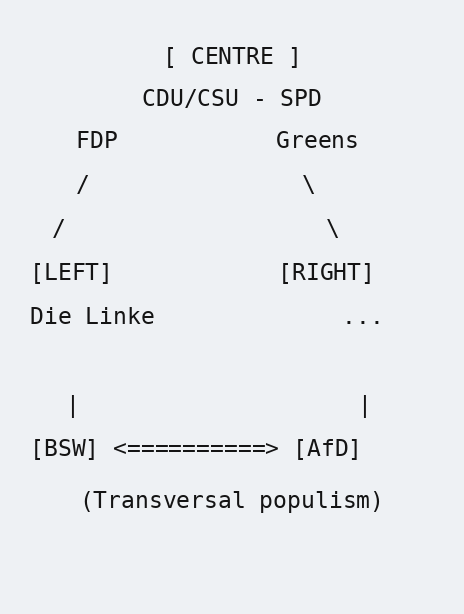
◦ 2026 (AfD-BSW): A convergence characteristic of cross-spectrum populism (horseshoe theory). This synergy captured the protest vote against the outgoing governing coalition: the CDU collapsed to 17.2% (down from 37.1% in 2021 — more than half its electorate lost), the SPD and the Greens held on to single digits by a whisker (9.3% and 8.9% respectively), and the FDP, on 2.6%, dropped out of the Landtag.[4],[5],[6]
• Nature of the political interaction:
◦ 1932 (KPD-NSDAP): Direct, hands-on collaboration on the ground, embodying the historical model of an avowed Querfront.
◦ 2026 (AfD-BSW): An objective alliance whose firewall (Brandmauer) was formally reaffirmed as soon as results were announced, by CDU secretary-general Franziska Hoppermann, for whom any cooperation with the AfD remains “ruled out”. The question of whether the BSW might tactically abstain in a possible third round of the vote for state premier — which would mechanically allow the AfD to run the Land without a formal coalition — is no longer hypothetical: the AfD now claims a mandate to govern despite lacking an absolute majority, and its leader Ulrich Siegmund has raised the prospect of fresh elections should government formation fail — elections he says would only benefit his party further.
Lessons from horseshoe theory (Hufeisentheorie)
The present case illustrates both the relevance and the limits of horseshoe theory in political science. The thesis holds that political extremes eventually converge at their outer edges.
In 1932, the KPD and the NSDAP converged in their visceral rejection of democratic pluralism and capitalism. In 2026, the AfD and the BSW bear out that same curve, sharing an anti-elite protest electorate, a strong illiberal resentment, and an economic and diplomatic nostalgia for the socialist Eastern Bloc.
Yet the comparison stops where respect for the Basic Law begins. Where the 1932 collusion deliberately sought chaos to bury democracy, Sahra Wagenknecht’s BSW is above all seeking to join governing coalitions in order to impose its terms there — especially given a destabilised CDU and an electorate deeply doubtful of Friedrich Merz‘s national leadership.
A forward-looking conclusion
Saxony-Anhalt in 2026 is not Berlin in 1932: the BSW and the AfD have no ambition to overthrow the Basic Law by force, but rather to use the rules of the democratic game to impose a sovereigntist, conservative agenda. Even so, the 1932 precedent reminds Western democracies that extremes need not like each other to paralyse institutions: it is enough for them to identify a common enemy at the centre of the political chessboard, as the AfD-BSW bloc’s ability, in Magdeburg, to saturate public debate and jam traditional institutional mechanisms confirms.
The day after the vote, three dynamics — already under way rather than merely prospective — are taking shape for the Federal Republic’s political stability:
1. Paralysis by blocking minority: Should the AfD-BSW bloc secure a critical minority in the Landtag, it could paralyse constitutional and budgetary appointments, forcing the CDU and the SPD into major programmatic concessions, particularly on migration and energy policy.
2. The definitive erosion of the firewall (Brandmauer): Under pressure from a growing protest electorate, the BSW’s need to take a position in votes for the regional premier could break the taboo of tactical abstention, de facto legitimising the AfD’s access to executive office.
3. The federal shockwave: A collapse of the traditional governing parties in the East, combined with growing polarisation over security issues and relations with Russia, risks accelerating a leadership crisis in Berlin, weakening Germany’s standing within European and multilateral institutions.
This third scenario was borne out immediately: the CDU’s defeat was laid directly at the door of Chancellor Friedrich Merz, while abroad, businessman Elon Musk and Lega leader Matteo Salvini congratulated the AfD on its victory — Musk going so far as to offer cooperation, to which Ulrich Siegmund responded favourably. In Mecklenburg-Western Pomerania, where regional elections are due two weeks later, Social Democratic state premier Manuela Schwesig warned that, for the first time in the Federal Republic’s history, a party classified as far-right had just clearly won a regional election.
The welfare state at the heart of the doctrinal rift
Although the AfD and the BSW converge on social conservatism, immigration and foreign policy (Russia/Ukraine), their economic outlooks reveal a fundamental doctrinal opposition over the role of the state and redistribution.
1. The BSW: socialist-inspired, protectionist state dirigisme
The Bündnis Sahra Wagenknecht’s economic programme sits within the continuity of the illiberal left, readapted to industrial sovereigntism:
• Interventionism and redistribution: The BSW advocates a massive strengthening of the welfare state, funded by higher taxes on large fortunes, high incomes and multinationals’ excess profits.
• Market regulation: The party demands caps on energy and rent prices, along with a significant rise in the statutory minimum wage to 15 euros an hour.
• Industrial sovereigntism: The BSW campaigns to protect German industry from globalisation through protectionist measures, while calling for an end to the planned ecological transition (“Green Deal”), which it deems destructive to working-class jobs.
2. The AfD: a wide gulf between its neoliberal origins and social populism in the East
The AfD’s economic line is historically more complex, torn between its neoliberal origins in Western Europe and its working-class electoral base in the East:
• Deregulation and tax cuts: The AfD’s official programme remains deeply anchored in a logic of reducing the state’s role. The party calls for the abolition of the wealth tax and inheritance tax, and drastic cuts to corporate taxes.
• Eastern “social populism”: In Saxony-Anhalt, driven by its national-populist wing, the AfD softens its rhetoric on pensions and welfare benefits to win over working-class voters. However, it strictly limits the welfare state to German citizens alone (“social chauvinism”, or national preference).
• Labour flexibility: Unlike the BSW, the AfD traditionally opposes overly strict labour-market regulation, stronger trade unions, and sharp state-imposed rises in the minimum wage.
Summary of the economic fault lines
• Funding public services: The BSW wants to tax the wealthy; the AfD wants to cut state spending (notably international aid, refugee-integration budgets and climate subsidies).
• Market philosophy: The BSW distrusts capitalism and seeks to rein it in; the AfD defends business owners and small and medium-sized firms (Mittelstand) against state bureaucracy.
[1]ZDF, provisional result of the 6 September 2026 Landtagswahl in Saxony-Anhalt: zdfheute.de
[2]t-online, results and seat distribution of the 2026 Landtagswahl in Saxony-Anhalt: t-online.de
[3]ZDF, live blog of the Landtagswahl results in Saxony-Anhalt, 6-7 September 2026: zdfheute.de
[4]ZDF, provisional result of the Landtagswahl in Saxony-Anhalt (CDU, SPD, Greens, Die Linke): zdfheute.de
[5]t-online, results and seat distribution of the 2026 Landtagswahl in Saxony-Anhalt: t-online.de
[6]Wikipedia (DE), Landtagswahl in Sachsen-Anhalt 2026: de.wikipedia.org
All our publications are free and Copyleft. They may be republished, in whole or in part, under following conditions:
→ keeping the title and content
(text, images, editor’s or translator’s notes, boxes)
→ crediting the author(s) and/or translator(s)
→ inserting a clickable link to the source.
Any monetization or commercial use of these publications is prohibited and will be subject to legal action.
https://claudiocarotti.substack.com/p/the-saxony-election-and-the-defenceless?utm_source=share&utm_medium=android&r=7ijbyi