Ankara, the Announcement That Changes (a Little) the Game
From the V2 to the Patriot: An 80-Year Ballistic Odyssey


It’s a phrase that made the rounds of newsrooms. At the NATO summit in Ankara, facing Volodymyr Zelensky, Donald Trump said, half-seriously, half-jokingly: the USA will give Ukraine a license to manufacture its own Patriot missiles. “Pretty cool, right?” he added. This statement was presented as a gesture towards Kyiv’s strategic autonomy, in a context where global stocks of these interceptors are depleted – notably due to the massive consumption caused by the war against Iran (1,200 missiles fired, costing $4.5 billion = €4 billion).
But the euphoria of supporters of “Servant of the People” (Zelensky) quickly fades when faced with industrial reality. Experts consulted are unanimous: producing a “made in Ukraine” Patriot is not a matter of simply signing an agreement. First, it would be necessary to build, in the middle of a war, a factory sufficiently hidden to escape Russian strikes – a year, in the best-case scenario. Then, it would be necessary to master the manufacturing cycle of the PAC-3, the most advanced interceptor in the family, which takes 23 to 25 months and mobilizes a network of over 400 suppliers spread across the USA, Germany, and Japan. Specialists’ verdict: no Ukrainian missile before 2029. In the meantime, Ukraine continues to depend on indirect transfers – allied stocks, missiles retired from Israeli service – to hold a sky where, in a single night, twenty-nine Russian ballistic missiles could strike Kyiv without any being intercepted.
To understand what this promise really represents – and why it is so difficult to fulfill – we must go back to the origin of this entire technological genealogy: the summer of 1944, on the Baltic coast.
Peenemünde, the Matrix of All Missiles
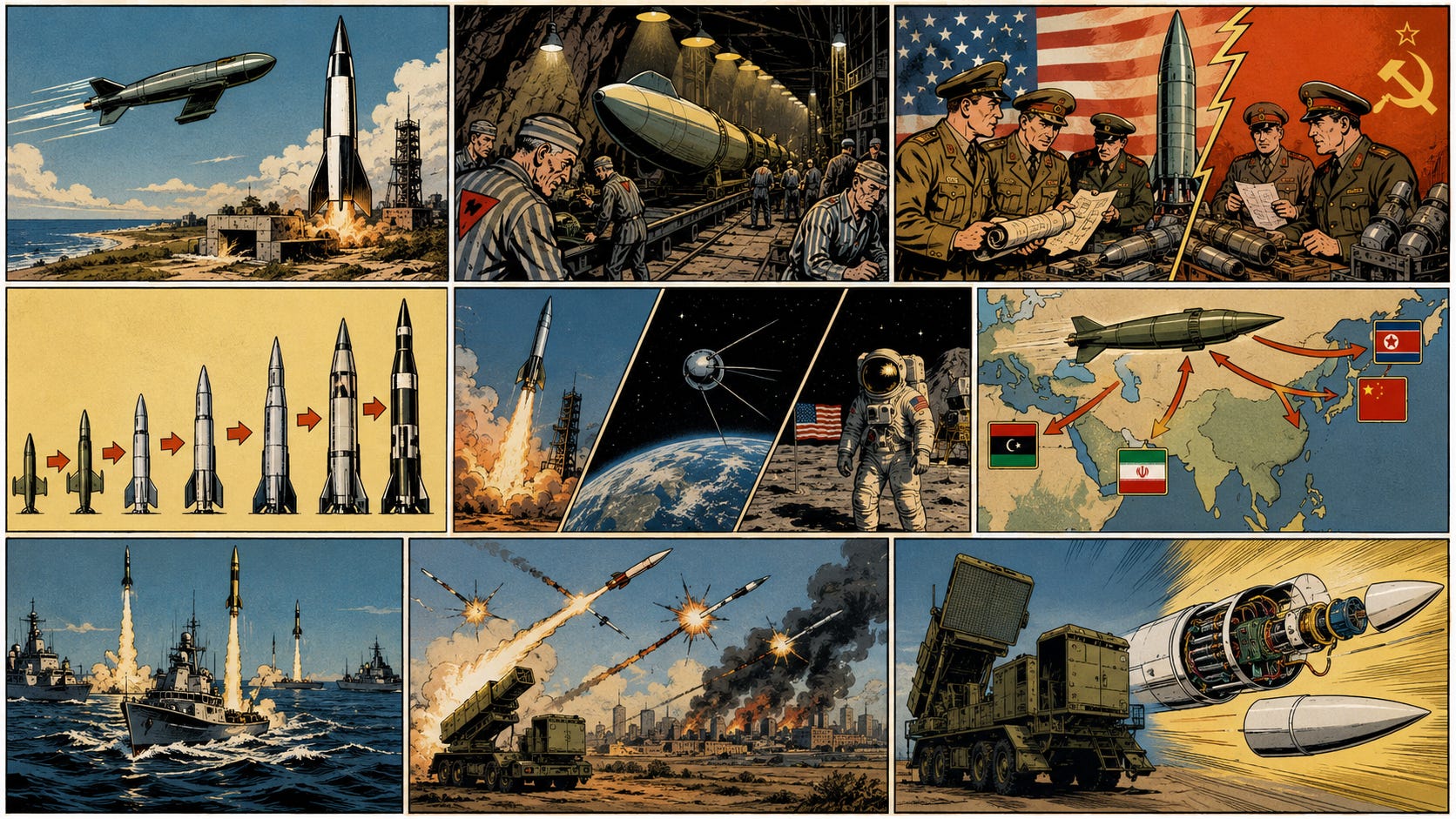
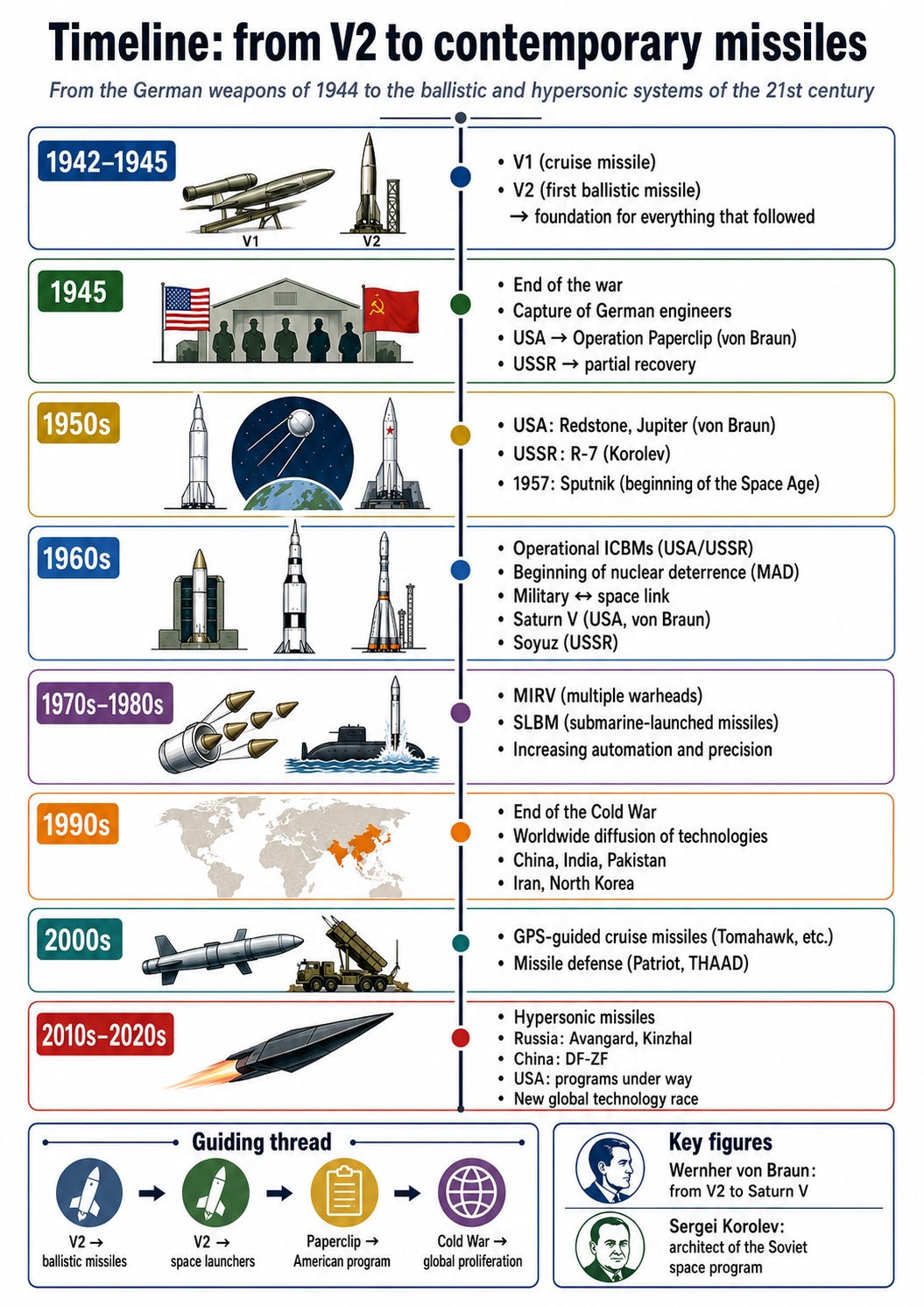
It all begins with two “miracle weapons” that the Nazi regime presented to a war-weary population as the promise of a turning point: the V1 and the V2. The V1 is a cruise missile – a pilotless flying bomb, propelled by a pulsejet engine, first launched at London on June 13, 1944. Imprecise, shot down in more than half of cases by Allied anti-aircraft defense, it nevertheless inaugurated a concept with a long future. The V2, on the other hand, is a much more radical breakthrough: designed under the technical direction of Wernher von Braun, it is the first ballistic missile in history, capable of leaving the atmosphere before falling silently, at over 5,000 km/h, on its target. No defense of the time could intercept it.
This feat had a horrific cost: the V2s were assembled in the underground tunnels of Dora-Mittelbau by deportees from the Buchenwald camp, in such inhumane conditions that about one-third of them did not survive – a toll exceeding even the civilian victims of the bombings on London and Antwerp. Von Braun knew of these conditions and continued nonetheless, driven by a personal obsession: the stars, Mars, more than the Reich itself.
1945: The Methodical Pillage and the Shift Westward
The collapse of the Reich triggered a race. The US Americans captured hundreds of V2s, tons of spare parts, and above all, the engineers: von Braun and his team deliberately surrendered to the West rather than to the Soviets. This was Operation Paperclip, which brought about 1,600 German specialists across the Atlantic between 1945 and 1957, their files cleaned of past compromises. In the East, the Soviets recovered what remained after the Yankee raid – equipment, sites, technicians – and placed the reconstruction of the V2 under the direction of Sergei Korolev, a former Gulag prisoner.
Each camp first rebuilt the enemy machine identically before surpassing it: the American Redstone and the Soviet R-1 were merely Americanized or Russianized V2s. Then, with the Cold War, the logic changed scale: it was no longer about striking a few hundred kilometers away but thousands, with a nuclear warhead. Thus were born the first intercontinental ballistic missiles – the Soviet R-7, which also put Sputnik into orbit, and then the Atlas and Titan families on the American side. The rocket became a state system, and the same technology split into two uses: the deterrent weapon and the space launcher. Von Braun himself embodied this dichotomy, from the Saturn V that propelled Apollo 11 to the Moon to the military programs he continued to support behind the scenes.
Two Lineages, One Ancestor
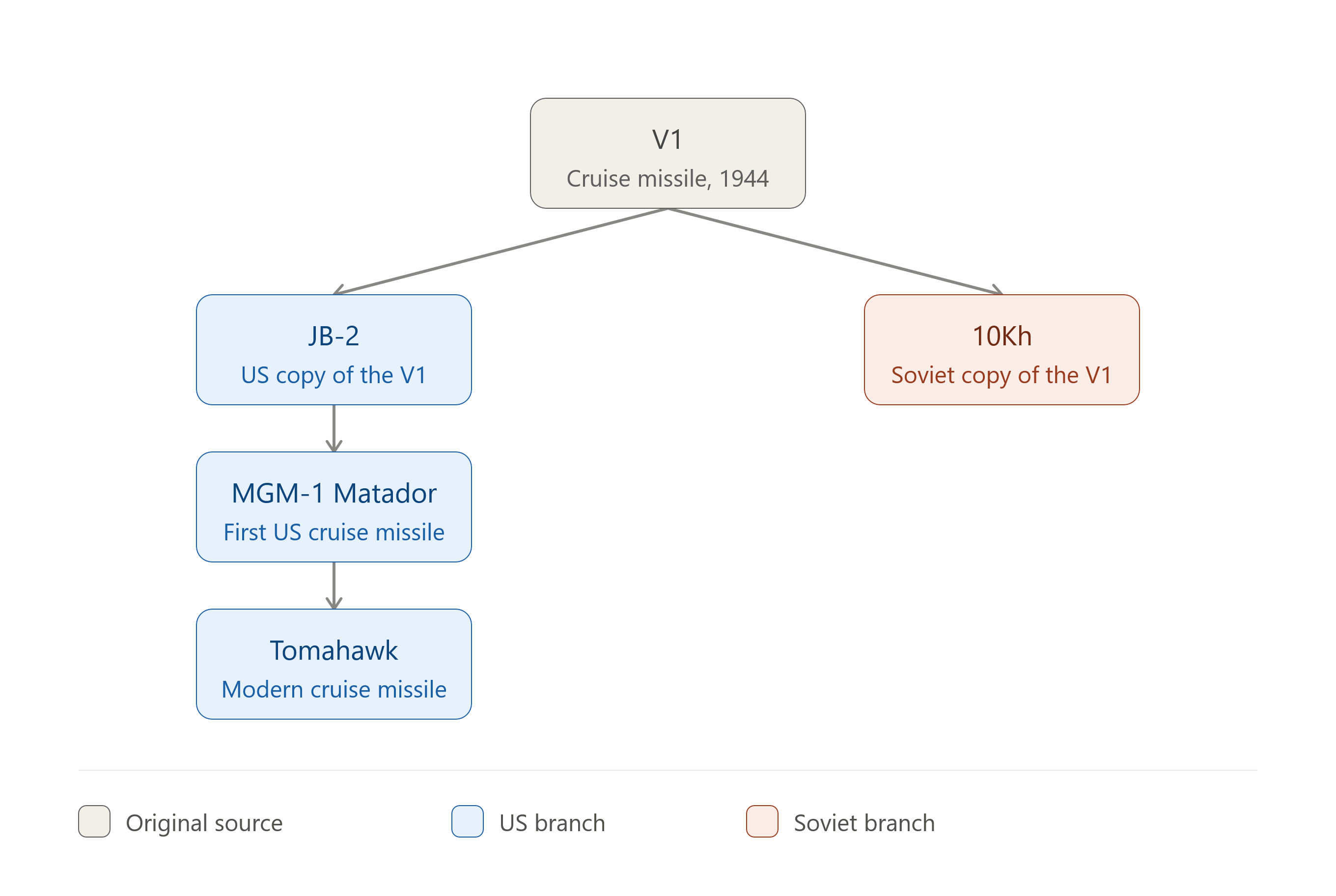
From this matrix, two major missile families are still born today. The first descends from the V1: these are cruise missiles, whose heritage is found in the American Matador – developed from the copy of the V1, the JB-2 – and then in iconic systems like the Tomahawk, or on the Soviet side in the 10Kh missile.
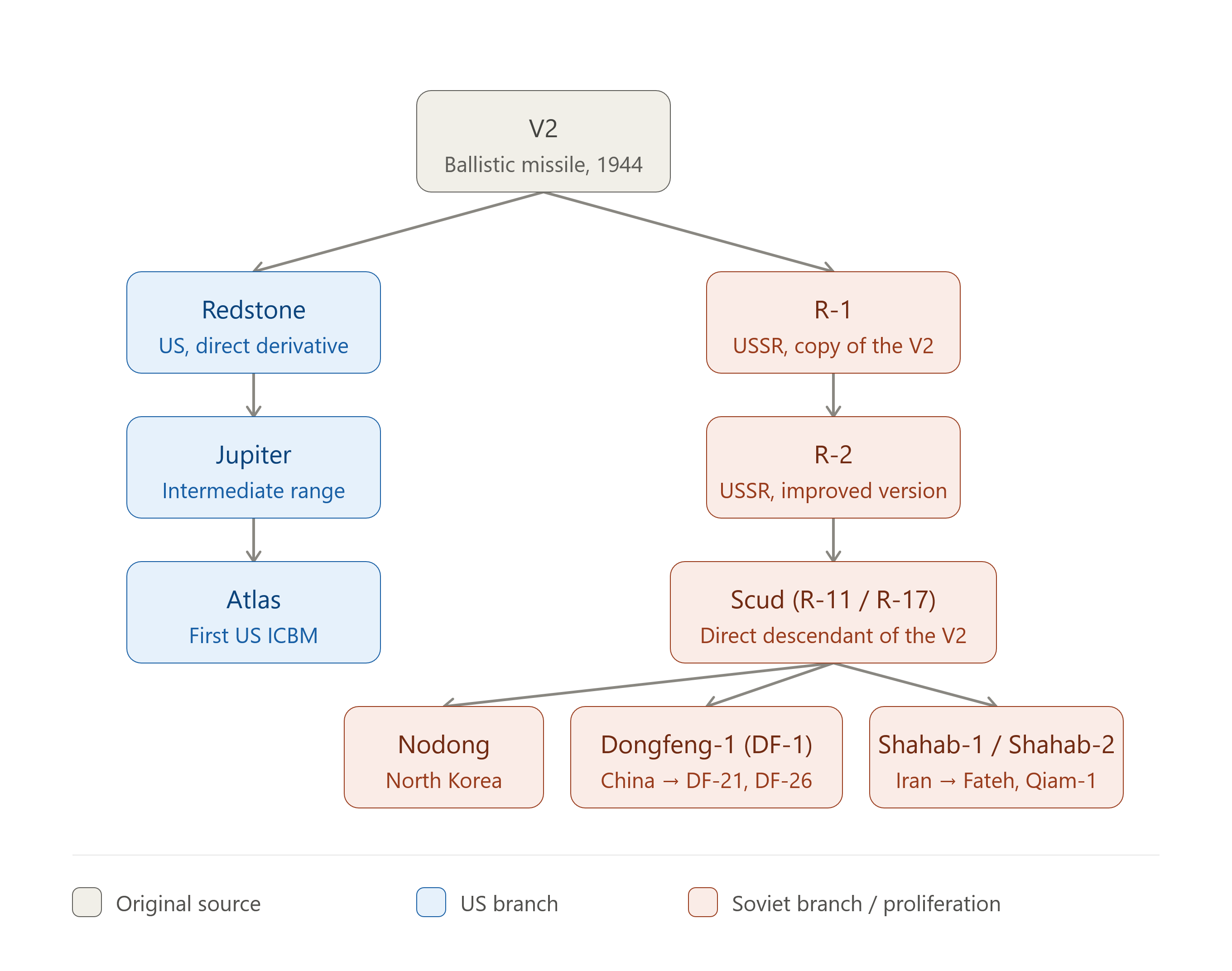
The second descends from the V2: these are ballistic missiles. On the Soviet side, the R-1 then R-2 lineage leads to the Scud family, described as a direct descendant of the V2, which in turn proliferated towards North Korea (Nodong), China – where the first Chinese ballistic missile, the Dongfeng-1, is a licensed copy of a Soviet derivative of the V2 – and then towards Iran, which received its first Scud-Bs from Libya in 1985 before developing its own versions. On the American side, von Braun’s Redstone gave rise to the Jupiter, and then to the lineage of Atlas ICBMs. One root, ever more divergent uses.
And the Patriot in All This?
This is where the story takes an unexpected turn: the Patriot does not belong to either of these two lineages. It is not a technical heir to the V1 or the V2 – it shares neither their propulsion, nor their guidance system, nor their architecture. It is a surface-to-air missile, a strictly defensive system, designed to intercept aircraft and, increasingly, ballistic and cruise missiles.
Its link to the V2 lies elsewhere: in the lesson rather than the technique. In 1944, the V2 struck London and Antwerp with no defense possible – a shock that convinced the Allies, and then the US Americans during the Cold War, that an anti-missile defense had to be invented. This quest, launched by the fear of the V2, culminated decades later in the Patriot, developed from the 1960s onwards to precisely counter the heirs of the V2: the Scuds and their derivatives. Its successive versions – PAC-1 and PAC-2 with fragmentation explosive charges, then PAC-3 with “hit-to-kill” technology, which destroys its target by pure kinetic impact – now make it one of the few systems capable of intercepting tactical ballistic missiles and even certain hypersonic vehicles like the Russian Kinzhal.
The Loop Closes
So this is what Trump promised Kyiv in Ankara: not a fragment of the Nazi heritage shipped in containers from Peenemünde, but access to a technology born, eighty years later, as an antidote to the threat that von Braun and his V2 had inaugurated. An irony of history that does not diminish the scale of the industrial challenge: the manufacturing of a Patriot today mobilizes a network as complex as it is discreet – Lockheed Martin and Raytheon in the USA, Mitsubishi Heavy Industries in Japan, MBDA and Diehl Defense in Germany, Sener in Spain. Wanting to implant this network in Ukraine, in the middle of a war, is to ask the country to join, in a few years, an ecosystem that the USA and its allies took decades to build – on the rubble, precisely, of the program that Wernher von Braun had once dreamed of taking to Mars.
All our publications are free and Copyleft. They may be republished, in whole or in part, under following conditions:
→ keeping the title and content
(text, images, editor’s or translator’s notes, boxes)
→ crediting the author(s) and/or translator(s)
→ inserting a clickable link to the source.
Any monetization or commercial use of these publications is prohibited and will be subject to legal action.