AI Robots: before replacing us, they learn from our gestures
Cameras, sensors, chores: the new global extraction of human labor


Français – English – Deutsch – Italiano – Español
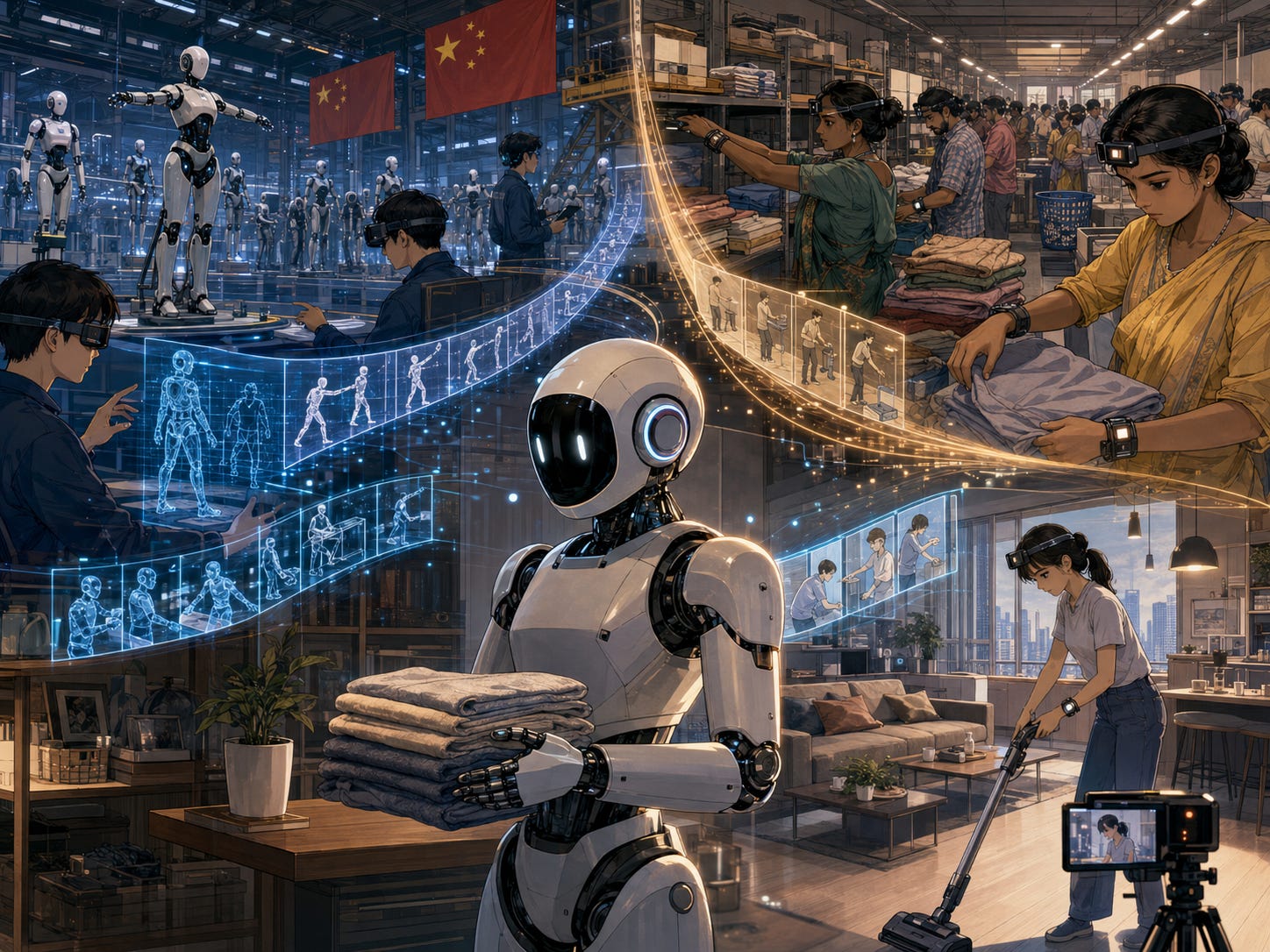
After texts, images, and sounds, artificial intelligence is now tackling the material world. The next frontier is no longer just making models speak, but teaching them to act: open a microwave, fold laundry, put away cutlery, mop the floor, serve coffee, assemble a chair. This “physical AI” fuels the hope of humanoid robots capable of intervening in factories, shops, offices, and eventually homes. But before replacing human labor, these machines must first absorb it in the form of data.
Unlike language models, which could be trained on vast amounts of text and images available online, robots need data that is much harder to produce. They must learn the relationship between vision, movement, the weight of objects, hand gestures, body trajectories, and the constraints of a real apartment or workshop. Seeing the world is not enough: they must know how to act in it.
China: capturing the gesture, from home to factory
China has taken an ambitious path, industrializing the collection. This approach responds to an accelerated demographic crisis: the Chinese working population is shrinking very quickly, aging is accelerating, and solutions must be found now to maintain a certain level of service in factories, logistics, and care in the coming decades. In this context, robotization comes as a gradual adjustment to lasting constraints, and it takes shape in concrete devices.
Streets as classrooms
Since late 2025, several cities, first Shanghai then Shenzhen, have opened urban training areas for humanoid robots. These are neither amusement parks nor closed laboratories, but streets, residential blocks, partially open neighborhoods where machines learn to move among pedestrians, overcome obstacles, and interact with humans.
These devices are framed by a precise architecture, often summarized by the formula “1+1+N”: one provincial training center, one urban demonstration zone, and a constellation of sectoral platforms. The goal is to repeat the collection of physical data on a large scale in real conditions.
Reality on an industrial scale
In these facilities, workers repeat the same gestures hundreds of times with virtual reality headsets, exoskeletons, or sensors, while humanoids learn to reproduce their movements. Some centers simulate houses, assembly lines, shops, or care facilities. Collection does not stop at laboratory doors: residents are paid to film themselves cooking, cleaning, or doing laundry; workers wear cameras and wrist sensors; robots sent to private homes slowly perform some chores while capturing valuable data.
This investment in humanoids is not technological fetishism. The bipedal silhouette allows machines to move in staircases, kitchens, factories designed for human bodies. Adapting the robot to the existing world costs less than transforming entire infrastructures. The humanoid thus integrates without overturning habits and lifestyles.
The silent lead
China’s lead can already be seen in the nascent humanoid market. Chinese companies dominate global sales, driven by players like Unitree and AgiBot, while Tesla, Figure AI, or Agility Robotics remain far behind in volume. The sector remains immature: robots are slow, costly, clumsy, often confined to research, demonstration, or limited industrial uses. But the advantage is strategic: the more robots and physical data centers a country deploys, the more experience it accumulates, the more it improves its models, and the more it reduces its costs.
China is not betting everything on the real. Chinese researchers claim to have developed Kairos-HomeWorld, a system capable of generating synthetic domestic environments from simple text instructions: virtual apartments, with floor plans, furniture, manipulable objects, and physical properties. The goal is to train robots without having to collect every scene in the real world. This approach could reduce costs, accelerate learning, and limit certain intrusions into privacy. But it does not eliminate the need for real data: simulations themselves must be based on existing homes, objects, and behaviors.
USA: capturing intimacy
The integration of humanoids into society takes a different path in the USA, confined to domestic intimacy. The New York-based startup Shift offers a free cleaning service in exchange for the right to film the inside of homes. Its employees clean apartments with a head camera, recording both their gestures and the configuration of private spaces. The user does not pay with money, but with data: their home becomes raw material for training future domestic robots. When the service is free, it is often the user — or here, their intimacy — that becomes the product.
India: the back office of physical AI
To our knowledge, no humanoid deployment project exists for the Indian market itself. Opportunistic, India has specialized in low-cost subcontracting. Companies like Cogito Tech turn offices, rented apartments, restaurants, or grocery stores into capture studios. Workers equipped with head cameras, GoPros, or iPhones repeat everyday gestures: folding clothes, organizing medicines, arranging tools, setting a table, cleaning a kitchen. The videos are then annotated, described, and sold to US West Coast companies, which are very hungry for data for their vision-language-action models.
The country offers an abundant, cheap workforce already integrated into the global data annotation economy. The tasks filmed are billed at a few dollars per hour to foreign clients, while local employees remain low-paid (about $300 per month). In short, the country supplies the raw material; others reap the benefits.
Today’s gestures, tomorrow’s robots
Behind the imaginary of the domestic robot, a new organization of work is taking shape. In China, the State is preparing a national humanoid industry to respond to a declining population. In India, subcontractors capture everyday gestures at low cost for US companies, as a temporary survival activity. In the USA, startups try to convert domestic intimacy into an exploitable resource. In all three cases, the autonomous robot of tomorrow rests on a mass of invisible human gestures today.
This technology promises to help the elderly, automate tedious tasks, and compensate for labor shortages. But it raises major social and political questions. Who owns the data captured in homes? Do the filmed workers really understand the future use of their gestures? How can employees who train machines that may replace them be protected? What becomes of privacy when every kitchen, every room, every workshop can become a training ground for AI?
As we have seen, the technological competition between China, India, and the USA in the AI robot race constitutes a new stage in global data extraction. After having absorbed the Internet, AI is entering homes, shops, and bodies at work. This movement is being built in Indian studios, New York apartments, and Chinese training centers. One filmed gesture after another, without anyone yet measuring all the consequences.
Sources
« Chinese researchers claim breakthrough in training household robots with AI-generated homes »
South China Morning Post, 5 juin 2026
https://www.scmp.com/tech/tech-trends/article/3356155/chinese-researchers-claim-breakthrough-training-household-robots-ai-generated-homes« Passer la serpillière, ranger les couverts, monter une chaise… En Inde, ces travailleurs de l’ombre qui entraînent les futurs robots IA »
Les Échos, 9 juin 2026, https://archive.vn/fnCwr« “Shift” : la start-up qui offre le ménage contre la captation de notre intimité »
France Culture / Radio France, 10 juin 2026
https://www.radiofrance.fr/franceculture/podcasts/un-monde-connecte/shift-la-start-up-qui-offre-le-menage-contre-la-captation-de-notre-intimite-1741878« China is winning the humanoid robot race while Tesla’s Optimus lags »
Rest of World, 5 février 2026
https://restofworld.org/2026/china-humanoid-robots-unitree-agibot-tesla-optimus« Chinese workers teach humanoid robots everyday tasks »
Rest of World, 7 janvier 2026
https://restofworld.org/2026/china-robots-training-centers-workers« How China is using human labor to win the humanoid robot data race »
Source : Rest of World, 3 juin 2026
https://restofworld.org/2026/china-ai-robotics-training-data
All our publications are free and Copyleft. They may be republished, in whole or in part, under following conditions:
→ keeping the title and content
(text, images, editor’s or translator’s notes, boxes)
→ crediting the author(s) and/or translator(s)
→ inserting a clickable link to the source.
Any monetization or commercial use of these publications is prohibited and will be subject to legal action.